
Some dogs hide treats because stashing valued food is part of their behavior, even when meals arrive reliably. Hiding a biscuit does not automatically mean the dog dislikes it or feels anxious. Look at appetite, body language, competition from other pets and whether the treat is comfortable to chew. A new reluctance to eat deserves attention.
You offer a treat. Your dog carries it proudly into another room. Later, while straightening a blanket, you discover that the dog bed has apparently opened a snack-storage department. The mystery is less about the hiding place than what happens before and after the treat disappears.
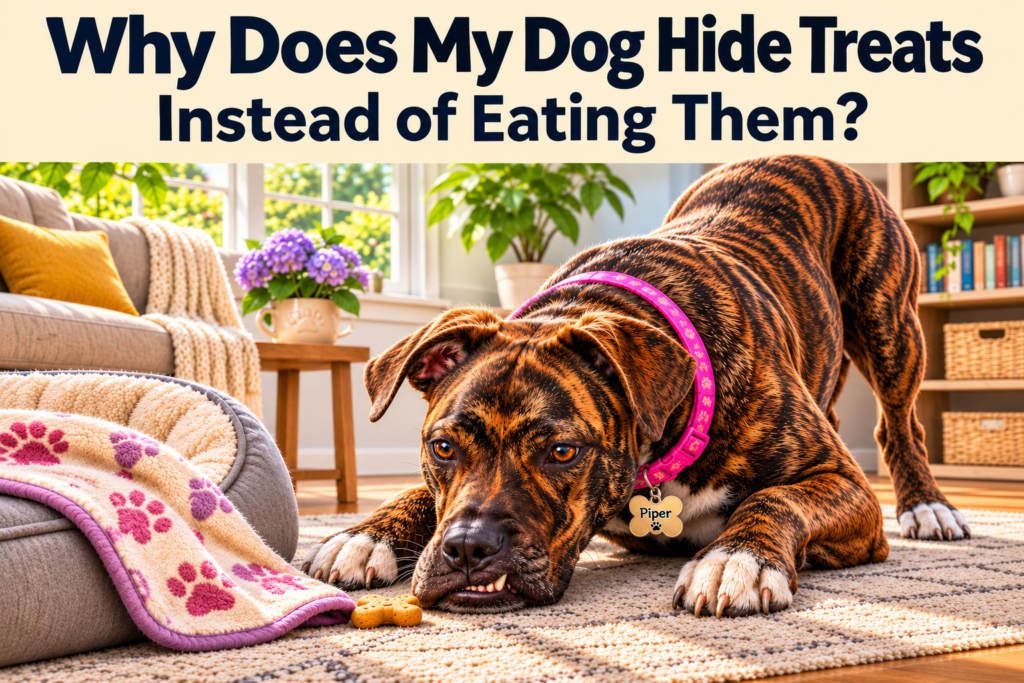
Stashing can be ordinary dog behavior
The American Kennel Club’s explanation of hiding behavior describes several possible influences, including storing valued items and pressure from other pets. The same outward action can occur in different situations.
A dog who quietly places a biscuit beside a blanket and then returns to a normal routine presents a different picture from a dog who frantically searches for a hiding place whenever another dog approaches. Neither picture lets us read the dog’s thoughts. The context gives us more useful clues than the biscuit alone.
Start by asking what changed. Is this a familiar habit with one type of treat, or a new behavior with food the dog previously ate? Is the dog eating normal meals? Can the dog move away from other pets while enjoying a snack?
Four things to observe before changing anything
Appetite: Does your dog still eat ordinary meals willingly? Hiding one long-lasting treat differs from avoiding food generally. A dog can have more than one issue at the same time, so do not use stashing as a complete explanation for a new appetite change.
Body language: Notice the whole dog. Loose movement and an easy departure differ from freezing, stiffening, hovering over food or growling as someone approaches. Avoid leaning over the dog to test the reaction.
The setting: Think about other pets, busy walkways and children. A place that feels quiet to you may still be a location where another animal regularly takes food or people step over the dog.
The treat: Size, texture and chewability matter. A snack your dog can easily eat is a different task from a large hard item. If a dog starts avoiding hard treats, chewing slowly or dropping food, arrange a veterinary assessment rather than assuming the dog is saving it for later. VCA describes these among possible signs of dental pain.
Use Trigger → Interpretation → Response → Reinforcement
This framework helps you make a small, sensible change without guessing at a single universal explanation. Keep the interpretation tentative until you have observed a pattern.
| Trigger you notice | Possible interpretation | A useful response | What to reinforce |
|---|---|---|---|
| A treat arrives soon after a full meal | The dog may not want to eat it now | Offer less at a different time | Calmly choosing to eat or walking away |
| Another dog approaches the snack area | Social pressure may affect the behavior | Give each dog a separate protected space | Relaxed enjoyment without competition |
| The treat is much harder than usual | Texture or chewing comfort may matter | Stop that item; check for new signs of discomfort | A comfortable routine after any needed veterinary care |
| You follow the dog to retrieve the treat | The interaction may be adding pressure | Stop following; manage access and recover abandoned food later | Returning calmly to a familiar place |
These are examples to guide observation, not diagnoses. You do not need to recreate a stressful situation to find out which row fits.
Try one small change at the next treat time
Choose a quiet location where the dog can enjoy a suitable snack without interruption. Separate pets if food competition is possible. Offer an amount and texture already known to suit your dog, and allow the dog to decide whether to eat it.
Then observe without hovering. Did the dog eat? Did the dog carry it away? Was the dog’s body loose? What happened when ordinary household activity continued at a distance? A short written note can be more useful than relying on a general impression.
For example: ‘After dinner, one biscuit, quiet room, carried to bed, left it and returned to family.’ That gives you a specific pattern to compare with another ordinary occasion. ‘My dog is being weird’ does not.
Change one manageable part of the routine at a time. If the dog begins eating comfortably in a separate room, you have learned something useful about the setting. It does not prove a lifelong personality trait or explain every future episode.
What if I find food in the couch or bed?
Recover abandoned food when the dog is elsewhere. Check washable bedding and accessible hiding places as part of normal cleaning, especially when a snack can spoil or when children or another pet could find it. Follow the food manufacturer’s handling and storage instructions.
Do not pull a blanket out from under a dog who is standing over the treat. If the dog is guarding the area, create distance and use barriers to keep others away. Ask a qualified professional for a plan rather than repeatedly testing whether the dog will let you take it.
PetMD’s discussion of burying behavior includes resource guarding as a possible complication. For the related handling problem, read Why Does My Dog Growl When I Try to Take a Toy?. A growl is information to respect, not a challenge to win.
Should I teach my dog to stop hiding treats?
A relaxed habit does not always need to become a training project. Management may be enough: choose an appropriate snack, provide a suitable eating area and remove abandoned food safely afterward. The aim is a workable household routine.
If you want the dog to bring an item to a particular place, teach that skill with low-pressure practice and rewards. Start with an object the dog handles comfortably. Do not make a highly valued food item the first test of a new cue.
Reward the behavior you want to see, such as calmly returning to a mat. Avoid chasing, cornering, scolding or repeatedly taking food to prove ownership. Our guide to how dogs learn explains how the consequences of an interaction can influence what the dog repeats.
When should I call the vet or a behavior professional?
Arrange veterinary advice when stashing appears alongside a new appetite change, difficulty chewing, drooling, dropping food or other signs that the dog feels unwell. Familiar hiding behavior does not rule out a health problem.
If the dog freezes, growls, snaps or guards a food location, prevent access by children and other animals and seek qualified help. Choose a professional who uses humane, reward-based methods and works with your veterinarian when medical factors may contribute. Do not deliberately provoke the dog for a video.
The useful distinction is between relaxed storage you can manage and a change that affects eating, comfort or safety. That is more informative than trying to decide whether every hidden treat means anxiety.
What about toys carried outside?
Carrying a toy into the yard can involve play, access to a favorite location or stashing an object. It is a separate question from hiding edible treats instead of eating them. Our article on dogs taking toys outside explores those situations.
For today’s biscuit mystery, begin with the next ordinary treat time. Observe the trigger, keep your interpretation tentative, make one useful change and reinforce a relaxed routine. You may discover that the snack-storage department only needed a quieter location—or that a new eating problem deserves a proper check.
Sources
- American Kennel Club: Why Is My Dog Hiding Things?.
- PetMD: Why Do Dogs Bury Bones?.
- VCA Animal Hospitals: Dental Pain in Dogs.
Sources checked November 2, 2026. The household examples are illustrative, not documented events involving Piper.