
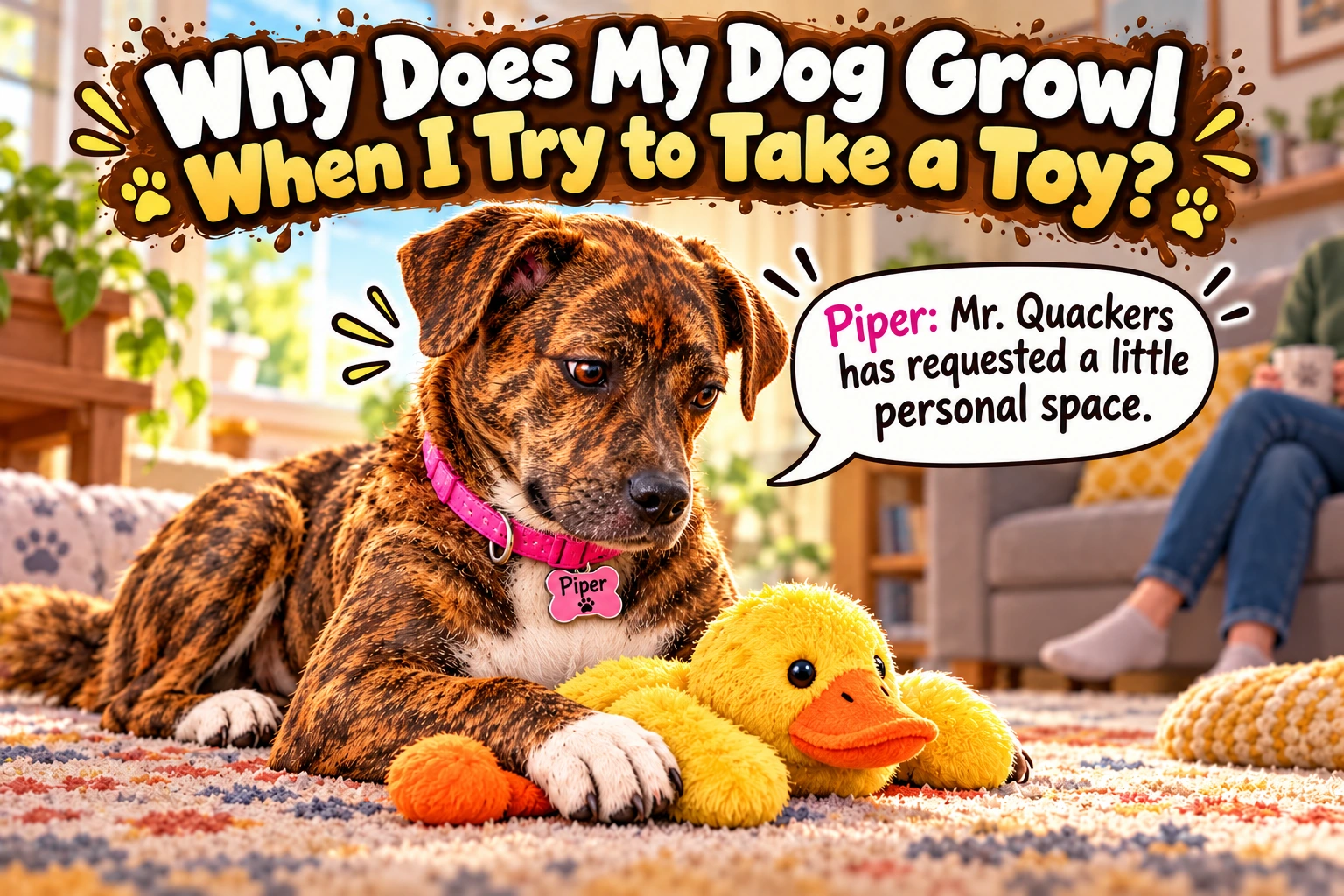
A growl when you approach a toy can be a warning that your dog is uncomfortable about losing it. Stop reaching and give space. A playful growl during an agreed game is a different context, but sound alone is not enough to decide which situation you have. [1]
You only meant to put the toy away. Your hand moves toward it, your dog becomes still, and the room changes. This is a moment to slow down, rather than prove who owns the duck.
Look at the whole interaction
A dog may growl during loose, mutually enjoyable tug. Another may lower their head over an item, freeze, stare, or move to keep someone away. Watch the sequence before and after the sound, including whether the dog has room to disengage. [1]
Treat uncertainty conservatively. Leave the toy and move away. A photograph of one pose, or a wagging tail in isolation, cannot safely settle the question. Do not recreate the scene to check your interpretation.
Observation comparison: in an easy game, you may see a curved body, changing positions, and voluntary breaks. Concern rises when movement stops, the dog covers the item, or an approach reliably triggers a warning. These are observations to discuss with a professional, not a diagnostic scoring system.
What to do right now
Stop approaching the toy. Keep children and other animals away, using a safe barrier or closed door where appropriate. Avoid cornering the dog or reaching over them. If the toy is safe and intact, waiting until the dog has left it can avoid an unnecessary confrontation. [1]
If an item is dangerous or may have been swallowed, contact your veterinarian promptly for a safe plan. Do not use a sock or damaged toy to test whether a trade works. Suspected ingestion has a different urgency from putting away an intact plaything. [2]
For example, if an adult dog lies over an ordinary rubber toy while a child walks past, move the child away first. The child’s task is not to offer a treat, retrieve the toy, or participate in training. Adults should arrange the environment so the situation does not recur.
Why repeated take-away tests can backfire
Resource guarding concerns retaining valued things and keeping perceived threats away. Repeatedly reaching in may make your approach predict exactly the loss the dog finds difficult. Punishing the growl can add risk without making the dog comfortable with the situation. [1]
Changing that expectation requires an individualized plan. Your veterinarian and a qualified reward-based behavior professional can assess health, history, household layout, and safe exercises. Do not begin hands-near-mouth trade drills with a dog already warning you.
The socks article describes exchanges for dogs who can do them comfortably. That should not be read as an instruction to confront guarding over a toy.
Make the household arrangement predictable
Choose where toys are available and where people pass through. Avoid leaving valued items in narrow doorways or children’s play areas. Supervise interactions and give dogs separate comfortable spaces when resources cause tension.
Collect items after the dog has moved away and is safely separated when necessary. If a particular object repeatedly creates concern, keep it out of circulation while you obtain advice. Do not remove every enjoyable activity and leave the dog without alternatives; discuss safe options with the professional supporting you.
Write down what was present, who approached, the distance, the first change in posture, and how the incident ended. Record naturally occurring events rather than provoking another example for a better description.
When help should be a priority
Seek professional support for guarding, particularly with snapping, bites, chasing people away, escalating intensity, or children in the home. Ask your veterinarian to assess a sudden change or possible pain. [1]
For now, end the contest before it starts: step back, keep others safe, and make a plan. Mr. Quackers can wait on the rug while the humans organize a calmer way to share the room.