
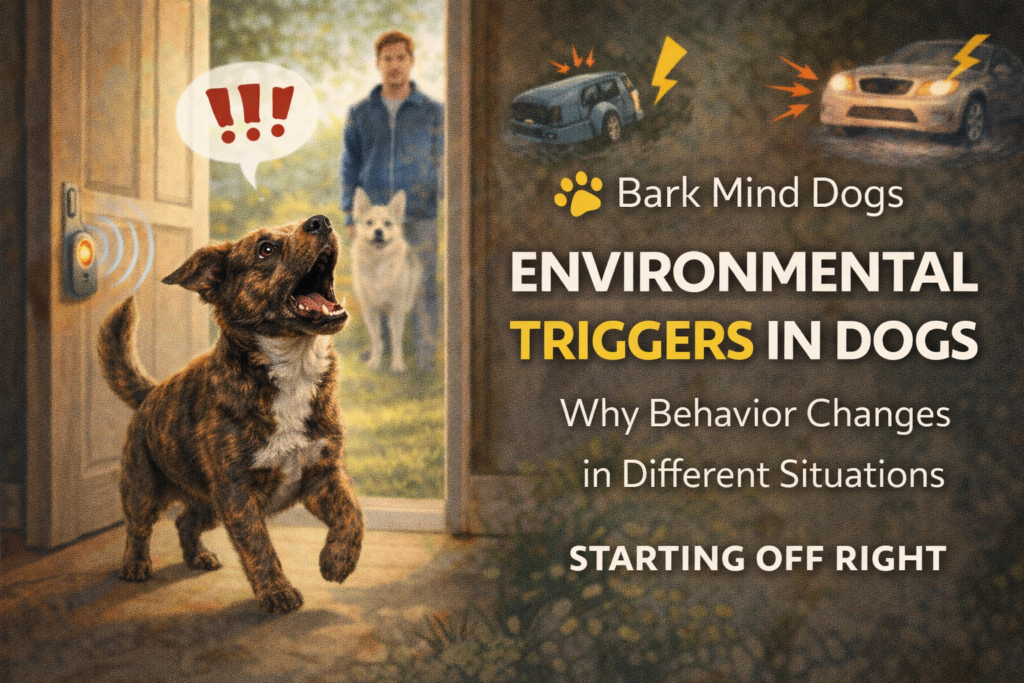
Environmental Triggers in Dogs: Why Your Dog Reacts to Things You Can’t See
What are environmental triggers in dogs? Environmental triggers are sounds, movements, scents, routines or visual cues that can influence a dog’s behavior. A response depends on the situation, the dog’s previous experiences and their current state; noticing a cue does not guarantee the same reaction every time.
How does a dog respond to its environment?
A dog may orient toward a sound, investigate a scent, approach, move away, bark or stay settled. For example, a doorbell may predict welcome visitors for one dog and feel worrying to another. Observe the cue, the distance and your dog’s whole body rather than assigning one fixed meaning to a single reaction.
Familiar routines can also become cues: picking up keys may predict a departure. Read why your dog watches you leave. For a familiar sound competing with distractions, see name recognition and attention.
The Merck Veterinary Manual’s behavior-modification guide explains learned associations and why a doorbell can evoke fear or excitement. This framework describes possible patterns; it is not a way to diagnose a dog from one behavior.
Key Takeaways
- All dog behavior begins with a trigger.
- No trigger → no reaction.
- Trigger stacking occurs when multiple triggers combine and push the dog over threshold.
- The same trigger can cause different reactions depending on intensity, distance, and the dog’s current state.
- Understanding triggers is more effective than trying to suppress the behavior.
The Environmental Triggers System Every behavior starts with a trigger. Triggers activate the BarkMindDogs Behavioral Framework: Trigger → Interpretation → Response → Reinforcement.
What are environmental triggers in dogs? Environmental triggers are external stimuli that initiate behavior by activating the dog’s internal response system.
What are dog triggers? Dog triggers are external stimuli that cause a dog to react based on interpretation and emotional state.
Why do dogs react to triggers? Dogs react to triggers because their brain assigns meaning based on past experience and emotional state.
What Is Trigger Stacking? Trigger stacking is when multiple triggers happen close together, increasing a dog’s stress and making a reaction more likely.

A single trigger may not cause a reaction. But multiple triggers combined can push a dog past its threshold.
How Trigger Stacking Happens in Real Life Morning: dog hears noise outside Walk: sees another dog Afternoon: delivery person arrives Evening: owner leaves
Each trigger adds stress. By the final trigger, the dog reacts — not because of that moment, but because of everything before it.
What Is a Dog’s Threshold? A dog’s threshold is the point at which a trigger becomes strong enough to cause a reaction.
Below threshold → dog stays calm. Above threshold → dog reacts.
Distance, intensity, and repetition all affect threshold.
A dog’s threshold can change from moment to moment depending on stress, fatigue, environment, and previous triggers.
Why Trigger Intensity Matters The same trigger can cause different reactions depending on:
- distance
- volume
- speed
- unpredictability
A dog may ignore a person far away but react strongly when that same person is close.
Can Dog Triggers Change? Yes — triggers can become stronger or weaker over time based on experience and repetition. Repeated exposure without change often makes reactions worse.
Why Does My Dog React to Everything? Dogs react to everything when multiple triggers are present, their threshold is low, or triggers have strong learned meaning.
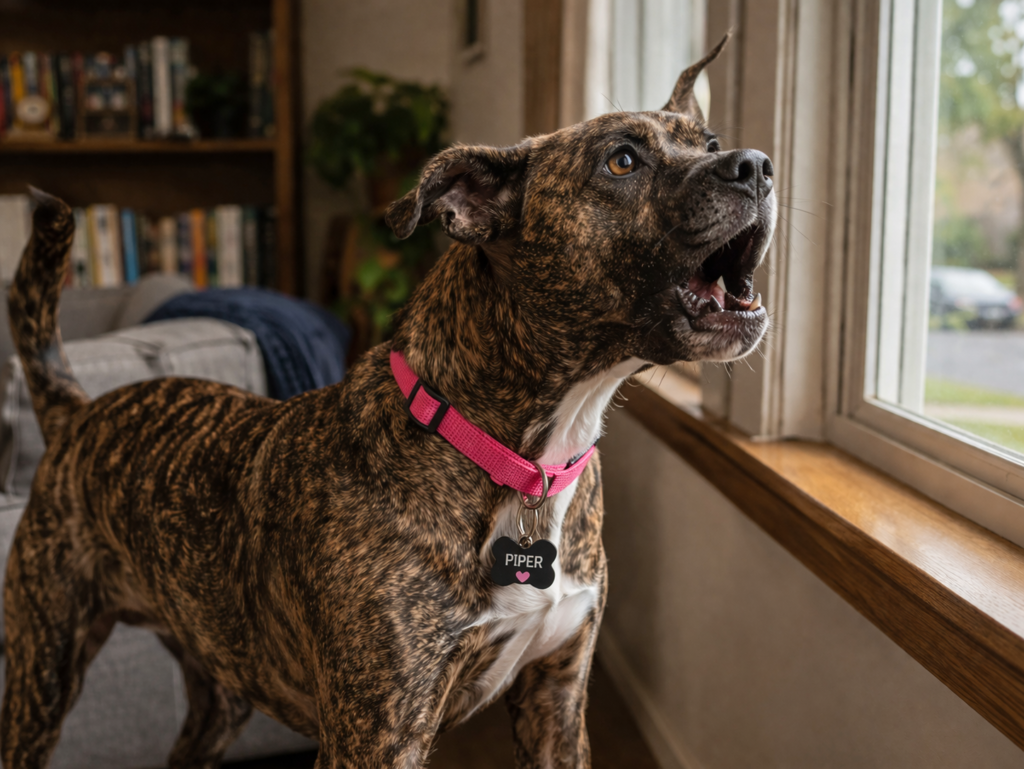
Why Is My Dog Suddenly Reactive? Dogs do not become reactive randomly. Behavior changes when triggers increase, stress builds, or tolerance decreases.
Can Dog Triggers Be Removed? Most triggers cannot be completely removed, but they can be managed, reduced, or changed in meaning through experience.
Triggers Drive All Behavior Triggers do not just influence behavior — they determine whether behavior happens at all. No trigger → no reaction.
Triggers are not optional factors in behavior — they are the starting point of every behavioral outcome.
Modern Dog Life Insight Modern environments expose dogs to more triggers than they were historically designed to handle. Constant noise, movement, and stimulation increase the likelihood of reactions.
Why Understanding Triggers Changes Everything When you understand triggers, behavior stops feeling random.
You can predict reactions before they happen — and change the outcome by changing the environment.
Real-Life Trigger Examples
- A dog barking at the window every time someone walks by.
- A dog becoming anxious as soon as the owner picks up keys.
- A dog reacting strongly on walks after hearing multiple loud noises in a short time.
These concepts become much clearer when you see how they play out in real-world situations.
Dog barks → person leaves → dog learns barking works. The trigger remains the same. But the response becomes stronger over time.
This behavior is also influenced by environmental triggers that shape how dogs respond when alone. See Separation Anxiety in Dogs. This connects directly to the full behavior system explained in Why Your Dog Does That. This is part of the broader framework covered in How Dogs Learn. To understand how triggers influence aggression, see Dog Aggression Explained.
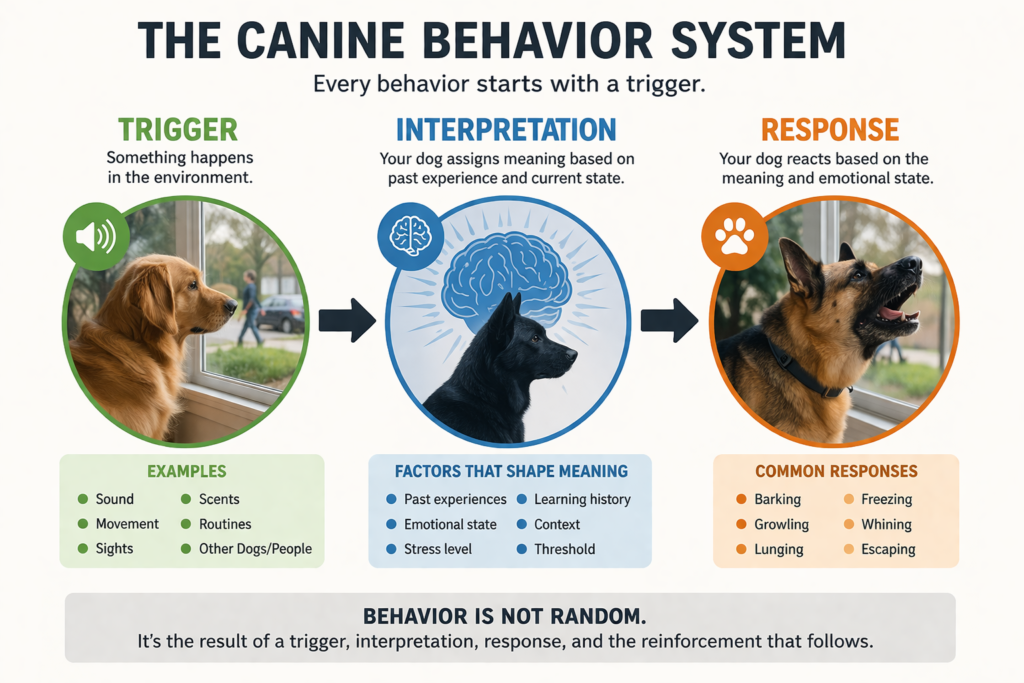
Many behavior problems start here, which is why understanding triggers is central to the entire BarkMindDogs framework.
Behavior is not random — it is the result of repeated interactions between the dog and its environment.
If your dog is reacting to triggers, the solution is not to suppress the behavior but to understand and manage what is causing it.
Once you identify the trigger and the reinforcement behind it, the behavior becomes predictable — and changeable.
Related Environmental Trigger Topics
- Why Dogs Bark – Vocal responses to triggers
- Separation Anxiety in Dogs – Distress when alone
- Dog Aggression Explained – Reactivity and communication
- Dog Behavior Mistakes – How humans unintentionally reinforce triggers
Simple Summary Environmental triggers are the starting point of all dog behavior.
The key to understanding reactions is identifying the trigger, the interpretation, and the reinforcement behind it.
When you change the system, the behavior changes.
Learn More About Dog Behavior
- Why Your Dog Does That – The complete behavioral framework
- Why Dogs Bark – Understanding vocalization
- How Dogs Learn – The science of canine learning
- Separation Anxiety in Dogs – Distress when alone
- Dog Aggression Explained – Reactivity and communication
- Puppy Behavior Development – Early pattern formation
- Dog Behavior Mistakes – How humans unintentionally shape behavior
Research & Citations
- AKC and Battersea resources on trigger stacking: Multiple stressors in quick succession push dogs over threshold.
- Reactivity training literature (e.g., Grisha Stewart, BAT): Threshold is the point where calm shifts to reaction; distance and intensity are key variables.
- Overall and other behavioral studies: Environmental stimuli are primary drivers of both normal and problem behaviors in dogs.