
Reverse sneezing is a series of rapid inward snorts that often stops on its own. A new, frequent or worsening pattern deserves veterinary advice. Ongoing difficulty breathing, weakness or collapse, or blue, purple or unusually pale gums requires urgent veterinary care. Do not assume that an alarming breathing sound is only a reverse sneeze.
The sound can stop a conversation: your dog stands still and suddenly snorts as though something has gone wrong. The most useful first question is whether the dog is breathing comfortably and returning to normal—not whether a description on the internet sounds familiar.
First, know when to seek urgent help
Cornell’s respiratory-distress guidance treats difficulty getting enough oxygen as an emergency. Warning signs can include pronounced breathing effort, abnormal gum color, weakness or collapse. If your dog is struggling to breathe or you are unsure whether breathing is adequate, contact an emergency veterinarian promptly.
Keep the dog as calm as possible and call ahead when you can. Do not delay urgent care to complete a checklist or obtain a better video. A reassuring label is not a substitute for assessing the dog in front of you.
A familiar, brief event in a dog previously assessed by a veterinarian is different from a first unexplained episode. Even then, changes in the pattern deserve attention.
What does a reverse sneeze look like?
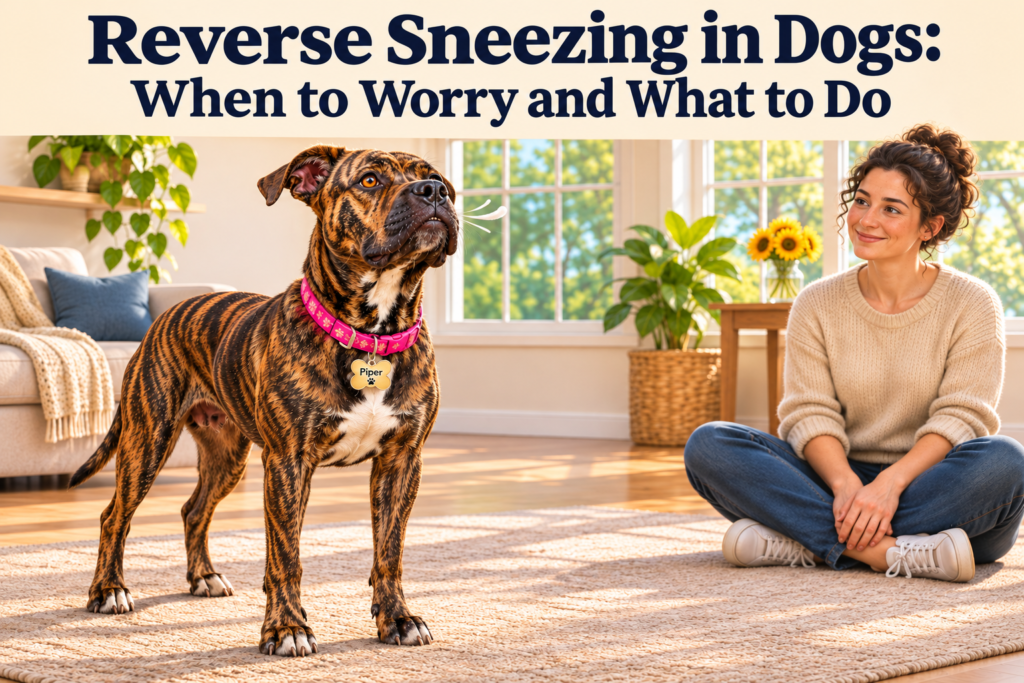
During an ordinary sneeze, air is expelled outward. During a reverse sneeze, a dog makes repeated inward inhalations through the nose. The dog may stand with the head and neck extended and make a loud snorting sound.
Cornell’s explanation of reverse sneezing describes this as a reflex associated with irritation around the back of the nose and throat. Many episodes are mild and sporadic, with the dog returning to normal afterward.
Appearance alone cannot confirm the cause. Coughing, choking, airway disease and other problems can also alarm an owner, and some signs overlap. A veterinarian can interpret the history, examine the dog and decide whether further investigation is needed.
When should I call my regular veterinarian?
Arrange advice for a new pattern, episodes that become more frequent or severe, or events accompanied by other changes such as coughing, nasal discharge, reduced appetite or reduced activity. Mention any recent illness, exposure or change in the dog’s environment.
VCA’s reverse-sneezing guide explains that a veterinarian may need to rule out other causes of snorting or abnormal breathing. The purpose of the visit is not merely to attach a name to a noise. It is to decide whether that noise fits an uncomplicated reflex or needs a different explanation.
| What you observe | A sensible next step | What not to assume |
|---|---|---|
| A familiar brief event, then completely normal behavior | Follow the plan your veterinarian has already given you; note changes | That every future episode will have the same cause |
| A first event or a pattern that is becoming frequent | Contact your veterinarian for advice and an assessment | That a recognizable sound confirms the diagnosis |
| Ongoing breathing difficulty, abnormal gum color, weakness or collapse | Seek urgent veterinary care | That waiting for a time limit is safe |
If you cannot comfortably place the event in the first row, get veterinary advice. A chart is an aid to communication, not a diagnostic test.
What should I do during an episode?
Give the dog space, keep your own movements calm and remove avoidable excitement. If the situation allows, step away from an obvious irritant such as smoke or a strong aerosol. Avoid a crowd of people leaning over the dog.
Do not force food or water into the mouth, hold the mouth shut, or put fingers into the throat to investigate an unexplained sound. Some veterinary guides discuss specific maneuvers for a confirmed reverse sneeze. Ask your own veterinarian to demonstrate an appropriate response for your dog instead of experimenting while you are unsure what is happening.
If the dog recovers, let the dog settle and watch what happens next. Comfortable breathing and a return to usual behavior are useful observations to report. Continuing distress changes the priority to urgent help.
What can trigger reverse sneezing?
Excitement, eating or drinking quickly, leash pressure and environmental irritants are among the contexts described in veterinary guidance. Some dogs have no obvious trigger. Other causes of irritation require examination rather than guesswork.
A possible association is not proof of a cause. ‘It happened after a walk’ is an observation. ‘The dog is allergic to the yard’ is a conclusion you cannot establish from that event alone.
Our environmental-triggers guide encourages the same habit: notice what is present, reduce unnecessary exposure when practical and avoid deciding that every response has one explanation. Do not intentionally expose a dog to an irritant to reproduce the event.
Use the BarkMind framework carefully
Trigger: Record what happened just before the sound: resting, greeting someone, eating, drinking or walking. If nothing stood out, write that down too.
Interpretation: Treat reverse sneezing as a possibility to discuss with your veterinarian. Distinguish what you observed from the explanation you are considering.
Response: Choose calm space and appropriate veterinary contact according to the dog’s breathing and recovery. A new or worsening pattern should move you toward professional advice.
Reinforcement: After the dog is comfortable again, return to a calm routine. The purpose is to support settling; reverse sneezing is a reflex, not disobedience to punish or a behavior to train away with treats.
This is a framework for your response, not a claim that a dog learns to reverse sneeze for attention.
What should I record for the vet?
A short, specific description can make a consultation more useful. Record only what you can observe safely:
- The date, approximate duration and how many events occurred.
- What the dog was doing immediately beforehand.
- Whether the sound seemed to happen on breathing in or out.
- Any coughing, discharge, unusual effort or other changes you noticed.
- Whether the dog returned fully to usual breathing and behavior afterward.
If it is safe and does not delay care, a short video can help the veterinary team understand the sound and movement. Include the dog’s body as well as the face when possible. Do not hold the dog in a position or recreate the event for the camera.
For example, ‘Three short snorting bouts after greeting a visitor, then normal walking and breathing’ communicates more than ‘My dog sounded strange again.’ An approximate observation is fine; you do not need perfect data before asking for help.
Is reverse sneezing the same as a play sneeze?
No. Dogs can sneeze during lively interaction, and the social setting is useful context. Our article on sneezing during play addresses that separate question. A play situation does not automatically explain every snort or breathing change that happens nearby.
Likewise, occurring after eating or at night does not establish a particular diagnosis. Give the veterinarian the timing as part of the history rather than using it as a reason to rule out other problems yourself.
The useful goal is a clear next step
For a dog with an established veterinary assessment and a familiar, uncomplicated pattern, follow the plan you were given. For a first, frequent or changing pattern, call the vet. For breathing difficulty or other emergency signs, seek urgent care.
You do not need to become an expert in breathing sounds. You need to observe clearly, respond calmly and know when the dog needs professional help.
Sources
- Cornell University College of Veterinary Medicine: Reverse Sneezing.
- Cornell: Recognizing and responding to canine respiratory distress.
- VCA Animal Hospitals: Reverse Sneeze in Dogs.
Sources checked November 2, 2026. This educational guide does not diagnose an individual dog’s breathing problem.