Your dog trots over with a toy in their mouth, tail wagging like crazy… and the second you reach for it, they back up with that mischievous sparkle in their eyes.
It feels like they’re teasing you. It feels like they’re playing keep-away on purpose. It feels frustrating as hell.
But here’s the truth: Your dog isn’t being difficult. They’re being consistent.
Dogs often bring toys to invite interaction. For a relaxed, playful dog, keeping hold can make tug or keep-away rewarding, so attention may reinforce the pattern. Holding a toy can have other meanings too; look at the whole situation and body language.
The more it works, the more your dog will repeat it.
Why does my dog bring me a toy but not want to play fetch?
Bringing a toy does not necessarily mean “throw it.” Your dog may prefer holding it near you, a brief interaction, or a different game. Pause and let them choose whether to approach again; do not force a handover. The toy alone cannot tell you exactly what they want.
When holding a toy may be guarding
A stiff or frozen body, hovering over the toy, growling or snapping can signal a need for space. Stop reaching, move away calmly and keep children away. Do not chase, corner or punish your dog. Seek veterinary and qualified behaviour support for guarding or a sudden change.
For a relaxed dog without guarding signs, practise exchanging a toy for another favourite toy or a treat, and return the safe toy when practical. See Dogs Trust’s advice on resource guarding and reward-based swaps. For the learning behind a voluntary release, read how dogs learn.
Key Takeaways
- Dogs bring toys to start interaction or play — it’s an invitation, not a gift.
- Refusing to let go is part of the reward cycle — holding the toy keeps the game going.
- The behavior is reinforced by your attention, movement, and engagement.
- This is not disobedience — it’s a learned pattern that “works.”
- The stronger the reinforcement, the stronger the behavior becomes.
- Behavior is not random — it follows a predictable system.
What’s Actually Happening (The BarkMindDogs System)
This classic “bring the toy then dodge” game makes perfect sense when you look at it through the BarkMindDogs Behavioral System:
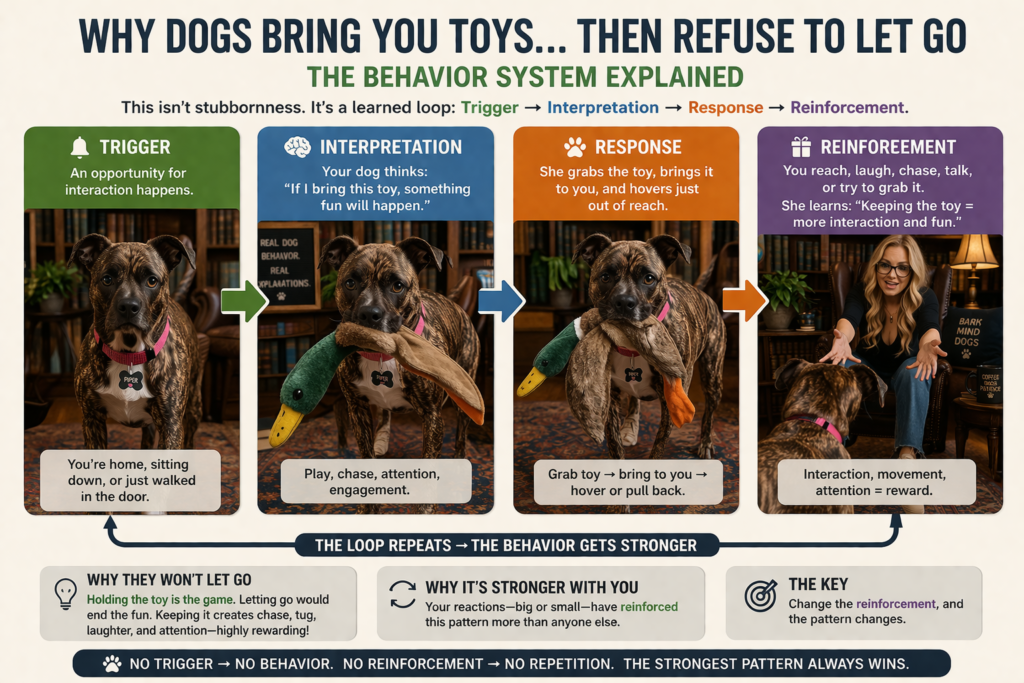
Trigger → You’re home, sitting on the couch, or just walked in the door. The dog sees an opportunity for engagement.
Interpretation → “If I bring this toy, something fun will happen — play, chase, attention.”
Response → Grab toy → bring it to you → hover just out of reach or pull back when you reach.
Reinforcement → You reach, laugh, chase, talk, or play tug. The dog learns: “Keeping the toy = more interaction and fun.”
Behavior is not random — it is learned through repetition. No trigger → no behavior. No reinforcement → no repetition. The strongest pattern always wins.
You are always training your dog — even when you don’t realize it.
This is the same learning loop explained in How Dogs Learn.
This pattern repeats every time the behavior is rewarded.
Why They Won’t Let Go (The Part That Drives Owners Crazy)
Holding the toy is the game for many dogs. Letting go would end the interaction. Keeping it creates chase, tug, laughter, and attention — all highly rewarding.
From the dog’s perspective: “Bringing it gets you interested. Keeping it keeps you playing.”
It feels like teasing or stubbornness to us. To them, it’s a successful strategy that has worked many times before.
This pattern often starts in puppyhood during playful tug and chase games. See Puppy Behavior Development for how these early habits form.
Why Dogs Do This With You (Not Everyone)
Dogs repeat behaviors with the people who reinforce them the most. If your dog plays this game with you but not others, it’s because your reactions — even small ones — have made the pattern stronger.
Every real-world behavior — from this toy game to barking or jumping — follows the same learning pattern. See Why Dogs Bark for how this plays out in everyday behavior.
Real-Life Examples (Sound Familiar?)
The “Fake Fetch” You throw the toy. Dog runs, grabs it, comes back… then stands just out of reach with the toy dangling. Why? Because the real reward isn’t fetching — it’s the chase and engagement when they refuse to drop it.
The “Keep Away” Game Dog brings toy → you reach → dog pulls away → you laugh or chase. You just reinforced the exact behavior you’re frustrated by.
The “Hover and Tease” Dog drops the toy at your feet… then snatches it back the moment you move. They’re testing and controlling the interaction — and your reaction makes it worth repeating.
The “Only With You” Dog Dog brings toy to you but ignores others. Because you are the reinforcement source.
Why This Behavior Gets Stronger Over Time
Because it works. Every time you reach, chase, talk, or engage, you’re adding reinforcement to the loop. The dog isn’t being difficult — they’re being consistent with what has paid off before.
Behavior follows reinforcement, not intention.
This is the same mechanism behind many other common issues. See Dog Behavior Mistakes for how humans unintentionally strengthen unwanted patterns.
A Note About Toys (From One Dog Parent to Another)
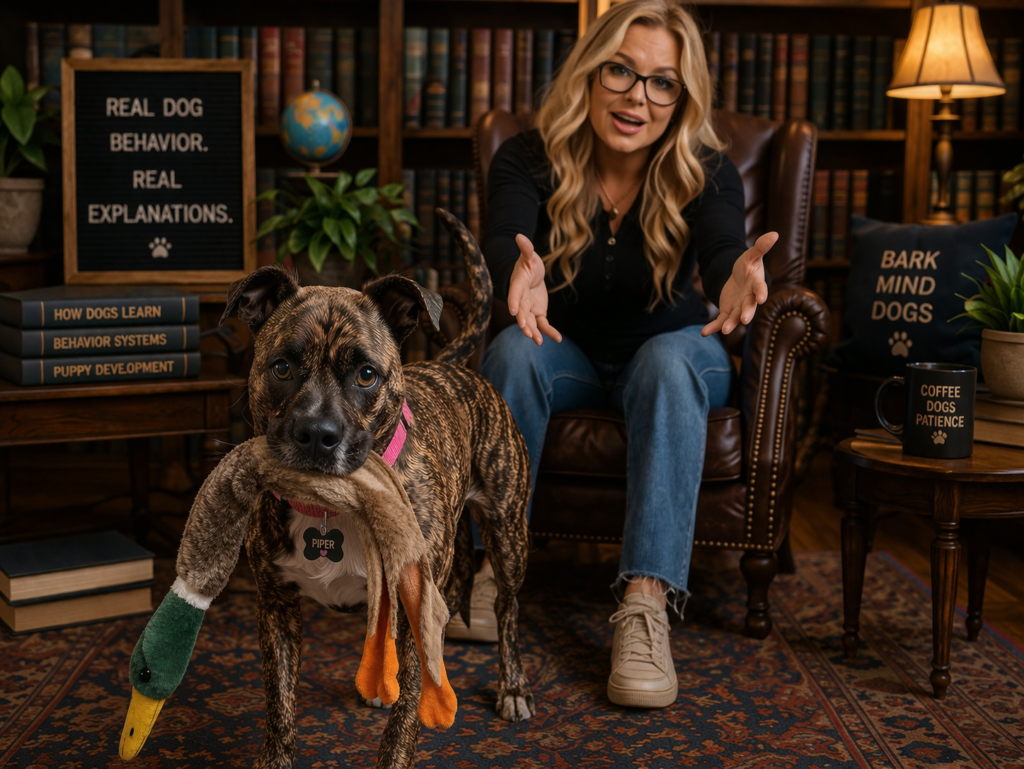
My dog Piper is obsessed with her favorite toy duck — I call him Mr. Quackers. She brings him to me constantly, then does the classic dodge-and-tease when I reach for him. It’s her favorite way to say “play with me!”
If your dog loves this game too, the type of toy you use can actually change how the interaction plays out. Here are two types that tend to work really well:
- Interactive tug toys (like Mr. Quackers style) — built for safe gripping and structured play. They channel the natural “keep away” energy into something more controlled. See similar tug toys here (Affiliate Disclosure)
- Puzzle or treat-dispensing toys — great for giving the dog a job and releasing energy without constant human interaction. They can help redirect the “bring and hold” pattern into independent play. See puzzle toys here (Affiliate Disclosure)
You’re not fixing behavior with a toy — you’re changing what the dog finds rewarding.
This isn’t just about toys — it’s about how your dog learns what works.
Strategic Takeaways
- Bringing toys is usually an invitation to interact, not a gift.
- Refusing to let go is often the rewarding part of the game.
- Change the reinforcement (how you respond) and the pattern shifts naturally.
- Understanding the system turns frustration into clarity.
The behavior makes sense once you see the pattern. Your dog isn’t being difficult — it’s being consistent. The system is always running — and once you see it, you can shape it.
When you understand this behavior through the lens of triggers and reinforcement, it stops being frustrating and starts making sense. The system is always running — and once you see it, you can shape it.
FAQ
Why does my dog bring me toys but not give them? Because holding the toy is part of the reward and keeps the interaction going.
Is my dog teasing me? No. The behavior is learned and reinforced, not intentional teasing.
Why does my dog only do this with me? Because you have reinforced the behavior more than others.
Should I take the toy away? Avoid snatching it. For a relaxed dog, offer a rewarding swap. If your dog stiffens, growls or snaps, give them space and seek professional support.
Can this behavior be trained out? Yes — but only by changing reinforcement, not just giving commands.
Why does my dog bring toys then run away? Because the chase and keep-away part is highly rewarding to them.
Explore the Full BarkMindDogs Behavioral System
Pingback: Why Your Dog Randomly Checks to See If You’re Still Alive (Yes, They Actually Do This… And It’s Hilarious) - Bark Mind Dogs
Pingback: Why Your Dog Likes Sleeping With You (And What It Really Means) - Bark Mind Dogs