

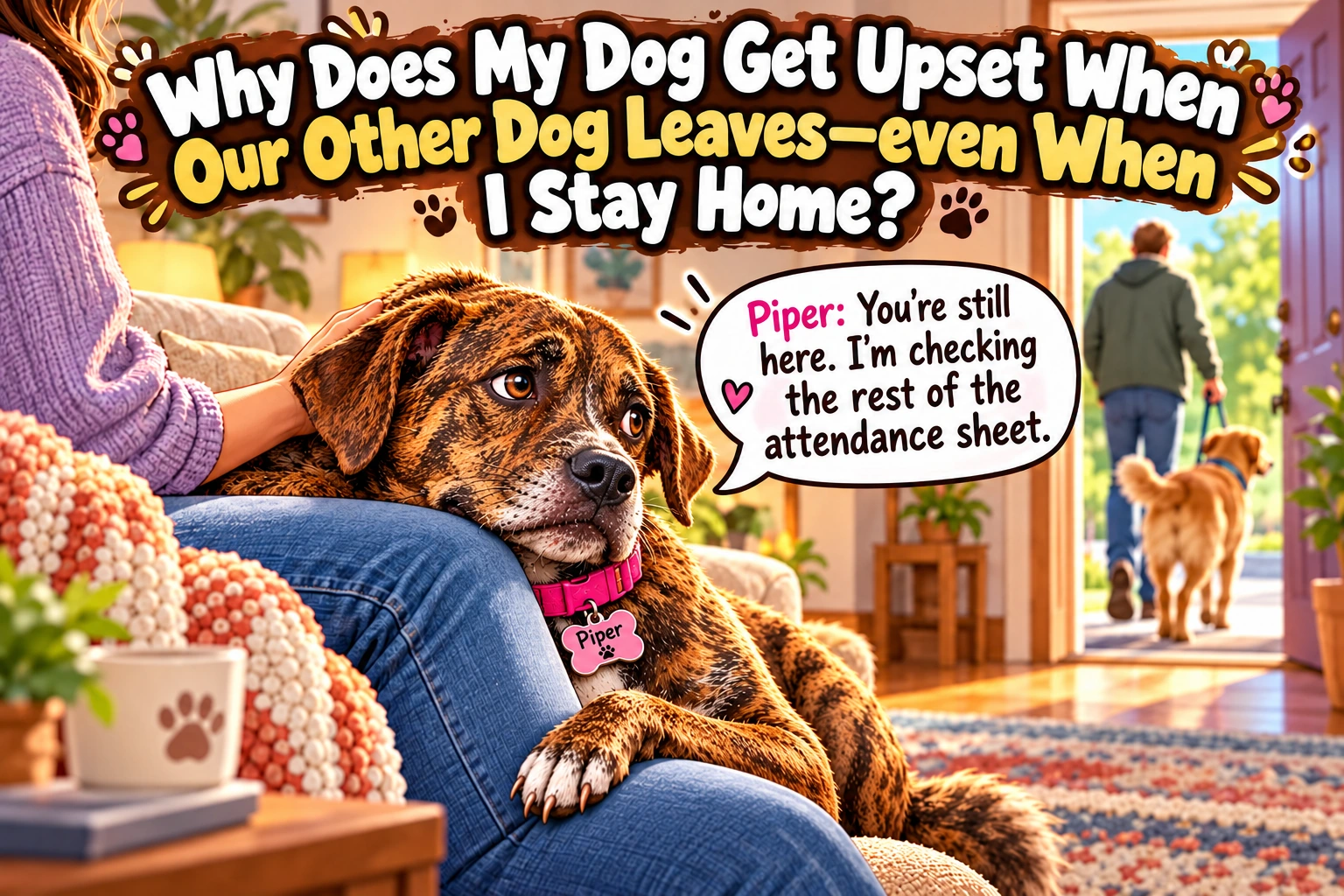
Yes, a dog can become upset during another dog’s departure even when you remain home. The missing companion, a changed outing routine, and frustration are all possibilities to explore. Record the actual sequence and arrange support if distress is repeated or substantial. [1][2]
One dog leaves for a walk or appointment. You are still in the kitchen, yet the dog who stayed paces near the door. Being present does not make your observation invalid. It tells us that “the person left” is not a sufficient description of what happened.
What exactly changed at the door?
Several things can occur together: a leash appears, a preferred activity seems available, a familiar dog leaves, and the house becomes quieter. Frustration about missing an outing and distress involving a social companion can look similar from the hallway.
Notice whether the response begins at the preparation cues, at the door closing, or later. Also note health and routine changes. If a companion has died rather than gone out temporarily, that is a different household change to discuss with your veterinarian; do not treat grief and an ordinary short absence as interchangeable.
These are possibilities to investigate, not a checklist that diagnoses the cause.
What dog-to-dog research can—and cannot—tell us
Research has compared dogs’ behavior during separation involving an owner or a cohabiting dog. It is relevant to canine social relationships, but the test setting and who else was absent complicate interpretation. It does not establish what causes distress in your home when you stay with one dog. [1]
General owner-separation guidance can help organize observations and protect welfare. A tailored assessment starts with the actual household pattern. [2]
An ordinary-departure observation card
Record departures that already need to happen. Do not repeatedly send the other dog out to see how upset the remaining dog becomes.
- Who left: which dog, which person, and for what ordinary purpose?
- Who stayed: familiar people and animals still present.
- Cues: leash, shoes, car, door, or another change before departure.
- Onset: first visible change and when it began.
- Behavior: pacing, vocalizing, door watching, resting, eating, or another observable action.
- Recovery: what happened afterward, including whether settling occurred before reunion.
Record “walked between door and window” rather than “thought she had been abandoned.” If safe, a short video of a naturally occurring episode may help a professional. Do not delay helping your dog in order to improve the recording.
Help the dog who stays without staging panic
Stay available in a familiar comfortable part of the home. Reduce unnecessary departure commotion and offer the usual calm routine. If the dog chooses a safe familiar activity, allow it; do not repeatedly insist on food or play when they cannot engage.
Prevent escape and injury while keeping the setup comfortable. A crate is not automatically suitable for a dog who panics in confinement. Discuss safe management and any necessary departures with your veterinarian or behavior professional. General separation guidance emphasizes reducing distress and matching treatment to the dog. [2]
For a mild moment of watching the door followed by normal rest, a record may be enough to start understanding the pattern. Prolonged pacing, repeated distress, escape attempts, self-injury, or inability to resume normal activity warrants professional assessment. [2]
Should the dogs practise being apart?
A professional may recommend carefully graded, comfortable experiences based on the dog’s response. There is no universal starting duration. Do not keep the separation going until the dog gives up or rehearse a full panic response as practice.
If this is new or accompanied by physical or behavioral changes, begin with a veterinary check. Ask for qualified reward-based behavior support when needed. Another dog, a television, or a calming product is not a guaranteed treatment.
Your useful next step is one accurate departure record and an easier arrangement while you seek help. You can comfort the dog who stayed without pretending that your presence explains every part of their experience.