

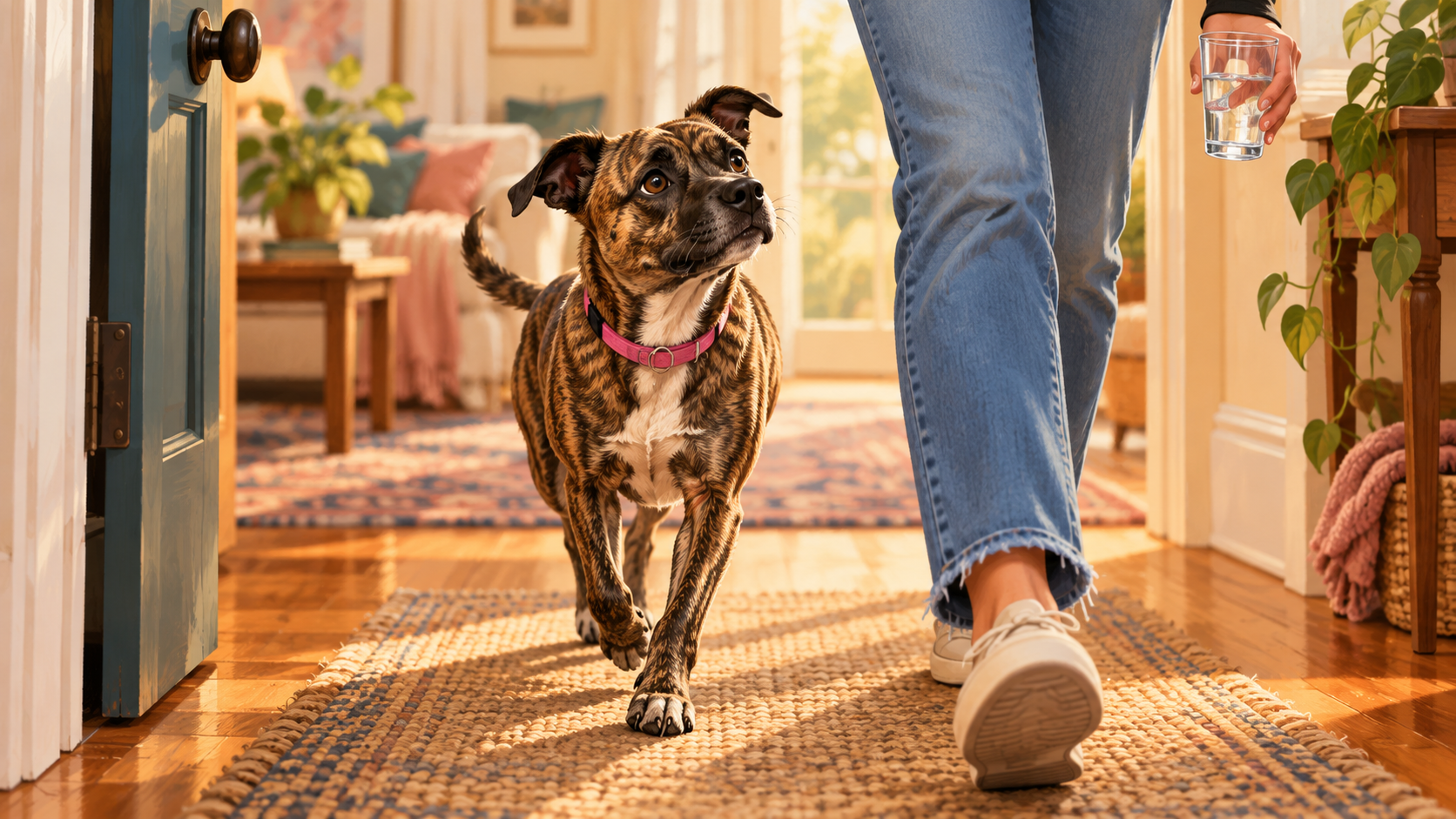
Your dog may follow you simply because being near you is pleasant, interesting or likely to lead to something good. Companionship, familiar routines, curiosity and anticipation can all play a part. Following by itself does not diagnose anxiety. The more useful question is whether your dog seems comfortable—and what happens when you actually spend time apart.
You get up for a glass of water. Four feet join the trip. You return to the couch. Your assistant returns too. Apparently, hydration is a team project.
That can be a lovely part of living with a dog. You can enjoy the company while also helping your dog feel comfortable resting somewhere else.
Five possible reasons for your furry shadow
1. Your company is rewarding
Dogs form social bonds with people, and proximity can be part of that relationship. In a problem-solving study, dogs persisted differently depending on whether their owner was present, supporting an owner-specific secure-base effect. That tells us something about attachment; it cannot tell us exactly why your dog followed you into the laundry room.[1]
2. Your movements predict the next good thing
Standing up sometimes precedes a walk. Going to the kitchen sometimes precedes dinner. If following has often led to attention or an enjoyable activity, it may become a well-practiced habit. Nothing needs to happen on every trip for the routine to remain interesting.[2]
3. Something might be happening
A door opening, a rustling bag or a change of room offers information. Curiosity is one plausible explanation when your dog briefly investigates and then returns to another activity. Treat that as a possibility to observe, rather than a thought you can confidently put in their head.
4. The day needs something different
Following can occur when a dog has little else to do or is expecting a familiar part of the day. Check the ordinary things: a toilet opportunity, water, suitable activity, food at the usual time and comfortable rest. The aim is to notice a need, not keep adding exercise until your dog is exhausted.[2]
5. Your dog may be having trouble feeling comfortable
A sudden increase in closeness, especially alongside other changes, deserves attention. Pain, illness or age-related changes can affect behavior. Distress during separation is another possibility, but it needs evidence beyond following you around.[2][3]
Look at the whole scene, not the number of rooms
Try this small observation exercise during ordinary life. There is no score and no pass or fail.
- Before: What happened just before you stood up? Was it near a meal, walk or usual departure?
- During: Does your dog move loosely, look around and choose other activities, or repeatedly pace and struggle to settle?
- After: When you sit down again, does your dog relax? Can they comfortably rest a little farther away?
- Across days: Is this a familiar pattern or a clear change?
For example, a dog who checks the kitchen and then naps may need a different response from a dog who cannot settle whenever you move. Neither example lets us diagnose a dog from a single moment. Our guide to environmental triggers explains why the surrounding situation matters.
Following you and struggling alone are different questions
If you are concerned about absences, a recording of an ordinary, necessary absence can provide useful information. Look for persistent vocalizing, pacing, escape attempts or difficulty resting. Do not deliberately leave an already distressed dog longer to see what happens. Speak to your veterinarian and a qualified behavior professional; arrange support for unavoidable absences where possible.[4]
A quiet dog is not automatically a comfortable dog, and a single bark is not a diagnosis. Share the pattern and recording with the professional helping you. Our separation-anxiety guide provides the broader context.
Help your dog discover that resting nearby works too
For a dog who is comfortable and simply likes accompanying you, begin with something easy. Notice a moment when they settle on an existing bed or mat. Quietly offer an appropriate reward there. Practice while you are nearby, then make tiny changes your dog can comfortably handle. If your dog becomes uneasy, make the situation easier.[5]
Keep rewarding voluntary rest outside training moments as well. You do not need to remove affection, punish following or turn every room change into a lesson. This is an extra comfortable option for your dog, not a withdrawal of your company. Read How Dogs Learn for the learning principles behind that approach.
Piper’s imaginary job description: accompany the human, inspect the destination, supervise the return. The joke is ours; your dog’s actual reason needs observation.
A few questions owners often have
Does following me mean my dog has separation anxiety?
No. Following alone cannot establish that. Pay particular attention to behavior during actual separation and seek help if your dog struggles.[4]
Can I let my dog follow me if we both enjoy it?
You do not need to stop a relaxed, harmless routine just because it has a label. Make sure your dog can rest comfortably and that being underfoot does not create a fall risk.
Why does my dog follow one person more?
Different people can have different routines and histories with the same dog. Notice who provides which activities and how the dog behaves with everyone. A following preference is not a reliable ranking of who is loved most.
What if this started suddenly?
Contact your veterinarian, particularly if appetite, sleep, mobility, toileting or usual behavior has changed too. Describe what is new instead of assuming your dog has become needy.[3]
Your dog can love your company and learn to enjoy comfortable time apart. Start by understanding the pattern in front of you. That is more useful than deciding your little shadow must be doing something wrong.