

By Dr. Rich Prather, D.C. · November 6, 2026
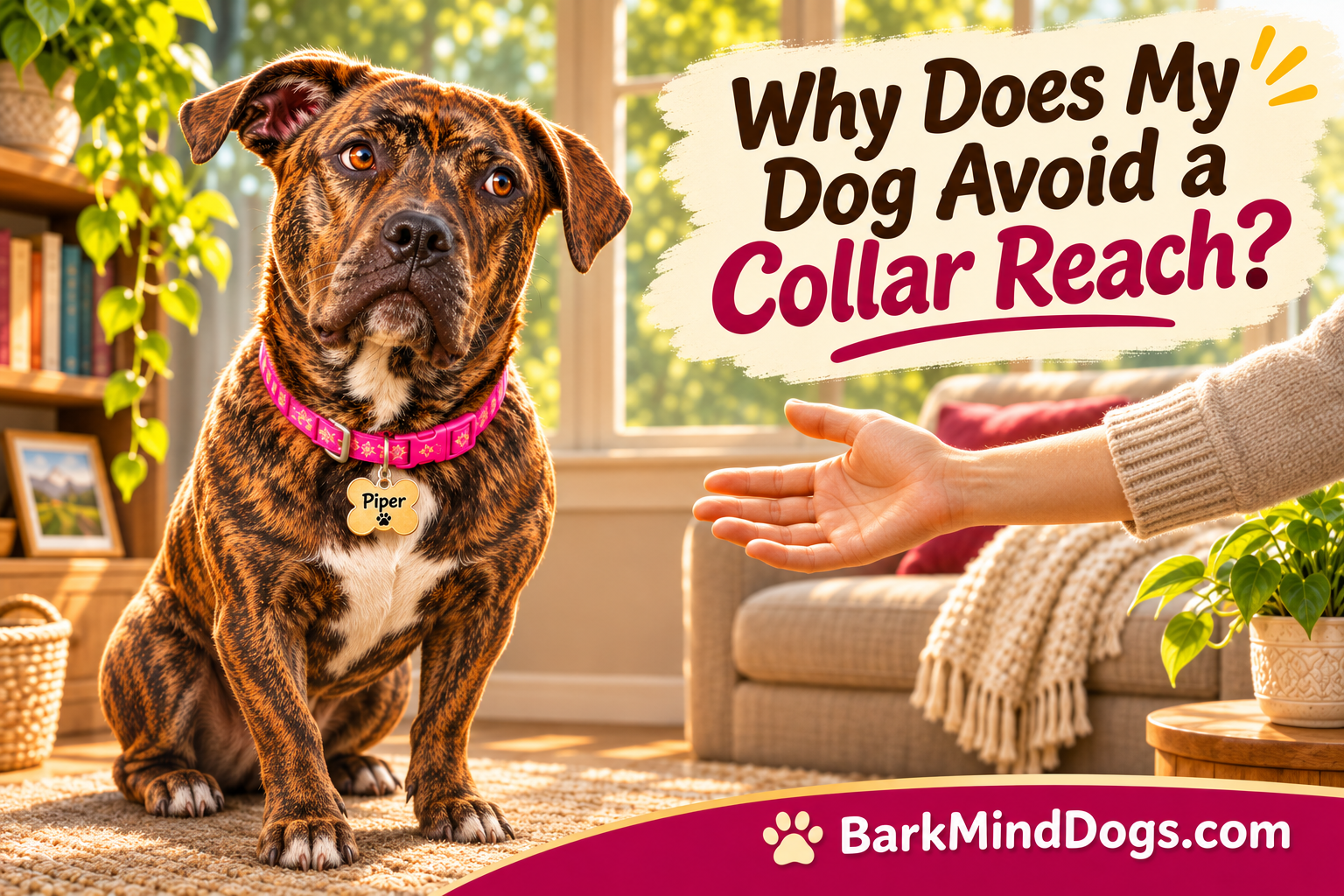
A dog may back away from a collar reach because the approaching hand predicts restraint, an unpleasant experience, or discomfort. Some dogs simply have not learned to feel comfortable with that handling. If the reaction is new or the neck seems painful, arrange a veterinary check. For practice, stop chasing the collar and start with an approach your dog can comfortably choose to accept.
In this article
Piper has noticed that human hands can mean excellent ear scratches—or that the backyard investigation is officially over. From a dog’s point of view, those are very different announcements.
Look at what usually happens after the reach
Does reaching for the collar lead to being pulled off the couch, guided into a crate, or taken away from play? The SPCA of Texas handling guide explains why dogs may become uneasy when a collar touch repeatedly leads to something they do not want.
That does not establish a history of abuse, and it does not prove your dog distrusts you in every situation. A very specific movement can become uncomfortable even when the rest of your relationship is affectionate.
Separate these questions: Is your dog avoiding the hand, the touch, the clip sound, or wearing the equipment? A dog who happily wears a collar but ducks from a hand needs a different starting point from one who scratches, freezes, or seems sore while wearing it.
| Pattern | What to check | First response |
|---|---|---|
| Moves away before any touch | Approach angle and what the reach usually predicts | Pause farther away; allow voluntary approach |
| Flinches, yelps, or reacts to neck contact | Possible pain or irritation | Stop testing the area and contact your veterinarian |
| Comfortable until the leash appears | Equipment, clipping, or the next activity | Work on those parts separately |
| Freezes, growls, or snaps | Handling is already too difficult or unsafe | Give space and seek professional help |
Change the everyday routine first
The Wisconsin Humane Society’s touch-sensitivity guidance recommends avoiding collar grabs used to maneuver a sensitive dog. Teach and reward an invitation to move with you instead. Practice that invitation when there is no deadline.
Set up doors, gates, and walking equipment so you are not repeatedly making a last-second grab. In a secure room, invite your dog toward the next activity; do not trap them with a treat and then seize the collar. Ask other adults in the home to use the same plan. Children should not take on collar-handling practice with an uneasy dog.
If immediate safety requires moving your dog, focus on safe separation and get help rather than trying to turn that stressful moment into a training session.
Build a comfortable collar touch
This practice is for a dog who can remain relaxed near your hand and has no unresolved pain or bite concern. If your dog has snapped or bitten during handling, have a qualified professional plan the work with you.
- Invite, rather than pursue. Stand or sit slightly sideways in a quiet, secure space. Let the dog choose to approach. If an approaching hand already causes retreat, begin farther away; there is no need to touch the collar yet.
- Pair a small approach with a reward. Move your hand only as far as your dog comfortably accepts, then provide a small treat. Stop before the dog feels the need to dodge.
- Introduce a moment of gentle contact. Once the approach is comfortable, briefly touch the outside of the collar while providing a reward. Release immediately. Do not pull or steer.
- Practice clipping separately. When touch is comfortable, introduce the clip sound and brief attachment in small steps. Sometimes unclip and let your dog return to their activity, so practice does not always end the fun.
The SPCA guide builds from voluntary hand approach to brief collar contact. Battersea’s equipment guidance likewise recommends gradual introductions and stepping back if the dog moves away. Progress depends on comfort, not a fixed number of repetitions.
A useful pause test is to lower your hand and stop. Does your dog remain loose and choose to stay nearby? Or do they leave, stiffen, or seem relieved that contact ended? Respect that information. Taking a treat alone does not prove the handling is comfortable.
Our How Dogs Learn guide explains how repeated experiences shape these expectations.
Track the reach, not your dog’s obedience
Use BarkMind’s Trigger → Interpretation → Response → Reinforcement pattern as an observation aid. The trigger might be a hand above the head; a possible interpretation is that restraint is coming; the response is ducking; getting distance may make ducking useful to the dog.
Your job is to change what the approach predicts. For example, record: “Hand stayed beside my knee; dog approached; brief outer-collar touch; relaxed afterward.” On a harder day, record the actual change: a different person, hurried movement, a noisy room, or a leash clip. That gives you something specific to adjust.
A helpful household rule is ask, pause, observe. It keeps the work focused on the dog’s comfort instead of how quickly a person can finish clipping a leash.
Will a harness solve it?
A comfortable, well-fitted harness may change how you attach a leash, but it still involves handling. Some dogs dislike equipment passing over their head or being touched under their legs. Introduce the chosen design gradually and seek help if fitting it causes distress. Do not assume new gear erases an uncomfortable association.
When a veterinary check comes first
Stop practice and contact your veterinarian for a sudden change, pain, skin irritation, or difficulty moving the neck. Do not repeatedly touch a painful spot to confirm the reaction. Freezing, growling, snapping, and persistent avoidance also call for a safer plan with professional guidance.
If touch elsewhere brings a warning, read why a dog may growl during petting. If you are unsure how rewards fit into training, see why a dog may only listen when treats are visible.
Piper’s request is modest: let the hand become predictable. A collar touch should be something a dog can learn to welcome, one comfortable moment at a time.