
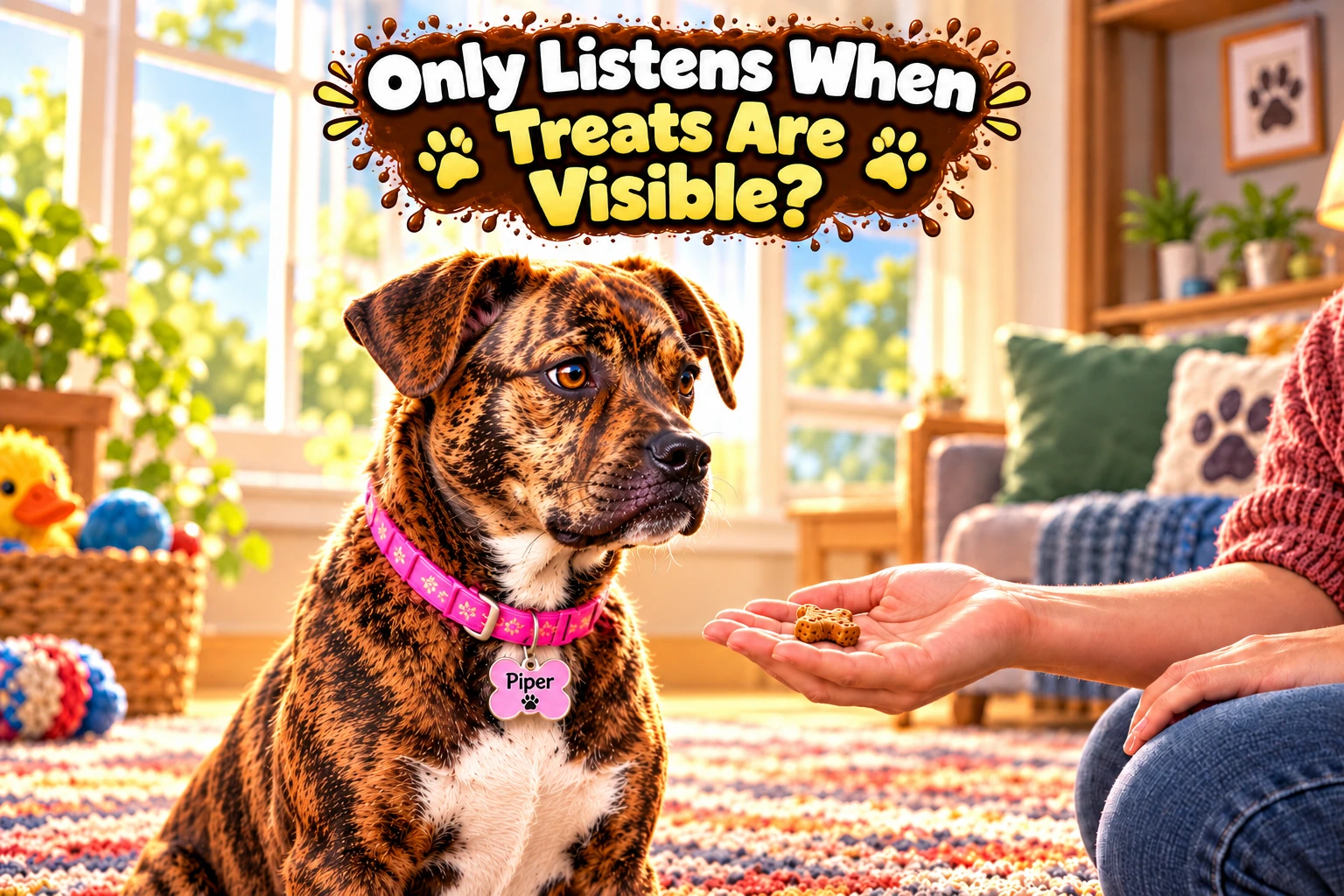
Your dog may have learned that visible food is part of the cue, or the behavior may not yet be reliable in the situation where you are asking. That is different from proving your dog is stubborn, manipulative or uninterested in you. The useful change is often to move food out of the prompt while continuing to reward the behavior afterward.
A treat can serve two different roles. Food held in front of the nose can lure a movement. Food delivered after a response can reinforce that response. Fading the first does not require abruptly removing the second. The American Kennel Club’s guide to this problem makes that distinction practical. [1]
Check what your dog has actually practiced
Picture two requests. In the kitchen, you hold food, move your hand upward and say “sit.” At the park, you say “sit” with your hands still while another dog passes. The word may be the same, but the hand movement, visible food, location and distraction have all changed. A missed response cannot tell you which change mattered.
Choose a familiar, comfortable behavior and a quiet room first. Do not test recall near traffic, unclip a leash to see what happens, or ask for a movement that might hurt. A sudden change in an otherwise well-established response, especially with signs of pain or illness, deserves veterinary attention.
A short practice plan: hide the food, keep the reward
- Prepare before calling the dog. Put small suitable rewards in a pocket or container the dog does not need to stare at. Keep the environment easy and have everything ready.
- Use the familiar cue once. If your dog knows an empty-hand signal, use it without holding food. Do not add a new word, a new location and a harder distraction simultaneously.
- Mark the response. When the behavior happens, use an already learned marker such as “yes,” then deliver the reward. If you have not taught a marker, work on clear, consistent reward timing rather than assuming an unfamiliar click explains itself.
- Reset after a miss. Pause and make the next attempt easier. Do not repeat the cue insistently or display food only after several failed requests as your standard rescue routine. A qualified reward-based trainer can help fade a lure in small steps if the empty-hand signal is not yet understood.
- Repeat briefly, then stop. A few easy successes are more informative than a long, frustrating session. Add difficulty gradually after the response is comfortable.
This is a practice structure, not a guarantee that every dog will progress in a fixed number of trials. If hiding the food makes the response disappear, reduce the change. You may need to teach the hand signal more clearly before expecting a spoken cue alone. If you want to compare optional enrichment and training supplies, browse Piper’s Picks; you do not need to buy anything to practice these steps.
Use the behavior framework without mind-reading
Trigger: Note the cue, hand position, food visibility and surroundings. “Same word” does not necessarily mean the dog encountered the same cue.
Interpretation: A possible explanation is that visible food or a hand movement became part of the learned signal. Another is that the distraction is too difficult. These are working hypotheses, not a statement of the dog’s motives.
Response: Record whether the dog performs the behavior, how promptly, and what else is happening. Sniffing or looking away is an observation; “disrespect” is an interpretation the observation cannot establish.
Reinforcement: Ask what follows the response and whether the dog finds it valuable. Reward after the behavior. Avoid making a visible treat the only reliable announcement that responding will pay off.
Do praise and affection replace food?
Sometimes a dog values attention, access to sniffing or play, but their effectiveness depends on the dog and context. Do not assume a pat has the same reinforcing value as food just because a person prefers using it.
In a 2012 experiment, Feuerbacher and Wynne compared food and brief social interaction as consequences for a nose-touch response in dogs and hand-reared wolves. Food generally maintained more responding in that task. The study does not show that affection is meaningless, that all dogs value the same reward, or that every real-world behavior should be trained identically. [2]
Use what your dog demonstrably enjoys, and include food rewards within an appropriate daily diet. As a behavior becomes reliable, a trainer can help vary rewards and introduce useful everyday outcomes. Reliability is the reason to adjust a plan; a calendar deadline is not.
If it works at home but fails outside
Keep food hidden in both settings and change just one thing: move to a slightly different quiet location, or add a small distraction at a comfortable distance. Note the result. If performance drops, return to the easier version and build gradually. Do not solve a training gap by increasing pressure.
The American Veterinary Society of Animal Behavior recommends reward-based training and advises against aversive methods. Punishment is not a necessary next step because a dog responds inconsistently without visible treats. [3]
For the underlying learning concepts, see How Dogs Learn. For your next practice, choose one easy cue in one quiet place, hide the food before asking, and still reward a successful response. Observe which part needs teaching rather than asking your dog to prove loyalty without reinforcement.
Sources
- AKC: Dog Only Listens When I Have Treats, Stephanie Gibeault, MSc, CPDT.
- Feuerbacher & Wynne (2012), Relative efficacy of human social interaction and food as reinforcers for domestic dogs and hand-reared wolves, Journal of the Experimental Analysis of Behavior, 98, 105–129. DOI: 10.1901/jeab.2012.98-105.
- AVSAB Humane Dog Training Position Statement (2021).