
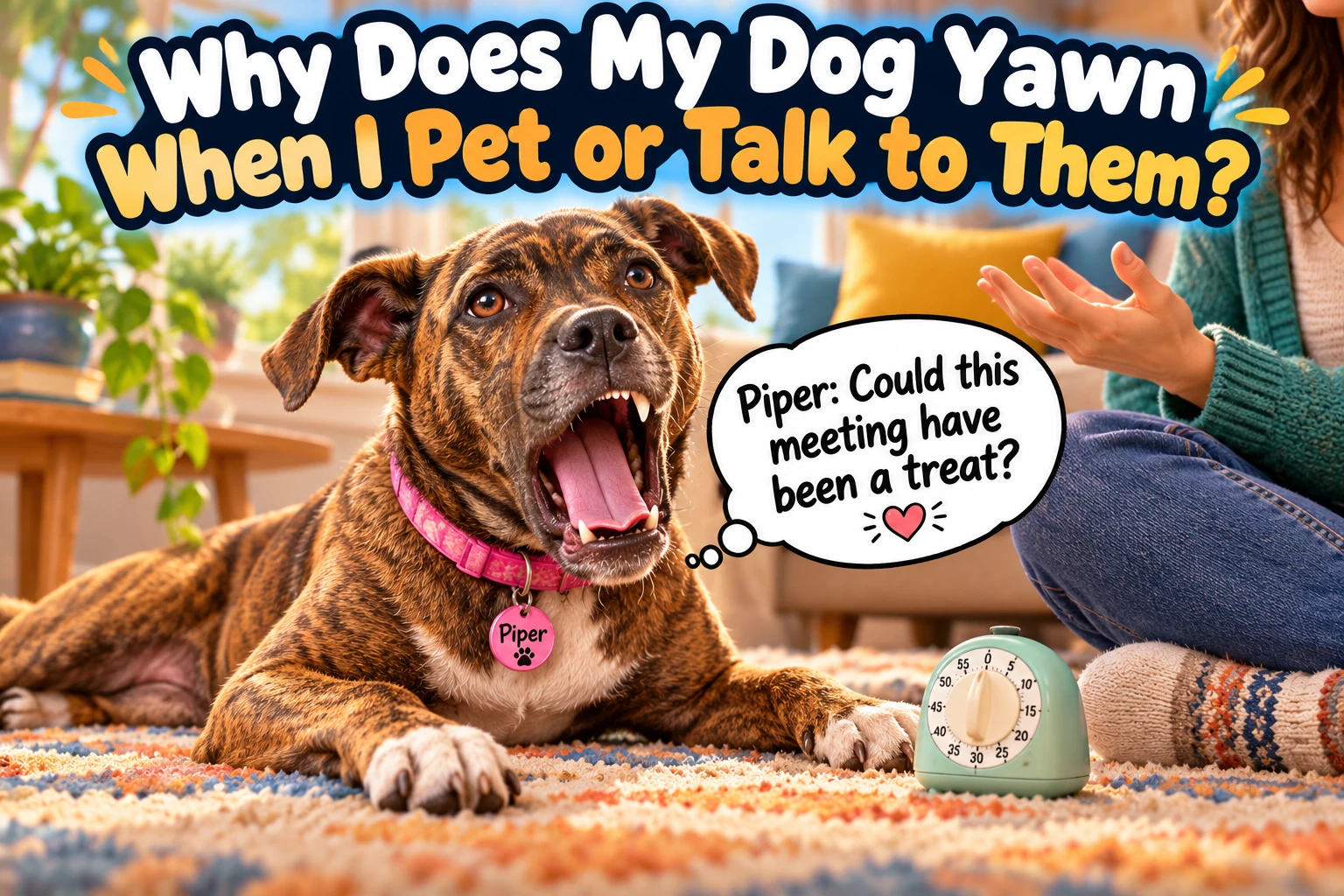
You are explaining your day to the only member of the household who has never interrupted you about the electric bill. Halfway through the story, your dog produces an enormous yawn.
Were they sleepy? Bored? Politely requesting that you stop?
Yawning can happen around tiredness, changes in activity, and emotionally charged or uncomfortable situations. One yawn cannot tell you which explanation applies. Look at the whole interaction and whether your dog chooses to continue it. [1][2]
Start with what happened just before the yawn
Compare these two scenes.
The couch nap: your dog has been asleep. You sit nearby, they stretch, yawn, and lean comfortably into your hand. The yawn fits a sleepy transition. It is still worth watching their response rather than assuming they want unlimited petting. [1]
The enthusiastic greeting: a visitor bends over the dog and hugs their neck. The dog turns their head, holds their body tensely, and yawns repeatedly. Here, the combination of context and other changes gives you a reason to stop the interaction and create space. You do not need to wait for a growl. [2]
A quick way to respond
| What happened around the yawn? | What to try |
|---|---|
| Your dog just woke, stretched, and stayed loose. | Allow a quiet wake-up; offer contact only if welcomed. |
| Petting or a visitor’s closeness came with turning away or tension. | Stop touch, give space, and leave a clear exit. |
| Training became repetitive or difficult. | Take a break or return to one easy, familiar task. |
| Yawning is new and frequent, with pain or other changes. | Describe the pattern to your veterinarian. |
Use these as practical responses to the whole situation, not a diagnosis from the yawn alone. [1][2][5]
Try a petting pause
If you are unsure whether your dog enjoys the contact, stop moving your hand and give them an easy opportunity to leave. Do not hold their collar or block their route while asking for a preference.
A dog who moves back into contact or nudges your hand may be choosing more interaction. One who turns away, gets up, or stays tense should have space. Stillness alone is not an invitation, and no single gesture provides a complete translation. AKC handling guidance likewise emphasizes willingness to engage and ending touch when a dog seems uncomfortable. [3]
For an ordinary example, imagine scratching your dog’s shoulder during television time. They yawn. You pause. They settle farther down the sofa. There is no need to follow them and resume petting; you have an easy answer about what to do next, even without proving the reason for the yawn.
Does yawning mean I am boring my dog?
It is a funny caption, but not a reliable conclusion. Your dog may be sleepy, responding to an interaction, or doing something whose precise mechanism we do not fully understand. VCA notes that yawning remains incompletely explained. [1]
You can enjoy the timing without taking it personally. Piper may look like she is reviewing your presentation skills, but the useful question is whether she is comfortable and free to choose another activity.
What if it happens during training?
Look at the task. Have you repeated a difficult cue many times? Is the room busy? Are you leaning over the dog or reaching quickly? Is the dog also turning away, slowing down, or having trouble engaging?
Reduce the difficulty and offer a break. Practise one familiar, easy behavior in a quieter setting, or end the session and try later. Reward-based training should help the dog succeed rather than increase pressure until the performance looks right. [2][4]
A simple example: if your dog has stopped responding during a long stay exercise, do not keep lengthening the stay because they completed it yesterday. Return to an interval they can comfortably manage. That is a training adjustment, not a diagnosis of stress from a yawn.
Is a contagious yawn proof of empathy?
It may be tempting to yawn at your dog and interpret a reply as a special bond test. Yawning research involves several competing explanations, and a home observation cannot establish a human-like emotional process. Likewise, a dog who does not copy you has not failed an affection exam. [1]
When should I mention it to the vet?
If yawning becomes frequent or unusual for your dog, note what else has changed. Difficulty opening or closing the mouth, drooling, altered eating, apparent pain, or repeated unusual mouth movements deserve veterinary advice. Breathing difficulty or collapse requires urgent attention; do not treat those signs as an exaggerated yawn. [5]
For a familiar yawn during petting, begin with the easy response: pause, watch, and let your dog choose. You do not need a perfect interpretation to make the interaction kinder.
Related reading
A shake-off after petting is another behavior that benefits from context. Our guide to dry-dog shake-offs explains what to watch before and afterward, and how to distinguish a quick whole-body shake from repeated shaking that needs a veterinarian.