
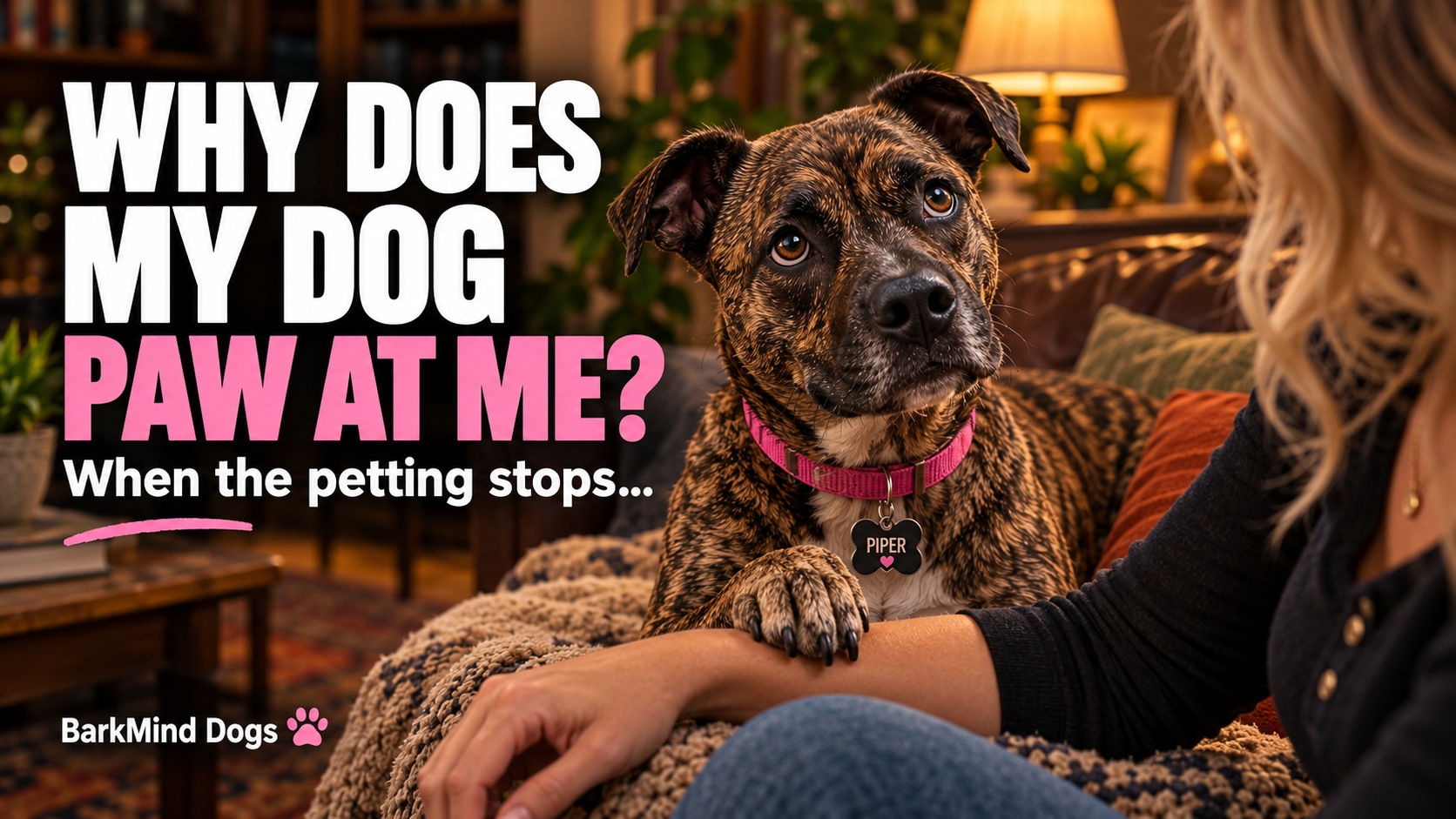
Your dog may have learned that a paw tap makes petting start again. If you stop, feel a paw and resume the ear rub, that little sequence can become a reliable way to ask for more. But a paw is not a word with one fixed translation. Look at the situation and the rest of your dog’s body before deciding what they want.[1]
You thought the cuddle session had ended. Your dog has submitted an amendment.
There is room for affection and boundaries here. You can enjoy a gentle request, check whether touch is welcome and teach a more comfortable way to ask if claws are becoming part of the conversation.
Why the tap keeps working
Imagine this ordinary pattern: petting pauses, your dog touches your arm, you smile and continue. If the dog enjoys that outcome, pawing may happen more often. At BarkMind, we might illustrate it as a trigger, a response and a rewarding result. The “interpretation” between them is a possible explanation—not a transcript of your dog’s thoughts. Our learning guide explains that distinction.
The AKC describes pawing as a possible request for touch, attention, food or an opportunity to go out. It also notes that uneasiness can accompany it. That is why the same movement deserves a different response in different situations.[1]
Try a pause, then let your dog choose
When your dog approaches comfortably and welcomes petting, offer a few gentle strokes, then stop. Notice whether they move closer and seek contact, stay comfortably nearby or move away. Ontario SPCA’s three-pet guidance recommends short interactions with pauses, watching throughout and stopping if the animal becomes uneasy.[2]
- Moves closer with a relaxed body: you can offer more gentle contact if you want to.
- Moves away or turns from the interaction: let the pause remain a pause. Do not follow to finish the cuddle.
- Seems tense, restless or conflicted: give space and look at what else is happening rather than interpreting the paw alone.
This is an invitation to observe, not a test your dog must pass. A wagging tail alone does not settle the question. Consider the whole body and whether the dog can comfortably leave.[3]
What if I need to stop?
You are allowed to finish a conversation, answer your phone or use your arm again. Check ordinary needs first: does your dog need a toilet opportunity, water, activity or help getting comfortable?
For a relaxed dog repeatedly asking for attention, make your response predictable. End petting calmly. At other moments, notice and reward the quieter version you would prefer: resting beside you, approaching with four paws down or settling on an existing comfortable spot. Plan some enjoyable interaction before the dog has to keep asking. SF SPCA recommends scheduled attention and reinforcement of settled behavior.[4]
Timing matters. If every paw tap immediately produces “go to your bed” and a treat, the dog may learn a longer routine that still begins with pawing. Practice the alternative during calm moments too. Keep the approach kind; humane training relies on rewarding useful behavior and managing the situation rather than pain or intimidation.[5]
When the paw deserves a different kind of attention
If the pattern starts abruptly, becomes persistent or accompanies other changes, speak with your veterinarian. If touch brings freezing, growling or snapping, stop and give your dog space. Do not keep petting to find out whether they will tolerate it. Changes in comfort and body language deserve consideration, not a label such as demanding or dramatic.[3]
Piper’s imaginary translation: “Your hand appears to be on an unauthorized break.” That is character humor, not a claim that every paw means the same thing.
Questions about that little tap
Is my dog petting me back?
It can feel that way, and you can appreciate the contact. The movement alone cannot establish the dog’s intention. Watch whether the pattern follows your petting pause and what happens when you respond.
Should I always ignore pawing?
No. First consider whether your dog needs something or seems uneasy. For a comfortable dog requesting optional attention, you can choose when to interact and reinforce a gentler alternative.
How can I reduce scratches?
Prevent rehearsing painful contact where possible, keep clothing or distance between claws and skin when needed, and reinforce another way to approach. Arrange appropriate nail care if necessary. Do not grab or pin the paw as a punishment.
Does it prove my dog loves me?
A familiar request can be a lovely part of your relationship. No single movement measures a bond. Enjoy the moment without needing it to prove more than it can.
If you like exploring those everyday moments, our dogs-feel-like-family article looks at the broader relationship. For this particular tap, the best answer starts close to home: pause, notice and respond to the dog in front of you.