
Why the sudden launch? Fast-moving wildlife can trigger a strong urge to chase, and chasing can be rewarding in itself. A recall practised in the kitchen may not work at that distraction level. Prevent the chase, notice the animal early, and practise turning away while your dog can still respond. [1][2]
The walk is going beautifully. Then a squirrel moves. Your dog becomes a launch sequence; you become ground support.
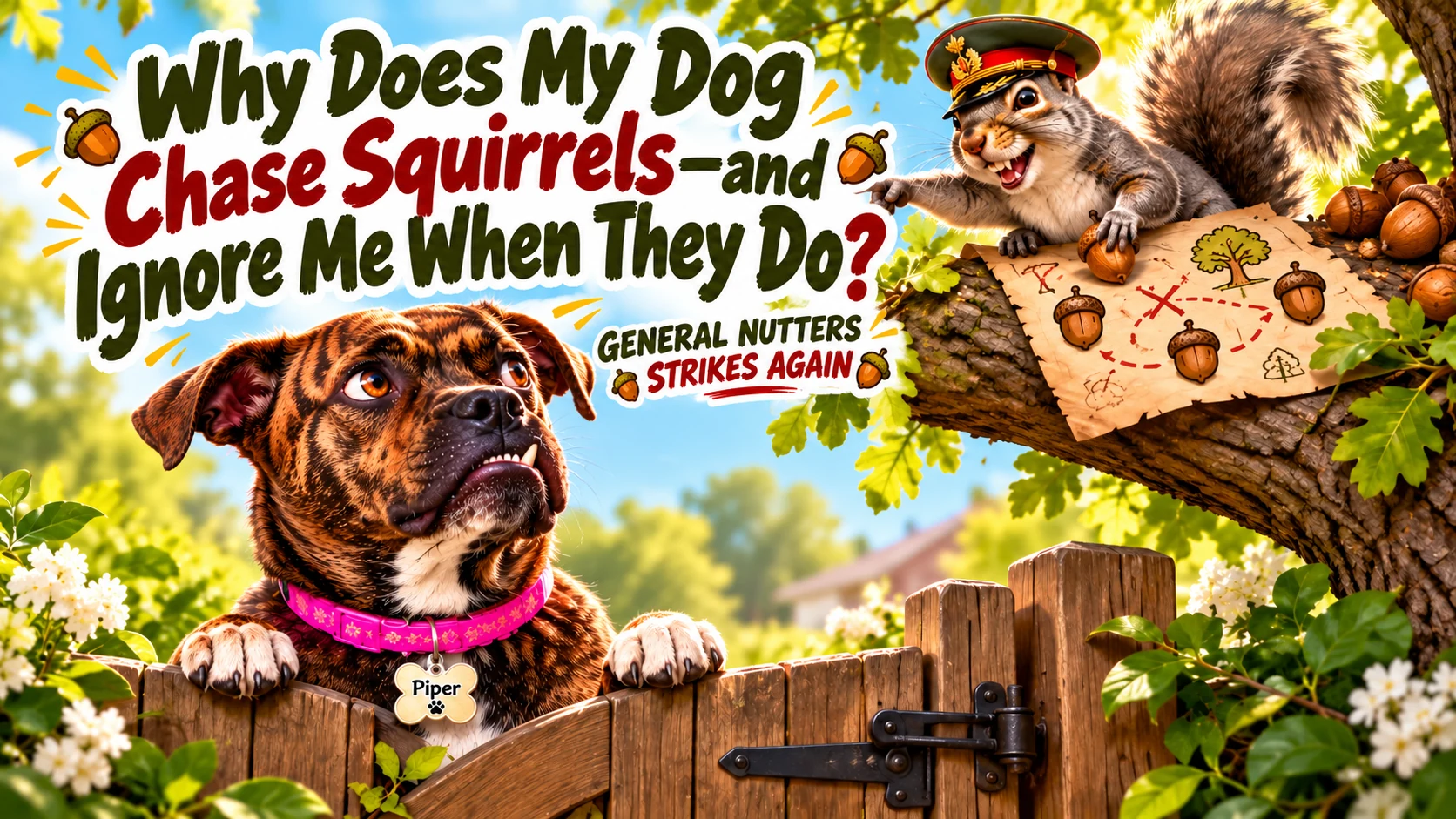
General Nutters considers every oak tree a military installation. He has no intention of cooperating with a training session. Keep your distance from real wildlife while you practise.
Find the moment before the launch
Look for a change from ordinary sniffing to focused watching: the mouth may close, the body may become still, and weight may shift forward. These observations together can warn that your dog’s attention is narrowing. They do not guarantee what happens next. The practical test is whether the dog can still turn with you and respond to a familiar cue without a struggle. [2]
Choose quieter routes and keep enough distance that you can notice these changes. Do not deliberately move toward a squirrel to see how close your dog can get before reacting.
Walk through one early sighting
Practise a turn cue in a quiet place first. Now picture a squirrel on a distant tree: your dog has noticed, but has not lunged.
- Check your exit. Notice a clear route away from the tree, traffic, other dogs, and people. Keep hold of the leash with enough control to guide the turn without a jerk.
- Use the familiar cue once. Say this way and begin a comfortable turn away. Mark the moment the dog turns their head and body with you.
- Reward in the direction of safety. Deliver a small reward beside you, away from the squirrel. Continue walking away and reward another step with you. Do not stop feeding directly under the tree while the dog winds up again.
- Increase distance. Stop farther away, where the dog can resume ordinary movement and respond more easily. If a moving squirrel makes that distance too difficult, leave the area.
There is no single right distance. You need enough room for your dog to notice the squirrel and still turn with you; if that becomes difficult, move farther away. [1][2]
If the turn does not happen
Do not stand beside the tree repeating the cue and offering increasingly frantic treats. You may already be too close. Safely guide the dog away, use a visual barrier such as a parked vehicle if accessible, and try an easier location later. Food that works indoors may not compete with an imminent chase.
Practise the turn in a quiet space: say the cue, move away, and reward following you. Only add more distraction when the easier version is comfortable. Reward-based recall practice builds useful skills, but a recall remains a safety support rather than permission to test an unready dog around wildlife. [1][3]
Equipment and handling need to fit this particular dog
Use a properly fitted harness and a secure leash you can handle. Check the fit, attachment, and condition before leaving. If you cannot safely hold the dog during a lunge, choose safer management and obtain hands-on professional help.
A long line can provide exploration space in an appropriate open area, but it needs learned handling. Attach it to a suitable harness rather than a neck or head collar; a dog hitting the end at speed can be injured. Avoid places where the line can catch people, dogs, or obstacles. Practise managing slack and slowing the dog with a qualified professional before using it around intense distractions. Do not tightly coil a line around your hand or body. [1][4]
Give chasing instincts an appropriate outlet
Suitable games in a secure area can provide a legal outlet without involving wildlife. Choose activities your dog can pause and enjoy safely, and include breaks. For a dog who remains highly focused on animals, a qualified behavior professional can help build a realistic plan rather than promising to erase their interest. [1]
Your next step is to practise one easy turn before the next wildlife encounter. General Nutters has enough responsibilities without setting your training difficulty.
Watch the related video on YouTube
Keep exploring
Sources and further reading
- Dogs Trust behavior team: preventing wildlife chases and harness/long-line management
- Battersea behavior guidance: managing chase behavior and distractions
- Woodgreen behavior team: recall practice for dogs who chase
- Battersea: using and handling a long-line lead
- Blue-9: Balance Harness product and fit guidance