
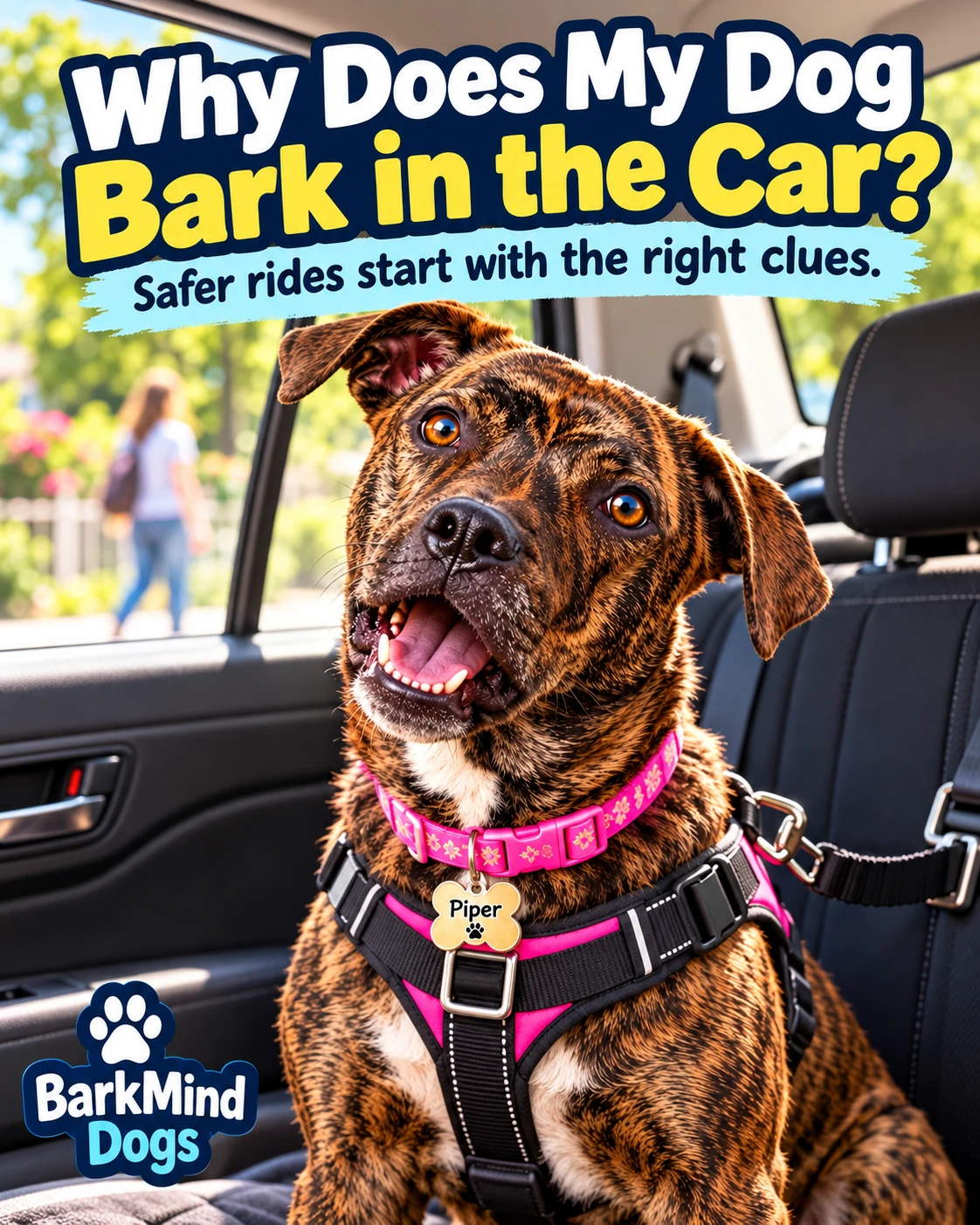
A dog may bark in the car because of excitement, things passing the windows, frustration, fear or travel-related discomfort. Several can happen together. Notice when the barking starts before deciding what to change. If it distracts you from driving, pull over somewhere safe rather than trying to train from the driver’s seat.
Piper’s imaginary vehicle-announcements department has one employee and no volume control. In real life, a noisy back seat deserves a practical plan, starting with safety and comfort.
First, make the ride safe
Keep your dog secured in the back of the vehicle with a suitable travel harness or properly secured crate, fitted and installed according to its instructions. Choose equipment with independent crash-test evidence where possible; a walking harness, seat cover or ordinary dog bed is not automatically a crash-protection system. Keep the dog out of the driver’s lap and away from front airbags, and keep their head inside the window. AVMA travel guidance and Cornell’s travel-safety guide explain these precautions.
The driver drives. Arrange practice while parked, or have another adult handle observation and rewards during a suitable short journey. Never reach behind you, turn to film, feed treats or adjust equipment while driving. Do not leave a dog alone in a parked car.
What happens immediately before the barking?
The timing gives you a starting hypothesis, not a diagnosis. VCA’s travel guidance describes triggers ranging from entering the car and restraint to engine noise and movement.
| What you observe | What it could suggest | A useful first response |
|---|---|---|
| Barking starts when the keys appear or near a familiar destination | Anticipation or arousal; worry is also possible | Practise a much smaller part of the departure routine without immediately taking a trip |
| Barking follows pedestrians or dogs past the window | Visual triggers, frustration or fear | Choose quieter routes and reduce the dog’s view safely |
| Barking starts with the engine or movement, with drooling, lip licking or vomiting | Travel anxiety, nausea, or both | Contact your veterinarian before increasing practice |
| The dog struggles as the harness is fitted or avoids getting in | Fit, handling discomfort, pain or a learned association | Check equipment and discuss new discomfort with your veterinarian |
| Barking begins after a long stretch of travel | An unmet break need or growing discomfort may be involved | Stop safely for a planned water and toilet break |
One sign is rarely enough. A wagging tail does not establish that the whole experience is enjoyable. Conversely, a few barks do not by themselves prove an anxiety disorder or an intention to protect you.
Use Trigger → Interpretation → Response → Reinforcement
Write a short record after the trip, when the car is safely parked. Treat Interpretation as a possibility you can revise.
- Trigger: What changed just before the bark—keys, harness, engine, movement, a cyclist, slowing near the park?
- Interpretation: What fits the pattern? Note observable signs instead of writing “he hates the car” as a fact.
- Response: Make the next setup easier, check comfort and keep the driver free to concentrate.
- Reinforcement: Practise and reward a useful response at a difficulty the dog can manage, such as resting on their travel mat or briefly looking back to a passenger.
For example, suppose Piper stays loose and quiet while parked but barks whenever a dog walks close to the closed window. That pattern makes passing dogs a useful training target. It does not establish whether she wants distance or a greeting. Start farther from passing dogs rather than testing her at a busy dog-park entrance.
Build comfort in small steps
Choose a safe, cool location. If the dog cannot comfortably approach the vehicle, begin outside it; do not lift or lure them into a situation they are trying to escape. A veterinarian or qualified reward-based professional can help with severe avoidance.
- Find an easy starting point. This might be looking toward the parked car, voluntarily approaching an open door or sitting briefly in the secured travel setup. Keep the vehicle stationary and safely ventilated.
- Pair that easy moment with something pleasant. Offer a small familiar reward if the dog can eat comfortably, then allow a break. Food is optional; it is not a way to hold a distressed dog in place.
- Change one feature at a time. Closing a door, starting the engine and moving are separate challenges. Return to an easier step if the dog stiffens, tries to escape, becomes persistently vocal or cannot settle.
- Add very short movement only when ready. A tiny comfortable trip is more useful than repeatedly completing a route that overwhelms the dog. There is no required seven-day timetable.
- Keep everyday journeys manageable. When travel is unavoidable, ask your veterinarian how to make that journey more comfortable rather than using it as an intense training session.
For visual triggers, a safe shade or a different secured position may reduce the view. Do not obscure the driver’s visibility, block ventilation, cover a dog who becomes distressed under a cover, or remove their restraint. A covered crate helps only if the dog is comfortable in that crate.
If your dog barks at people or other dogs
Begin while parked in a quiet place, at enough distance that your dog notices the trigger without escalating. A passenger can pair a brief sight of a distant person with a small reward, then let the dog look away. Reward voluntary check-ins too. Do not wait for an explosion before trying to work.
If barking starts, reduce the difficulty: leave the setup safely or move farther away. Do not keep a person walking closer to “teach the dog it is harmless.” Comfort and safety take priority over withholding a reward after a bark. Work on the pattern with a professional if you cannot find a manageable distance.
Related situations have different setups: see barking at people outside the house window and barking at dogs on walks. A car adds motion, restraint and driver distraction, so a house-window plan cannot simply be copied into a moving vehicle.
What if the barking starts near the park?
If your dog otherwise travels comfortably, practise an easy waiting routine at home and beside a parked car first. Reward a brief, relaxed pause before the next departure step. At arrival, park safely, secure the leash before opening an exit and manage the door so the dog cannot bolt. Do not unclip the travel restraint until another safe restraint is in place.
Shorten the challenge if waiting produces frantic barking. Avoid turning every arrival into a prolonged test of silence. The aim is a safe, repeatable transition that your dog can succeed at.
Check for nausea and seek help early
VCA’s motion-sickness guidance lists drooling, lip movements, restlessness and vomiting among possible signs. Anxiety and nausea can overlap. Bring the timing of symptoms to your veterinarian; a dog can need medical help as well as behavior support.
Do not start human travel medicines, sedatives or supplements without veterinary advice, and ask for individual instructions about feeding before travel. A puppy, dog with diabetes or dog taking medicines may have different needs from another traveler.
Arrange veterinary advice for new travel distress, repeated nausea, difficulty getting into the car or discomfort with restraint. Ask about a board-certified veterinary behaviorist when panic, escape attempts or aggression make travel unsafe; the ACVB directory can help locate one. Acute collapse, breathing difficulty or suspected overheating warrants urgent veterinary care.
Common questions
Should I ignore barking in the car?
Not as a blanket rule. First check safety, nausea, fear and practical needs. For an established excitement-related routine, you can teach a relaxed alternative before the barking begins. Ignoring a dog does not treat motion sickness.
Will more rides fix it?
Only comfortable, appropriately gradual practice is useful. Repeated difficult journeys may strengthen a bad association. Let the dog’s response determine the next step.
Will a bark collar help?
It does not resolve the underlying travel problem. BarkMind follows AVSAB’s reward-based training guidance: avoid shock, spray, startling and physical corrections. Seek an individual plan if everyday management is insufficient.
What should I measure?
Record the trigger, route, duration, body posture, nausea signs, ability to settle and recovery after a trigger. Fewer barks alongside better comfort is more informative than silence alone.
Keep exploring with Piper
Start with Why Dogs Bark, environmental triggers and How Dogs Learn. If the increase is new in several settings, read Why Has My Dog Suddenly Started Barking More?.
Sources and scope
The linked AVMA, Cornell, VCA, AVSAB and ACVB resources support the safety, clinical and training guidance. Examples are illustrative, not reports of observed Piper behavior or clinical cases. This guide offers education and practical observation, not an individual diagnosis.