
Dogs may bark at other dogs on walks because they are worried, frustrated, excited, or struggling with a mixture of feelings. Leash restriction can make an encounter harder. Start by creating enough space to leave safely, rather than arranging a greeting to find out which explanation is right. [1][2]
You round a corner, another dog appears, and your quiet companion becomes the loudest participant on the sidewalk. Being friendly in another setting does not make that moment easy for either dog.
Why the leash changes the situation
A leash limits choices. A dog who wants to approach may become frustrated; one who wants distance may feel unable to avoid the encounter. Woodgreen and the ASPCA describe both patterns. Noise alone cannot reliably separate them. [1][2]
This article concerns reactions to other dogs, rather than ordinary pulling toward an interesting smell. Keep that distinction in your notes. “Pulled toward grass” and “froze when a dog appeared” are different events even if both tighten the lead.
A sudden change also warrants a veterinary check, especially if discomfort or reduced movement may be involved. A behavior plan should take the whole dog into account. [1]
Your sidewalk encounter plan
Before heading out, choose a route with visibility and places to turn. Avoid a narrow passage if you cannot create space there. Check that your walking equipment fits and that you can manage your dog safely.
When you notice another dog, use the space available: change direction, cross only when traffic permits, or step behind a suitable visual barrier. Keep moving if standing still makes things harder. Dogs Trust recommends distance and routes with options rather than forcing close encounters. [3]
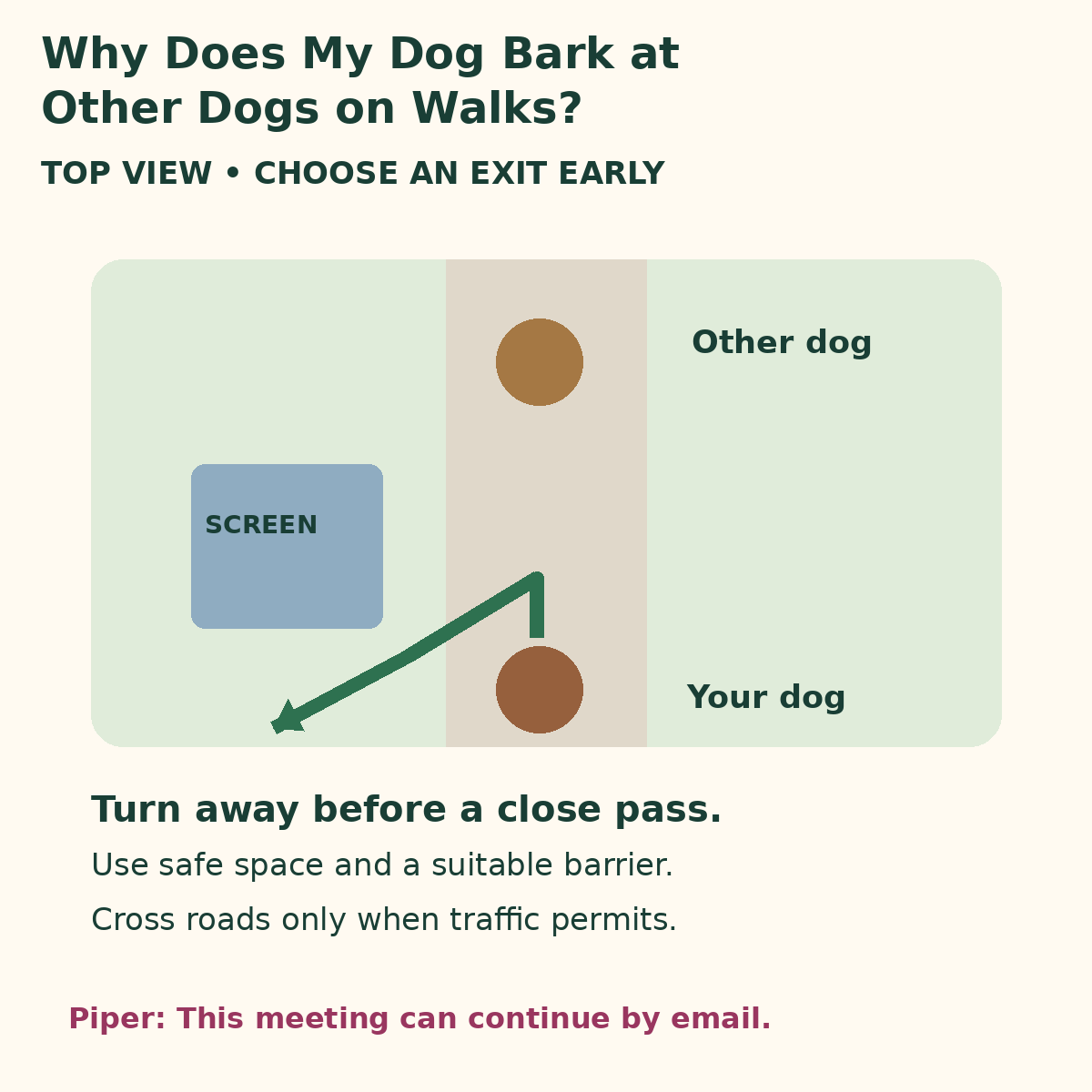
Route sketch: a wide path splits before a narrow section. The approaching dog continues along one route; your route turns away behind a parked vehicle or solid screen. Neither dog needs to pass nose to nose. The diagram shows an option, not a promise that every road crossing or parked car is safe.
What to practise before the surprise corner
Practise a cheerful turn-away cue at home and on empty stretches of path. Reward moving with you. It should be a familiar action, not a brand-new instruction shouted during a lunge.
At a manageable distance from another dog, reward comfortable attention and turning back toward you. Professional guidance can help set the distance and progression. If your dog is already struggling, move away; do not withhold an exit until they stop barking. [2][3]
For example, if the other dog is across an open field and yours can notice, turn away, and resume sniffing, you have useful information about an easier setting. Use that easier setting as a starting point, and adjust to the space available on each walk.
If treats or cues stop working
Food refusal can be a clue that this setup is too difficult, though appetite and food choice also matter. Looking away, recovering after the dog passes, and moving comfortably are useful observations alongside eating. Do not treat taking food as proof that the dog feels fine.
Create space first. Avoid forced greetings, leash corrections, and repeated close passes intended to make the dog “get used to it.” The ASPCA’s guidance emphasizes working below an overwhelming level rather than flooding. [2]
Track distance and recovery
After an ordinary encounter, record: where the other dog appeared; available space; what your dog did first; your exit; and how long it took to resume normal activity. Approximate descriptions such as “across the street” are adequate when you cannot measure safely.
Keep others out of the experiment. Do not borrow an unsuspecting dog as a practice target or ask a stranger to stand still while yours struggles.
For repeated reactions, bite risk, or difficulty maintaining control, ask your vet about qualified reward-based behavior support. A shorter, quieter route with an easy exit is a useful next step while you arrange help. Piper’s fictional town-hall meeting does not need an audience.