
Your dog flops onto the rug, feet in the air. Naturally, you reach for the belly. Then they turn away, get up, or give you a look suggesting that you misunderstood the invitation.
An exposed belly is not automatic permission to touch. Dogs roll over in different situations, including relaxed social contact, play, and interactions they find uncomfortable. Look for a loose body and willing engagement, and let your dog move away. [1][2]
Look at the approach, not just the position
A dog who walks over, rolls loosely beside you, and moves back toward your hand after a pause presents a different picture from one who rolls over as a person bends over them.
In the second scene, the dog may be trying to reduce social pressure rather than request more handling. A tense body, tucked tail, turning head, or repeated attempts to move away give you a reason to stop. Do not treat any one feature as a foolproof translation; the setting and combination matter. [1][2]
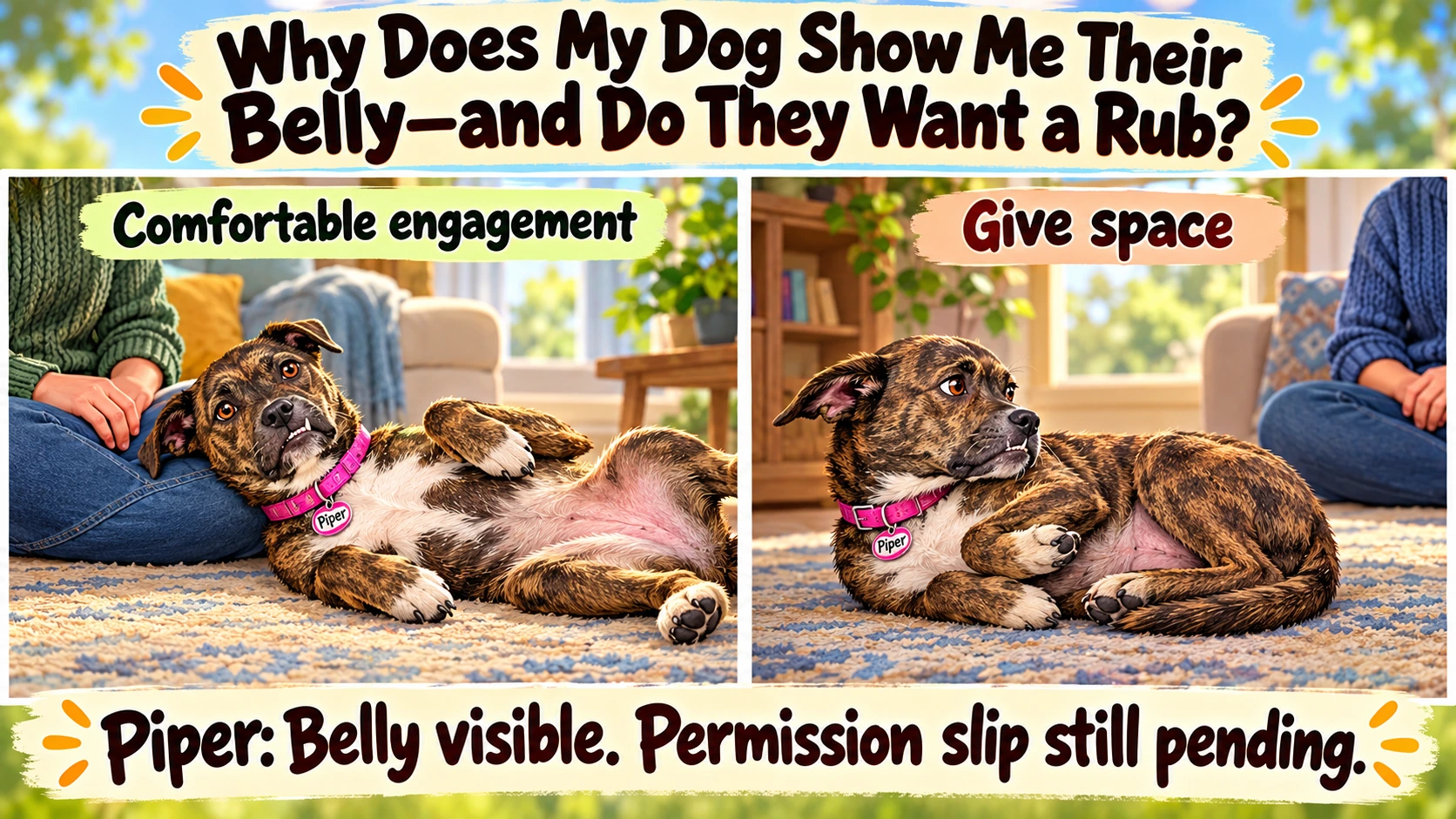
The left illustration shows Piper lying on her side with legs resting apart and a person nearby; the right shows her legs drawn closer and her head turned away. A still pose cannot show how she approached or whether she wants more contact. Watch what happens before touch and after you pause, and allow space whenever you are unsure. [1][2]
A simple contact check
For a familiar dog who comfortably approaches you, start with gentle contact in a place they usually enjoy, such as the chest or shoulder. Keep it brief, then pause. If the dog chooses more contact, you can continue while watching their comfort. If they turn away, stiffen, or move off, stop. Never roll a dog onto their back to start the exercise. [1]
Imagine that your dog rolls over beside your chair. You scratch their chest, pause, and they shift farther away. You have not failed to provide a sufficiently impressive belly rub. They have given you useful information about what to do next.
Children need active adult guidance around these interactions. They should not climb on, hug, corner, or investigate the belly of a resting dog. With an unfamiliar dog, there is no need to test whether a belly rub is welcome. Give them space. [2]
But my dog kicks their leg—isn’t that approval?
A kicking leg can be a scratch reflex. It is not a dependable pleasure meter. Look at whether the dog remains comfortable and freely engaged rather than rubbing harder to reproduce the movement. A reflex and a preference are different things. [3]
The same principle applies to a wagging tail. A moving tail does not cancel a tense body or an attempt to leave. You are watching the dog, not collecting one sign that lets the petting continue. [2]
Why roll over and then growl?
The dog may not have wanted that contact, may have become uncomfortable, or may be reacting to pain. Stop touching and create space. Do not punish the warning or try again to see whether it was serious. A growl deserves a safer setup, particularly around children. [2][4]
If this reaction is new, happens around a particular part of the body, or comes with other changes, arrange veterinary assessment. Do not press on the belly to locate the sore spot yourself. Your description of when it happens is useful; repeated provocation is not. [4]
Do all dogs like belly rubs?
No. Some prefer a shoulder scratch, a game, or simply resting near you without hands involved. Even a dog who usually enjoys a belly rub may not want one while tired, busy, or uncomfortable. Respecting that preference does not weaken the relationship. [1]
You can learn your dog’s ordinary patterns without making them accept every kind of touch. Necessary veterinary handling is a separate skill that can be taught with professional guidance; it is not a reason to insist on recreational belly rubs.
What should I do the next time they flop over?
Take a moment before reaching. Did your dog choose to approach? Do they look comfortable? Can they move away? If gentle contact is welcome, pause again before turning it into a long session.
Next time, give your dog a pause before offering more contact. Sometimes the best company is letting them enjoy the rug while you keep your hands on your own coffee cup.