

A long walk can leave a dog physically exercised but still alert, excited or uncomfortable. Restlessness afterward does not automatically mean they need another walk. Look at what happened outside, how comfortably they are moving, and whether home offers an easy transition into rest. A sudden or unusual inability to settle deserves veterinary attention.
Piper’s fictional position is that coming home should not end the sightseeing. The window, the hallway and your shoelaces might all have breaking news. With a real dog, the useful question is what changes between the walk and the moment they finally relax.
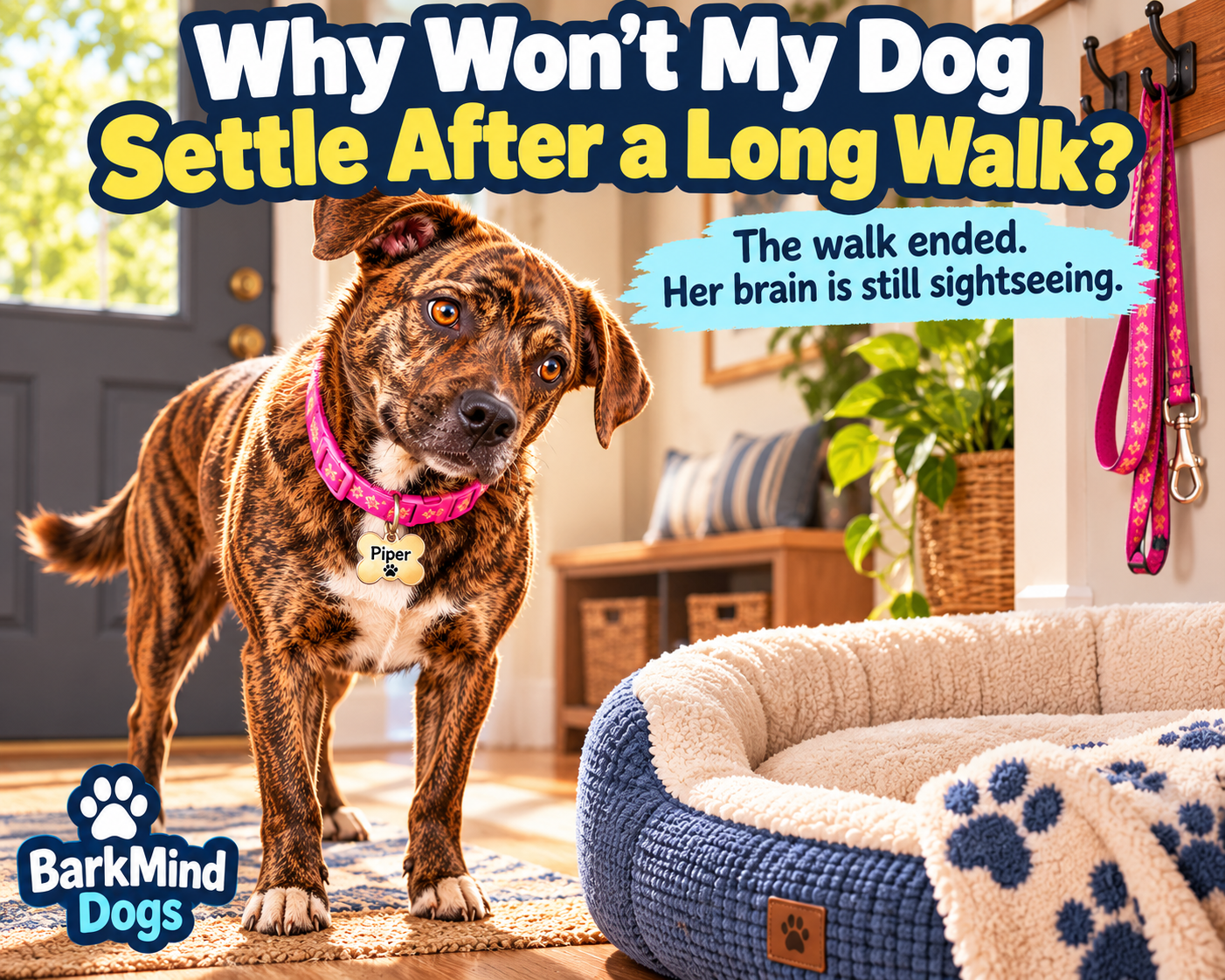
A tired body and a busy brain can arrive home together
Walking involves more than distance. A quiet familiar route, a crowded pavement and a session of repeated ball chasing can produce very different experiences. Dogs Trust describes both insufficient suitable activity and excessive stimulation among possible contributors to restlessness. More is not always the helpful adjustment.
A dog who encountered several barking dogs may keep scanning after the lead comes off. Another might return comfortably, then start bouncing because every arrival home leads to a lively game. A third may be pacing because movement hurts. Those situations can look similar from the sofa but need different responses.
Use “overstimulated” as a possible description of the situation, not a diagnosis. Panting, pacing, lip licking or difficulty disengaging need context; any one sign cannot tell you exactly what your dog feels.
Start with a comfortable arrival
Choose a calm moment to remove walking equipment safely. Offer access to fresh water and a comfortable resting area, and reduce immediate demands. If the dog needs a toilet opportunity, address that rather than repeatedly asking for a down.
Give them room to choose a comfortable position. Avoid holding them on a bed, shutting them into a crate they find distressing, or insisting that a still body proves relaxation. A familiar bed can be available without becoming a test they must pass.
If there are signs of pain, unusual breathing or illness, skip the training experiment and get appropriate veterinary help. A dog who accepts food may still be uncomfortable.
Record the transition, not just the mileage
For an otherwise well dog, a few ordinary observations can make the pattern clearer. You do not need to provoke the behaviour or delay care to finish a diary.
| When | What to notice |
|---|---|
| During the walk | Route, encounters, chase games, opportunities to sniff, and anything unusually exciting or worrying. |
| At the door | Comfortable movement, panting in context, equipment removal and the household’s greeting. |
| Once inside | Pacing, scanning, grabbing toys, seeking contact, choosing water or a resting place. |
| As things quieten | Whether breathing and movement return toward the dog’s usual pattern and whether they can rest voluntarily. |
A useful note is concrete: “Busy route with two close dog encounters; paced by the window after coming home; rested after the curtains were closed.” That suggests a next observation. It does not prove that every future restless episode has the same cause.
Try one small change on the next suitable walk
If the dog is comfortable and the pattern is familiar, change one manageable feature. A quieter route may tell you more than adding another mile. Where appropriate, replace some repetitive chase play with unhurried sniffing and walking suited to your dog’s needs.
At home, lower the volume of the arrival. Put the lead away, leave the bed accessible and allow a pause before offering another activity. If passing movement at a window keeps restarting the excitement, choose a quieter resting location or reduce that view.
Woodgreen’s guidance on sensory overload emphasizes looking at the whole day, including rest and repeated stimulating activities. The aim is a day the individual dog can manage, not a universal exercise or sleep timetable.
Quiet chewing or a simple food activity can suit some dogs, provided the item is safe for that individual and used with appropriate supervision. Watch the result: if the activity produces frantic searching, frustration or guarding, it is not serving as a helpful wind-down. Plain rest is also an option.
Do I need to teach a settle cue?
A comfortable mat and reward-based practice can help a dog learn that resting near you is worthwhile. Begin at an easy time when the dog is already able to relax, rather than introducing a difficult lesson immediately after an overwhelming outing. Reward calm choices without turning every second on the mat into another exciting task.
VCA recommends reducing exposure to a stressor and avoiding demands that increase distress. If your dog cannot respond to a familiar cue, make the situation easier instead of repeating it more loudly. Persistent difficulty is a good reason to seek a qualified reward-based behaviour professional, alongside veterinary assessment where needed.
When restlessness needs a medical check
Contact your veterinarian for a new or persistent change, especially when it comes with limping, sensitivity to touch, reduced appetite, unusual thirst, disturbed sleep or difficulty getting comfortable. Mention whether it follows every walk or only particular conditions.
Seek urgent veterinary help for collapse, breathing difficulty, severe distress, or repeated unsuccessful attempts to vomit with a swollen abdomen. Do not assume that pacing after exercise is simply surplus energy.
Common questions
Should I walk my dog again until they are tired?
Do not automatically add exercise to a dog who is already struggling to settle. Check comfort, the intensity of the outing and the home environment first. Your vet can help tailor activity when age, health or pain may be involved.
Why do some walks lead to better rest than others?
The route’s sights, sounds, encounters and activities may differ even when the distance is similar. Your observations can help you find a manageable pattern; they cannot diagnose a medical or behavioural condition by themselves.
Is this the same as nighttime zoomies?
Not necessarily. This article follows the transition immediately after walking. For a pattern centered on the evening, see nighttime zoomies. For overall sleep and changes in awake interest, see why dogs sleep so much.
For your next comfortable, ordinary outing: notice the encounters, make arrival calm and watch what your dog chooses. The next useful adjustment might be less excitement at the doorway, rather than another lap of the neighbourhood.