

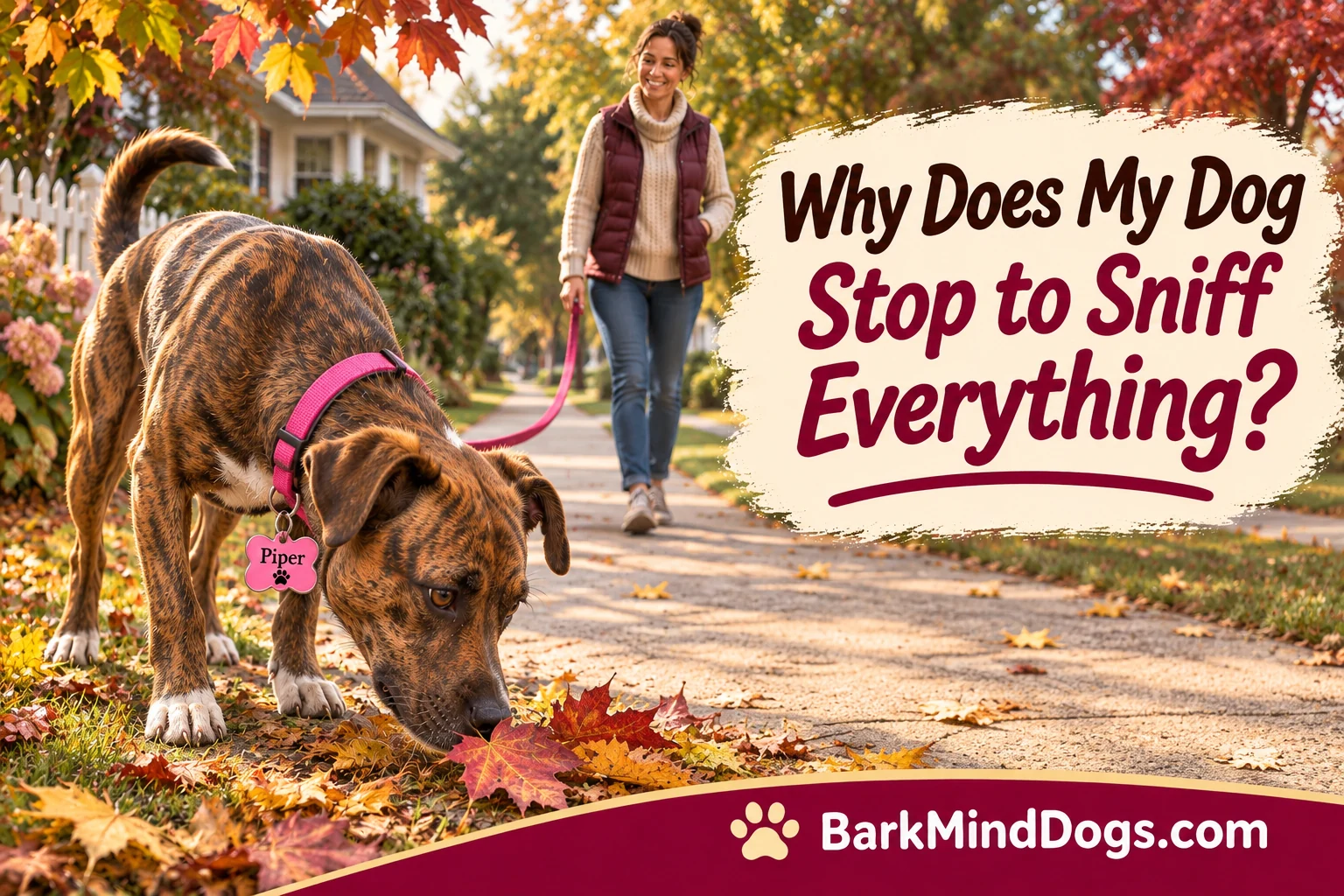
Your dog often stops to sniff because scent is an important way to explore the world. A familiar path can hold new information from other animals and passing activity. Frequent pauses are not automatically stubbornness. The useful question is whether your dog looks comfortable and can move on, or seems worried, sore, or unable to settle.
Piper has a clear position: “My Human calls this the same sidewalk. I call it the morning edition.”
A walk has more than one purpose
VCA describes sniff walks as a form of mental enrichment: the outing makes room for investigating scents rather than focusing only on speed or distance. You can offer both exploration and movement within the same walk. Read VCA’s explanation of sniffing walks.
There is no useful universal exchange rate between minutes of sniffing and minutes of exercise. A short scent outing does not automatically meet every dog’s movement needs. Age, health, weather, and individual preferences still matter.
Try asking a different question at the start: “What can this dog comfortably enjoy today?” That is more helpful than deciding the entire walk has failed because a lamppost required a second reading.
Plan a route with room to investigate
Choose a quiet, safe stretch where you can stop without blocking others. Allow slack in the leash where conditions permit. Stay away from traffic, discarded food, sharp litter, and recently treated areas. Sniffing is an opportunity to explore; it is not permission to eat an unknown object.
| Part of the outing | Your job | Your dog’s opportunity |
|---|---|---|
| A safe, quiet patch | Pause and watch the surroundings. | Explore a few interesting scents. |
| A narrow or busy section | Use a practiced cue and keep a comfortable distance from others. | Travel with you, earning rewards for an easy leash. |
| Another suitable sniff spot | Release with a consistent cue such as “go sniff.” | Return to exploring. |
This is a planning example, not a required ratio or timed training protocol. On a busy morning, choose a shorter route with a few real sniff opportunities. On a quieter day, allow more wandering within safe boundaries.
Teach “let’s go” where it is easy
The American Kennel Club suggests using sniffing as a reward for loose-leash walking and teaching a cue that gives permission to investigate. That makes scent part of the walk instead of a constant argument. AKC’s guide to sniffing describes this approach.
Begin in a quiet place with a low-interest scent. Say your chosen transition cue once, invite your dog to turn toward you, and reward the turn or first few comfortable steps. Then allow another sniff. Practice before expecting the cue to work at the most fascinating tree on the block.
If the cue does not work, avoid repeating it louder and louder. Make the situation easier, create space from distractions, and reward a smaller response. For a dog who pulls hard, start with our separate guide to leash pulling.
Sniffing, worry, and discomfort can look similar at first
A relaxed dog exploring a scent and then resuming the walk presents a different picture from a dog who freezes near every passing vehicle. Look at the entire body and setting. Does the behavior change in a quieter location? Is your dog limping, slowing down, or reluctant to leave home? Does the nose go down mainly when another dog approaches?
These observations can guide the next step, but sniffing alone cannot diagnose anxiety or pain. If the change is sudden or accompanied by limping, unusual fatigue, or reluctance to move, arrange a veterinary check. Stop the outing and seek urgent help for collapse or difficulty breathing. Our guide to refusing to walk covers a different question from ordinary scent exploration.
Try a simple comparison on your next outings
Choose two familiar, safe routes: one quieter and one busier. Without forcing either walk, record whether your dog explores with a loose body, accepts familiar rewards, and resumes walking comfortably. Note the conditions too. Heat, traffic, and a crowded sidewalk can change the experience.
Use what you observe to choose an easier route and realistic expectations. This is a practical observation exercise, not a scientific test or a way to label your dog.
Should every walk be a sniff walk?
There is no fixed schedule every household must follow. AKC’s sniff-walk guidance supports including scent opportunities in ordinary outings. You can also keep some stretches focused on movement when that suits your dog and surroundings.
For more help putting the pieces together, explore How Dogs Learn and BarkMind’s Behavior Guides. A walk can have a destination and still leave time for the neighborhood news.