

Dogs sometimes learn that barking brings attention, play, food, or an opened door. To change that pattern, meet your dog’s needs, notice quiet requests, and teach a clear alternative before barking starts. Do not assume every bark directed at you is a demand.
Piper has a wonderfully efficient announcement system. The challenge for the human is working out whether the announcement means “I need help” or “that worked yesterday.” This guide focuses on attention barking while you are present, rather than alarm barking or distress when alone.
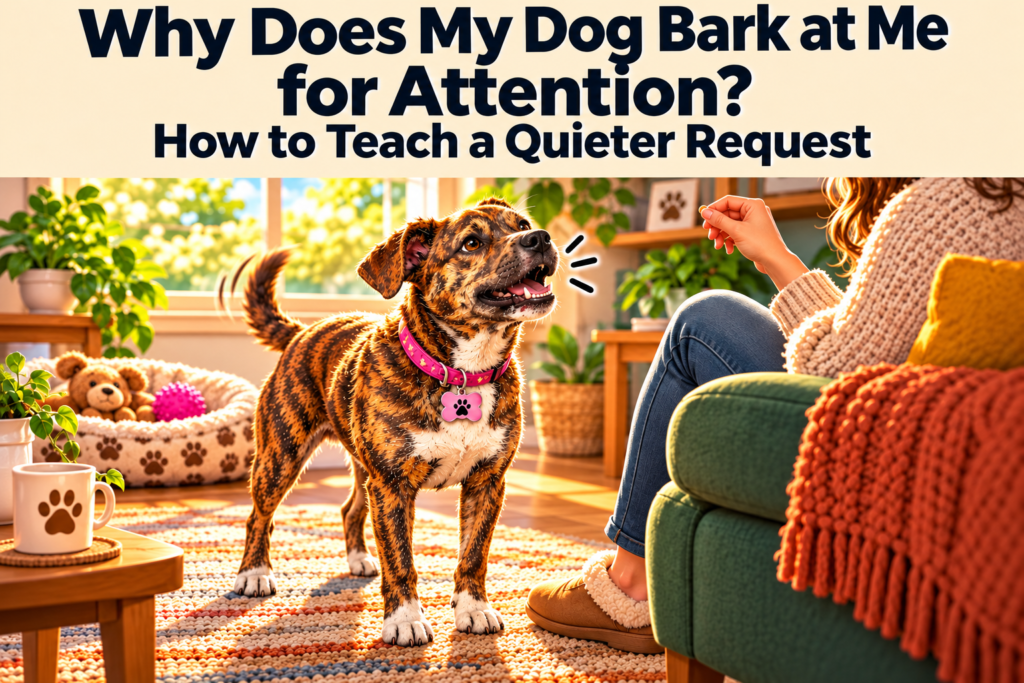
Is it attention barking—or a need you should answer?
Look at what happens before and after the barking. Does your dog face you when play stops, then settle when the game resumes? Does the barking reliably begin when you sit down to work? Those patterns suggest a learned request. A simple note—what happened, what your dog did, what you did next—can be more useful than guessing from the sound.
First check water, toilet needs, food routine, comfortable temperature, and opportunities for activity and rest. A dog who is hurting, frightened, or unable to settle needs help. New or unexplained vocalizing, especially with changes in movement, appetite, or sleep, deserves a veterinary conversation. Our guide to whining when nothing seems wrong covers that wider question.
Why talking back can keep the conversation going
The UC Davis veterinary behavior guide explains that a desired response can strengthen learned barking. From your dog’s perspective, a lecture may still be attention. That does not make your dog manipulative or mean you caused the problem deliberately; it tells you what to change.
Imagine a dog who barks beside the toy basket. On Monday you throw a ball. On Tuesday you say “enough” several times and eventually throw it. The details differ, but barking still led to the game. The new lesson needs to be equally clear: a quiet, easy request starts the fun.
Teach the request you want to see
Practice before the difficult moment. In a calm setting, reward a brief quiet sit or a relaxed pause near you. Use attention or a short game when that is what your dog wants; every reward need not be food. Keep the first attempts easy and stop while your dog can succeed.
Catch the early opportunity. If barking usually begins five minutes into a phone call, arrange a suitable activity before the call and acknowledge calm behavior along the way. Do not wait for an eruption to make your dog’s day interesting.
Be consistent without being rigid. For a clearly learned attention bark after needs are met, avoid launching the requested game during the barking. Respond to quiet and the alternative behavior you practiced. If the sequence becomes bark–pause–treat over and over, shift more rewards to calm moments before any bark and simplify the situation.
When ignoring is the wrong plan
A dog barking in panic at a noise, struggling behind a barrier, or becoming increasingly distressed needs a different approach. The ASPCA’s barking guide separates several motivations. Fear is not something to wait out with a blanket “ignore it” rule. Our separation anxiety and boredom guide addresses barking during absence.
Avoid shouting or punishment. If the pattern persists, a qualified reward-based trainer can help identify what is maintaining it. Seek veterinary behavior support when anxiety, pain, or aggression may be involved.
What progress can look like
Track quieter approaches, easier settling, and fewer interruptions in a specific situation rather than expecting a silent dog. Make one household plan so a quiet request works with everyone. The goal is communication that works for both ends of the conversation.
Sources
UC Davis School of Veterinary Medicine: Barking; ASPCA: Barking. Reviewed November 2, 2026. Household scenarios are original examples, not observations of a particular dog.