
You grab your keys and suddenly your dog acts like you’re shipping out for a six-year overseas deployment. The ears droop, the dramatic stare locks in, and they shadow you from room to room like a furry private investigator determined to shut down the entire operation. Some dogs let out the world’s saddest sigh and plant themselves by the door. Others launch into full Oscar-worthy emotional theater. Then you come back from a twenty-minute grocery run and they greet you like you just survived the Crusades and returned victorious. And yeah… the guilt hits hard. So does your dog actually miss you? Short answer — yes, absolutely. But not exactly the way humans miss each other. The truth is equal parts hilarious and heartwarming.
Watch: Does My Dog Miss Me? 🐾
Dogs don’t just “like” you. To them, you are their entire world — safety, routine, emotional stability, entertainment director, snack distributor, squirrel defense coordinator, and emotional support human all rolled into one. Thousands of years of evolution turned wolves into companions wired for deep human connection. Research using scent recognition and brain imaging shows dogs form attachment bonds remarkably similar to those of young children. Your scent, your voice, your presence all trigger comfort and reward centers in their brain. That’s why some dogs look personally betrayed when you step out to check the mailbox without them.
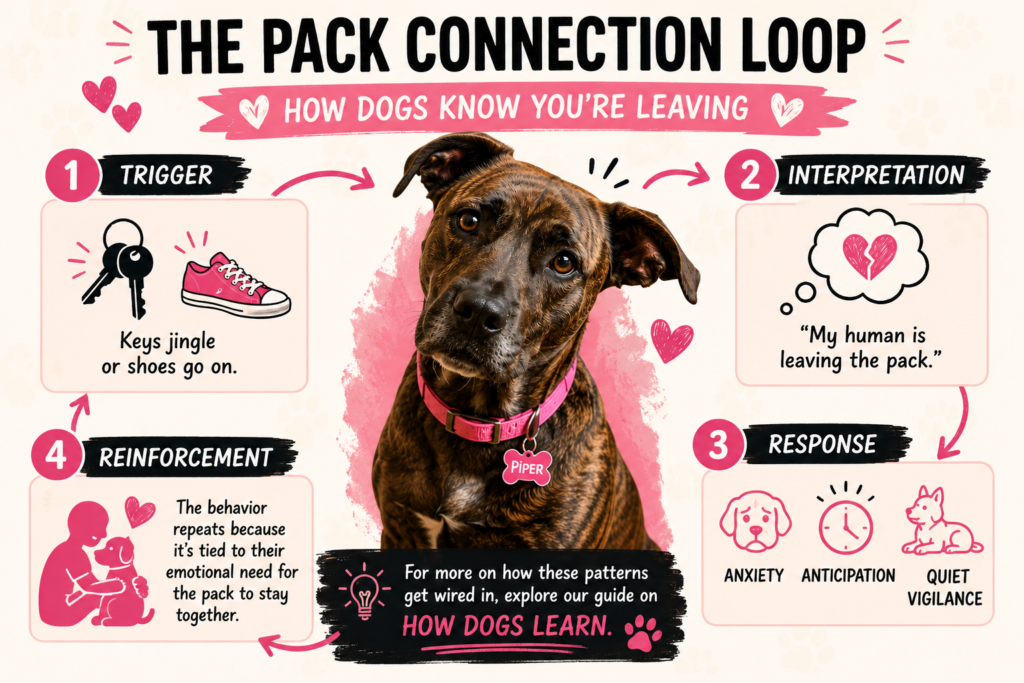
One of the most touching things dog owners see is their dog waiting by the door or window. This isn’t random. Dogs are elite pattern-recognition machines. They learn your departure cues, the exact sound of your car, your footsteps, even garage vibrations. They run a tiny FBI behavioral analysis unit from your living room, noticing details humans completely miss. That’s why some dogs start reacting before you even reach the door — they’ve already decoded the entire sequence. Trigger: keys jingle or shoes go on. Interpretation: “My human is leaving the pack.” Response: anxiety, anticipation, or quiet vigilance. Reinforcement: the behavior repeats because it’s tied to their emotional need for the pack to stay together. For more on how these patterns get wired in, explore our guide on How Dogs Learn.
The emotional side runs deeper than most people admit. When you leave, many dogs cycle through boredom, confusion, loneliness, mild stress, and hopeful anticipation. Not every dog reacts the same. Some sleep peacefully or self-entertain. Others treat the couch like it owes them money and stage dramatic negotiations. Breed, personality, daily routine, past experiences, and training all play roles. Highly social breeds bred to work closely with humans often feel separation as deeply wrong because their wiring expects constant pack connection. If you want the full deep dive on why these patterns form and how they get reinforced, check out our pillar guide on Separation Anxiety in Dogs and Environmental Triggers in Dogs.
Yes, your dog can literally smell how long you’ve been gone. Your scent is strongest right after you leave and slowly fades. Some researchers believe dogs use this changing scent gradient like a biological clock, helping them estimate when you should return. That makes the window staring feel even more poignant — they’re not just sitting there. They’re waiting for you.
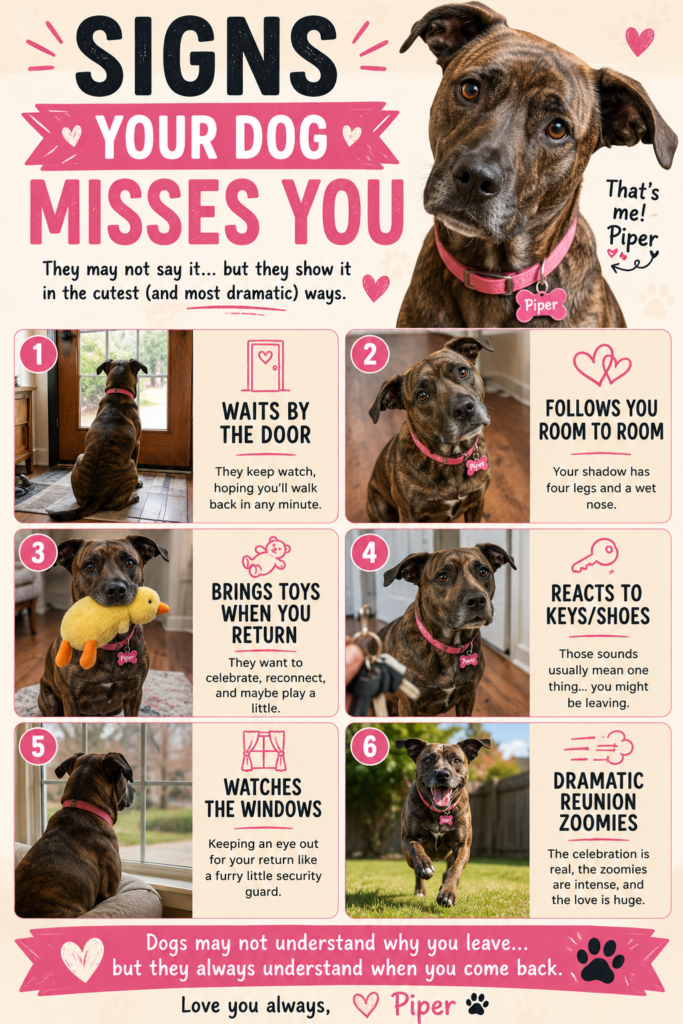
Then there’s the Velcro Dog phenomenon. These pups follow you everywhere — bathroom, kitchen, garage, you name it. Sometimes it signals underlying anxiety, but often it’s pure social attachment mixed with curiosity and habit. In their pack-oriented minds, where you go matters because food might appear, danger might lurk, squirrels require tactical assessment, or snacks could rain from the counter. They simply don’t want to miss critical operational developments. See why these habits stick in our breakdown of Most Dog Behavior Problems Start Here.
Then there’s Piper…
Piper takes missing her humans very seriously. The second keys jingle she flips into emotional surveillance mode. No barking. No whining. Just pure, historical disappointment. That deep side-eye that says, “I defended this house from three suspicious leaves and a rogue Amazon driver today… and this is the thanks I get?” She walks to the window like the hero in a rainy train-station goodbye scene. But the moment someone returns? Full chaos celebration. Zoomies engaged. Mr. Quackers gets violently shaken. The tail turns into a Category 5 hazard. And somewhere on the fence, General Nutters the squirrel freezes mid-acorn raid with a look that says, “The human has returned. Abort mission immediately.”
Can dogs get separation anxiety?
Missing you is normal. Panic is different. True separation anxiety goes beyond attachment and can include destructive chewing, nonstop barking, escape attempts, pacing, drooling, indoor accidents, or self-harm. This is genuine distress, not manipulation. Helping these dogs usually means building rock-solid routines, confidence training, environmental enrichment, gradual departure practice, and calming strategies. Many improve dramatically with the right support.
In the separation anxiety section, consider tools that support calm without replacing training: calming chews like BARK & SPARK Advanced Calming Chews, pheromone diffusers such as ThunderEase or TheraPet MD, or Anxiety Vests that provide gentle compression. These can be helpful additions alongside the behavioral work. Affiliate Disclosure
FAQ – Does My Dog Miss Me?
Q: Do all dogs miss their owners the same way? A: No. Some are more independent while others are total Velcro dogs. Breed, age, and past experiences make a big difference.
Q: Is waiting by the door a sign of anxiety? A: Usually it’s normal attachment. It becomes anxiety when it includes destructive behavior or panic.
Q: Can my dog really tell how long I’ve been gone? A: Science suggests yes — through scent dissipation and pattern recognition.
Q: What’s the best way to help a dog that struggles when I leave? A: Consistent routines, enrichment, and gradual alone-time practice. Check our full Separation Anxiety guide for step-by-step strategies.
The Best Part About Coming Home
One reason people love dogs so deeply is because of reunions. Dogs don’t care what kind of car you drive, how bad your day was, or whether you succeeded today. To your dog: you came back. And that matters.

So does your dog miss you? Yes. They notice when you leave. They track your absence. They anticipate your return. And for many dogs, your homecoming is genuinely the highlight of their day — even if they act like you abandoned them for tacos after fourteen minutes.
Join Piper’s Pack 🐾 If your dog also acts like you’ve returned from a thousand-year quest every time you come home… congratulations. You’re officially one of us. At Piper’s Pack on BarkMindDogs.com, we celebrate the hilarious, emotional, chaotic, weirdly genius things dogs do every single day. Inside Piper’s Pack you’ll find: funny dog stories, dog behavior breakdowns, Piper and General Nutters incidents, heartwarming dog moments, videos, blogs, dog-owner humor, and a growing community of people who completely understand why privacy no longer exists once you own a dog. Because life is simply better when someone loses their mind with happiness every time you walk through the door.

Final BarkMind Thought If your dog follows you around… waits by the door… brings you toys the second you come home… or acts like your return is the greatest moment in recorded human history… that’s not manipulation. That’s attachment. And honestly? In a world where affection often feels complicated, there’s something incredibly beautiful about a creature whose entire body lights up simply because you walked back through the door. That’s one of the reasons we love dogs so much. And maybe one of the reasons they love us too.
Great content! Keep up the good work!
Thank you! Piper says “WOOF”