
Why Dogs Bark: What Your Dog Is Really Trying to Tell You
Direct Answer Section Why do dogs bark? Dogs bark as a response to triggers in their environment, internal emotional state, or learned experiences. Barking is not random — it follows a predictable pattern of trigger → interpretation → response. Common reasons include alerting to sounds, reacting to unfamiliar situations, expressing excitement, frustration, or anxiety. Understanding the system behind barking matters more than simply trying to stop it.
Key Takeaways
- Barking is communication, not misbehavior.
- Dogs bark in response to triggers, not randomly.
- The same dog can bark for different reasons depending on context.
- Understanding the system behind barking matters more than stopping it.
- Dogs don’t bark randomly — they bark predictably.
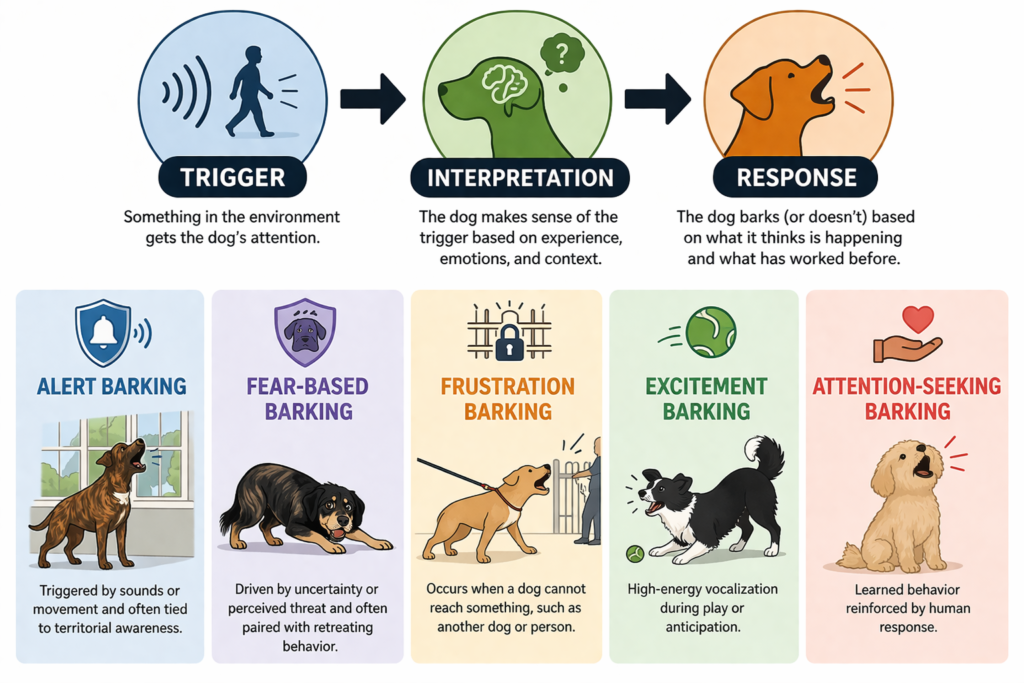
The Barking Behavior System Every barking behavior follows the same pattern: Trigger → Interpretation → Response.
If you change the trigger or the environment, the behavior changes. If you only try to stop the barking, the system remains the same. Barking is the output of the full BarkMindDogs Behavioral Framework — instinct, environment, reinforcement, timing, and emotional state working together.
Why do dogs bark? Dogs bark because something in their environment or internal state triggers a response. Barking follows a consistent pattern: trigger → interpretation → response, and is reinforced over time if it produces a result.
What Is Barking? Barking in dogs is a form of canine vocalization behavior used for communication in response to environmental stimulus, internal emotional state, and learned reinforcement patterns.
Barking is a vocal communication behavior produced by rapid expulsion of air through the larynx. It serves functions including alert signaling, social communication, emotional expression, and reinforcement-driven responses.
To understand why barking happens in specific situations, we need to look at how different triggers activate the system.
Why Do Dogs Bark at Nothing? Why do dogs bark at nothing? Dogs do not bark at nothing. They respond to sounds, movement, or environmental changes humans cannot detect, such as distant noise, scent shifts, or subtle motion.
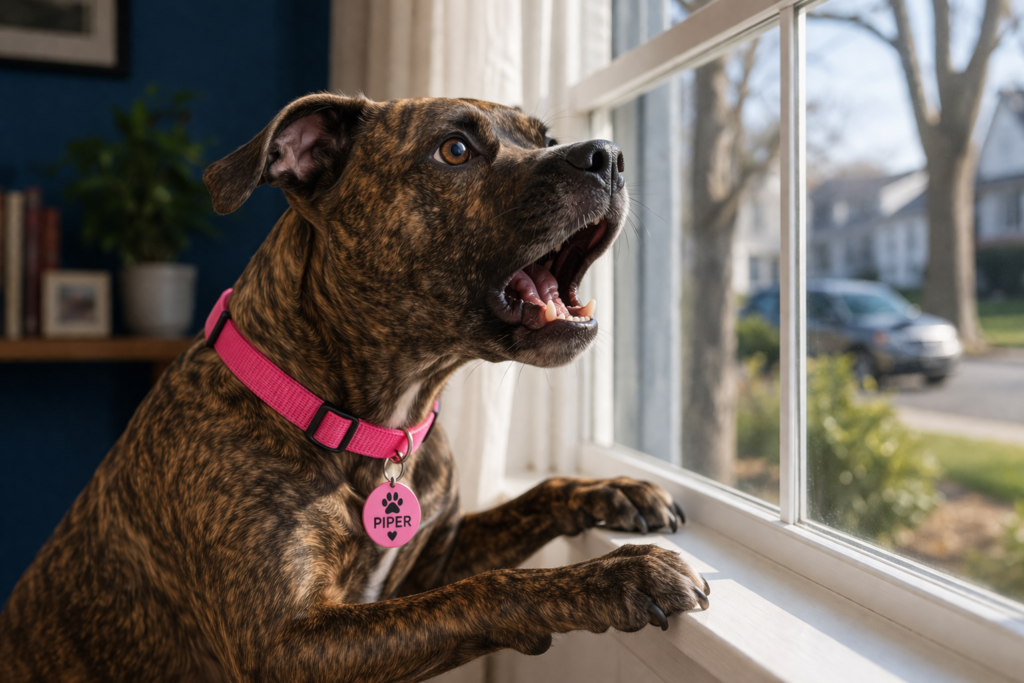
Why Do Dogs Bark at Night? Why do dogs bark at night? Dogs bark more at night due to increased sensitivity to sound and reduced visual input in quiet environments.
Why Do Dogs Bark at Other Dogs? Why do dogs bark at other dogs? Dogs bark at other dogs due to excitement, fear, frustration, or social tension depending on their experience and emotional state.
Why Does My Dog Bark When I Leave? Barking when left alone is commonly a sign of distress or learned protest behavior reinforced by your eventual return. It is one of the clearest indicators of separation-related issues. Full breakdown here: Separation Anxiety in Dogs.
Why Do Dogs Bark at Strangers? This is usually territorial or alarm barking driven by protective instinct. The dog perceives the stranger as a potential threat and alerts the pack (you).
Types of Barking Behavior Dogs do not bark the same way in every situation. Barking patterns vary based on the underlying system.
- Alert barking — Triggered by sounds or movement and often tied to territorial awareness.
- Fear-based barking — Driven by uncertainty or perceived threat and often paired with retreating behavior.
- Frustration barking — Occurs when a dog cannot reach something, such as another dog or person.
- Excitement barking — High-energy vocalization during play or anticipation.
- Attention-seeking barking — Learned behavior reinforced by human response.
Barking Trigger Table:
Doorbell Feeling: Alert / Defensive Why: Territorial response — the dog protects its space.
Being left alone Feeling: Anxiety Why: Separation distress and loss of structure.
Movement at window Feeling: Arousal Why: Visual stimulus triggers high alertness.
Other dogs Feeling: Uncertainty / Excitement Why: Social tension or greeting attempt.
Play or excitement Feeling: High energy Why: Energy release through vocalization.
Nighttime sounds Feeling: Heightened sensitivity Why: Reduced visual cues amplify minor noises.
Strangers Feeling: Protective Why: Territorial alarm to warn the family.
The Reinforcement Loop: Why Barking Persists Barking that “works” (gets attention, removes discomfort, or creates excitement) gets stronger over time. This pattern is explained further in How Dogs Learn. Environmental triggers play a major role in this process.
Why Do Dogs Bark for Attention? Why do dogs bark for attention? Dogs bark for attention when the behavior has been reinforced by a response. Even negative attention, such as yelling, can strengthen the barking pattern.
Why Do Dogs Bark at Sounds? Why do dogs bark at sounds? Dogs bark at sounds because their hearing is more sensitive than humans. Sudden or unfamiliar noises trigger alert or defensive responses.
Why Do Dogs Bark So Much? Dogs bark frequently when repeated triggers, high energy levels, or learned patterns reinforce the behavior. This is often called excessive barking in dogs.
Why Does My Dog Bark at Everything? Why does my dog bark at everything? Barking at everything usually indicates high sensitivity to environmental stimulus or a learned habit reinforced over time. Dog barking behavior explained this way helps owners see the real cause.
How Do You Stop a Dog from Barking? (System Answer Only) You cannot fully “stop” barking because it is natural vocalization behavior. Instead, address the underlying trigger, change the environment, or alter the learned reinforcement so the behavior no longer “works.”
Real-Life Barking Examples
- A dog barking at the window every morning when people walk by.
- A dog barking when the owner picks up keys to leave.
- A dog barking during play but stopping immediately afterward.
- A dog barking at the same time every night due to routine triggers.
Barking vs Other Dog Behaviors Barking is only one form of canine communication.
Unlike body language, which can be subtle, barking is a high-intensity signal designed to get attention quickly. Other behaviors like pacing, whining, or avoidance often occur alongside barking and provide additional context.
Why Barking Often Happens With Other Behaviors Barking rarely happens alone. It is often paired with movement, posture changes, or repeated patterns such as pacing or jumping. This is because multiple parts of the behavioral system activate at the same time, not just vocalization.
Dogs bark because something changed — not because nothing happened. The environment shapes the bark more than the dog itself. If the barking repeats, the system is reinforcing itself. Barking is predictable once the system is understood. The same trigger can produce different barking depending on the dog’s state. Dogs bark because they are responding to a trigger, not acting randomly.
What People Are Really Asking About Barking Most people searching about barking are trying to solve a problem — not just understand behavior. The most common concerns include excessive barking, barking when alone, and barking at everything. Understanding the system behind barking is the first step to solving all of these.
This connects directly to the full behavior system explained in Why Your Dog Does That. This is part of the broader framework covered in How Dogs Learn.
If your dog is barking excessively, the solution is not to silence the behavior but to understand what is causing it.
Once you identify the trigger and the reinforcement behind it, the behavior becomes predictable — and changeable.
Related Barking Topics
- Why does my dog bark at everything?
- Why does my dog bark when I leave?
- Why does my dog bark at strangers?
- Why do dogs bark at night?
- Why do dogs bark at other dogs?
Simple Summary Dogs bark because they are responding to triggers, not acting randomly.
The key to understanding barking is identifying the trigger, the interpretation, and the reinforcement behind it.
When you change the system, the behavior changes.
Main reasons dogs bark:
- environmental triggers
- emotional response
- learned reinforcement
- excitement or frustration
- protective instinct
Learn More About Dog Behavior
- Why Your Dog Does That – The complete behavioral framework
- How Dogs Learn – The science of canine learning
- Environmental Triggers in Dogs – Hidden forces shaping behavior
- Separation Anxiety in Dogs – Understanding and addressing distress
- Dog Aggression Explained – Reactivity and communication
- Puppy Behavior Development – Early pattern formation
- Dog Behavior Mistakes – How humans unintentionally shape behavior
Research & Citations
Yin (2002): Barking evolved as a key communicative tool during domestication.
Pongrácz et al. (2005, 2006, 2014): Humans accurately categorize dog barks by emotion using acoustic parameters.