

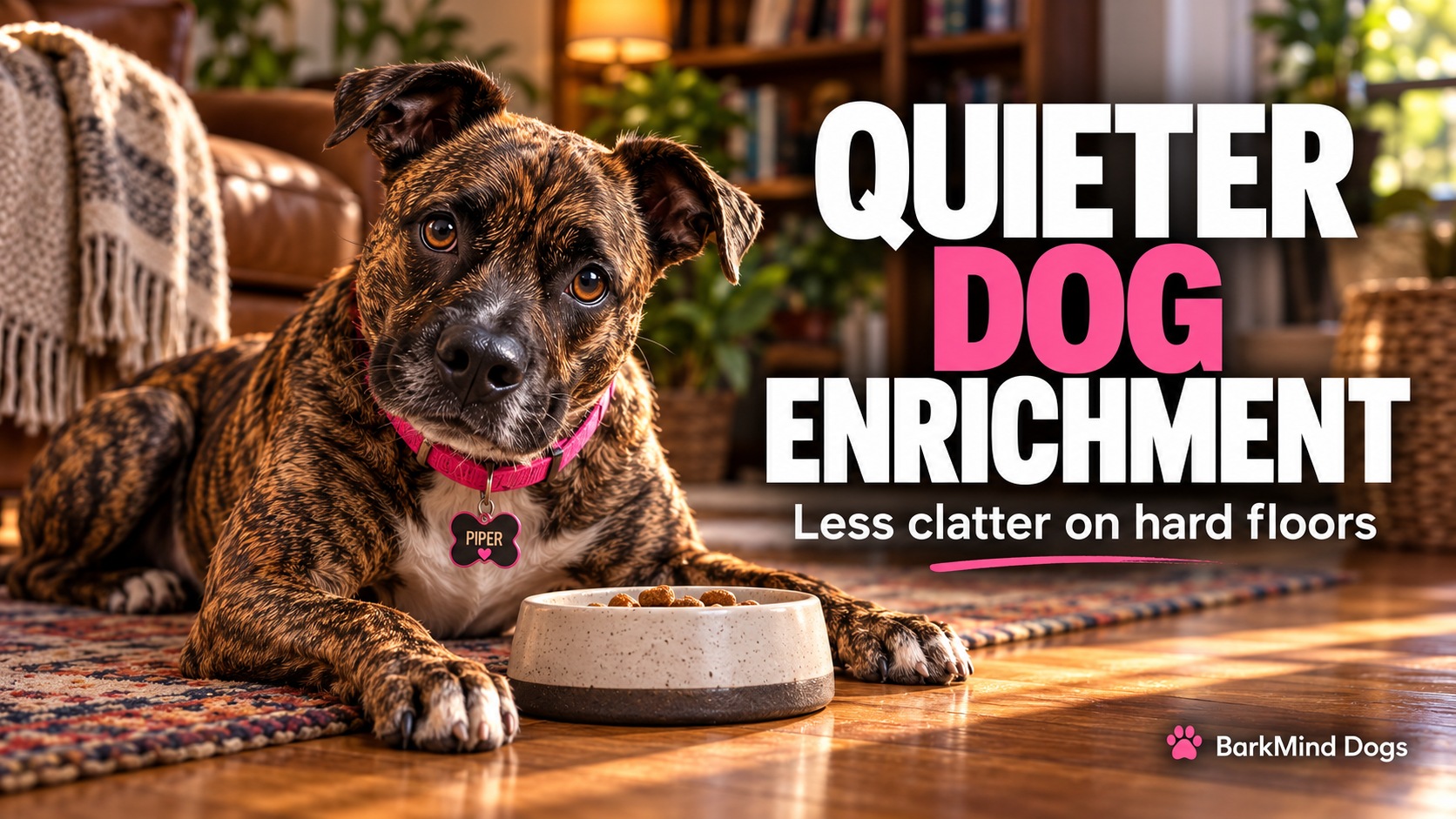
Stationary enrichment and soft activities are sensible places to start when you want less clattering on hardwood or tile. A feeder that stays in one area avoids some of the rolling and repeated collisions of a hard moving toy. But material alone cannot promise silence: your dog’s actions, the toy’s shape and weight, and the floor all affect what you hear.
A dog can be thoroughly enjoying a rolling feeder while the person downstairs receives what sounds like a tiny furniture delivery. The challenge is to choose an activity that suits both the dog and the home.
What this guide does: compare characteristics and explain a practical selection process. We have not performed hands-on sound tests, measured decibels or identified a tested “quietest” toy. Likely noise effects below are reasoned expectations, not measured rankings.
First, identify which noise you are trying to reduce
- Squeaking: a built-in squeaker or noise-making element.
- Rattling: loose food or parts moving inside a housing.
- Rolling and impact: a toy hitting floorboards, cabinets or furniture.
- Paws and movement: the dog running, scrabbling or repeatedly dropping an object.
Removing a squeaker does not solve floor impact, and a soft toy does not stop a dog running with it. Listen for the main source before replacing an activity your dog enjoys.
Compare the activity, not just the material label
| Activity type | Likely noise mechanism | Practical trade-off |
|---|---|---|
| Stationary licking or accessible food activity | Less rolling travel if the setup stays in place; tapping or movement is still possible. | Food residue, stability and cleaning matter. A flexible feeder may still be picked up. |
| Soft supervised sniffing activity | No hard shell repeatedly striking the floor, but paws and dragging can still be audible. | Fabric may need washing and drying; unsuitable if the dog tears off and swallows material. |
| Sliding or rotating compartment puzzle | Parts can click; the base may scrape or thump when pawed. | Choose manageable difficulty and a stable location; inspect compartments and removable parts. |
| Rolling or tipping food dispenser | Repeated floor contact, collisions and food rattling are possible. | Movement is part of the activity. A different location or activity may be a better quiet-hours choice. |
This is a comparison of mechanisms, not a table of proven sound levels. Preventive Vet specifically warns that some hard-plastic rollers and tippers can be loud on hardwood or tile and may damage flooring.[1]
Six features worth checking
1. How the dog gets the reward
Does the activity depend on pushing the object across the room? Or can the dog sniff or lick while remaining in one place? A stationary task removes some opportunities for collision, but only if your dog actually uses it that way.
2. What makes contact with the floor
Look at the underside and edges as well as the main body. A product described as rubber-like may still contain hard components. Soft material can reduce some sharp contact sounds, but it is not a guarantee of quietness or suitability for your dog.
3. Shape, weight and movement
A round design encourages rolling; a broad base may limit travel. Weight alone does not identify a quieter option. A heavy item that is dropped and a light hollow object that rattles produce different problems. We cannot rank them without comparable observations.
4. Whether your dog can use it comfortably
A task that repeatedly leads to frantic pawing or chewing may need an easier setup or a different activity. Do not make a puzzle harder just to keep the dog in one place longer. Enrichment should fit the individual dog’s abilities, preferences and health.[2]
5. Cleaning and drying
Check the exact manufacturer instructions. Can you reach trapped food? Do compartments come apart? Is dishwasher use actually allowed for that model? Fabric needs appropriate washing and thorough drying. Easy cleaning may matter more in daily life than a feature you use once.
6. What your dog is likely to chew or swallow
Appropriate size, intact materials and supervision come before acoustic convenience. Inspect for damage and follow the specific instructions. A mat is not a sensible quiet solution for a dog who eats mat fibers.[2]
Two documented designs—and what they do not prove
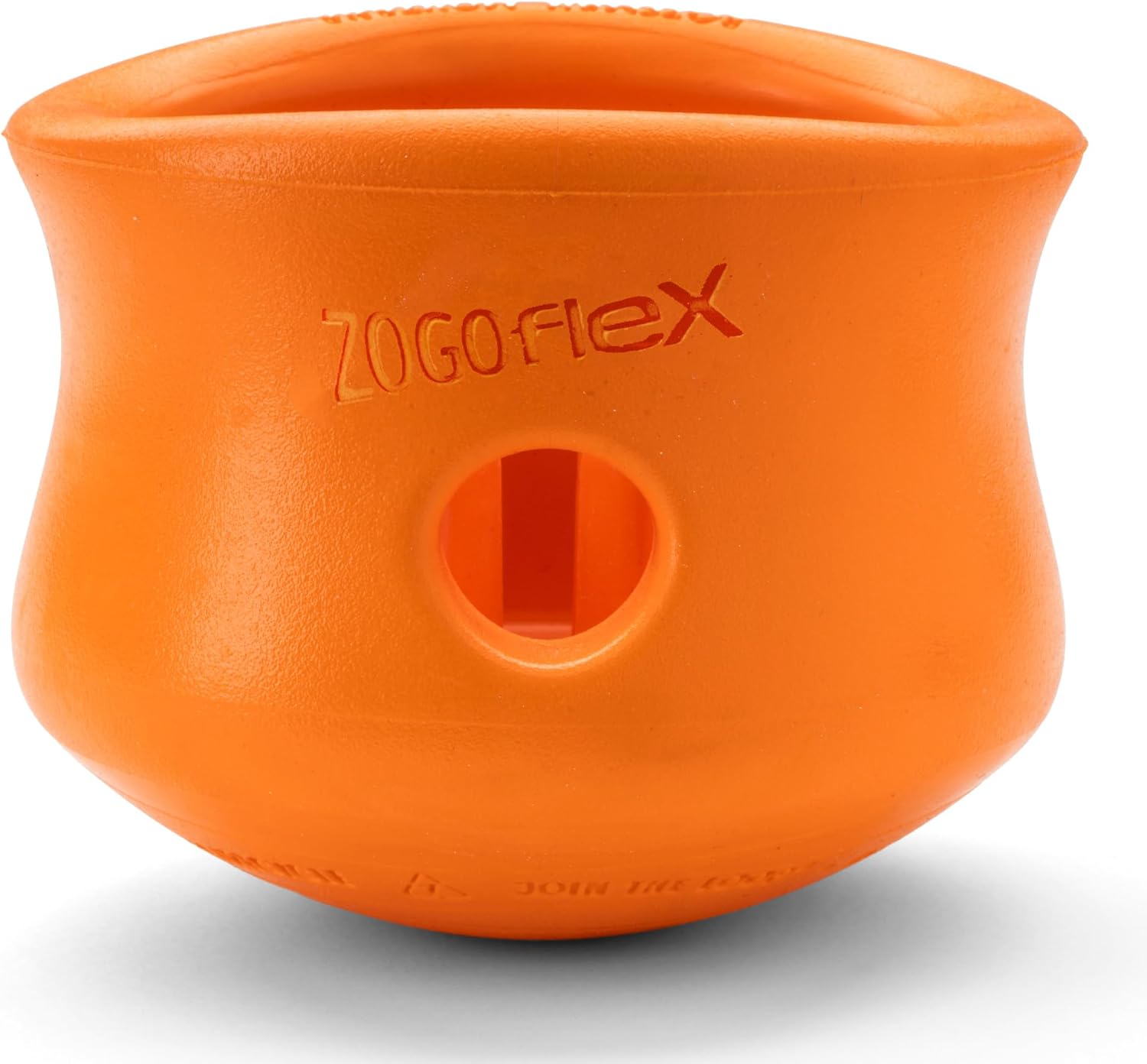
West Paw Toppl Affiliate Disclosure: the manufacturer describes a fillable toy for moderate chewers and allows top-rack dishwasher cleaning. Its open design makes it a useful example when considering accessible food activities. Those documented characteristics do not establish a sound level, suitability for every chewer or a promise that it stays stationary.[3]

Nina Ottosson Dog Tornado Affiliate Disclosure: the manufacturer documents rotating tiers, optional covers and hand washing. It is an example of a compartment puzzle with adjustable challenge. Its parts can move; no comparative noise measurement was verified. The instructions require supervision and replacing damaged toys.[4]
The Toppl link opens an XL Tangerine listing. Check the available sizes and the manufacturer’s fit guidance for your dog. The Dog Tornado link opens the Level 2 model. Product availability and options can change.
View West Paw Toppl on Amazon Affiliate Disclosure · View Dog Tornado on Amazon Affiliate Disclosure
These examples explain design differences. They are not tested winners or an instruction to buy. You may already have an appropriate activity that works.
Try the no-purchase changes first
- Choose the location. Use a safe area away from furniture the toy repeatedly hits and from busy walking routes.
- Change the activity during quiet hours. Offer a suitable stationary or sniffing task instead of an activity that depends on rolling.
- Consider a washable, nonslip surface. It may change movement and contact noise, but check that it stays secure, suits your flooring and will not be chewed or swallowed.
- Keep the task manageable. Our learning guide explains why repeated successful experiences matter.
- Listen to the result. Is the clatter actually reduced, or has the sound simply moved elsewhere?
A mat cannot be assumed to soundproof a floor. What you hear beside a toy also does not tell you exactly what is transmitted to a downstairs room.
A useful home comparison without pretending to run a laboratory
If you want to compare activities you already own, use the same location and similar conditions while supervising your dog. Make a short recording from the same place and note the activity: licking, rolling, dropping or running. Listen for the type of noise and frequency of impacts.
Treat recordings as informal observations. Phones can automatically adjust audio, and different dog actions change the comparison. Do not turn a phone clip into a calibrated decibel claim or a guarantee for neighbors. If the downstairs sound matters, a consensual check in the affected room is more relevant than judging only beside the toy.
Questions about quieter enrichment
Does rubber mean silent?
No. A flexible object can still thump, roll into furniture or make noise when dropped. Check the complete design and the dog’s use.
Will a mat stop noise reaching downstairs?
It may change a particular contact sound, but there is no universal guarantee. Floor construction and the actual activity matter.
Can I leave a “quiet” toy out overnight?
Quietness does not establish unattended-use safety. Follow the exact instructions and your dog’s demonstrated use; some puzzles require supervision.[4]
Should I discourage all indoor play?
You can plan quieter activities for particular places and times while still giving your dog suitable opportunities to move and play elsewhere. The aim is a workable routine, not a dog who never makes a sound.
For the bigger picture of surroundings and behavior, see Environmental Triggers in Dogs. The best choice is an activity your dog can enjoy safely and your household can comfortably live with. That answer may begin with changing the setup rather than changing the toy.
Sources and further reading
- Preventive Vet: Hard-plastic roller/tipper noise and feeder selection
- Dogs Trust: Individual fit and enrichment safety
- West Paw: Toppl product characteristics and care
- Outward Hound: Dog Tornado characteristics and care
Products are included as documented design examples. We have not conducted hands-on noise testing, and an affiliate link does not establish that a product will be quiet or suitable for every dog.