
Quick answer: Your dog may recognise their name yet fail to respond because of distraction, learning history, stress or difficulty hearing. Practise in an easy setting and reward attention; ask your veterinarian about a sudden change in responsiveness.
You say your dog’s name and suddenly their head snaps around, tail starts thumping, ears perk straight up, and for that one perfect second it feels like they truly get it—they know exactly who they are and that you’re talking straight to them.
But then, five minutes later, you call the same name again while they’re staring at a leaf blowing across the yard or listening for the faintest rustle in the bushes, and it’s like you never spoke at all. You’re left standing there wondering if they actually know their name… or if they’re just responding when it suits them.
And if we’re being honest… some of them look at you like they heard you… and just decided not to respond.
Many dogs learn to recognise their name as a familiar sound. A response does not establish a human-like concept of personal identity, and a missed response does not prove deliberate disobedience.
And what most people get wrong about this is the key to fixing it. Most people try to get louder… when they should be getting more meaningful.
This is where the BarkMindDogs system makes everything click. Like all dog behavior, name recognition comes down to instinct, environment, learning, reinforcement, and emotional state working together. You can explore exactly how dogs learn in our full guide here: How Dogs Learn.
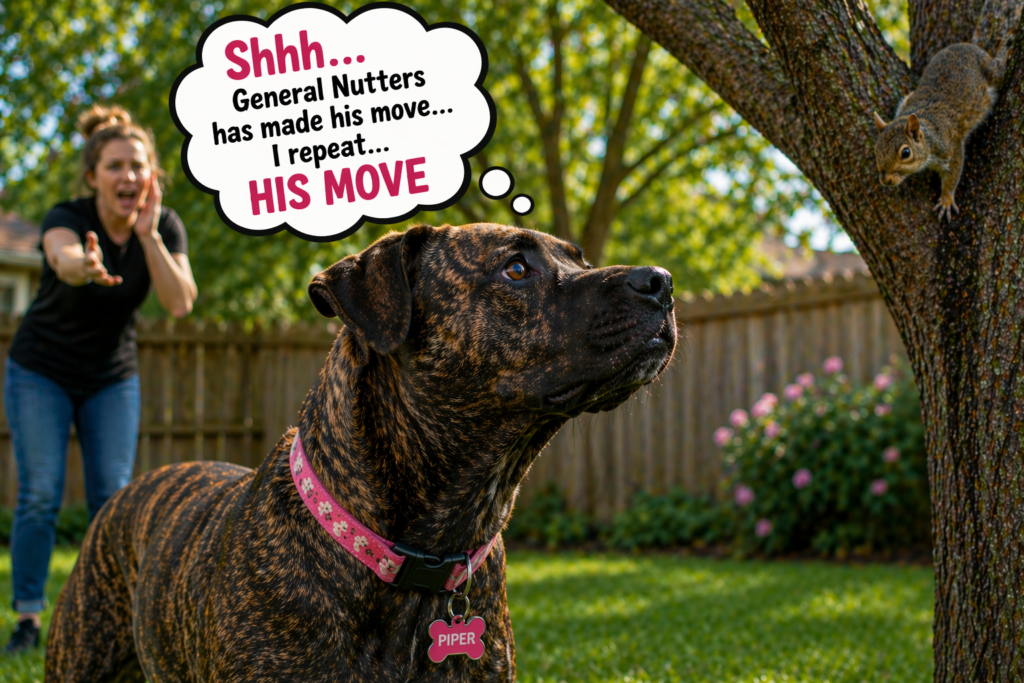
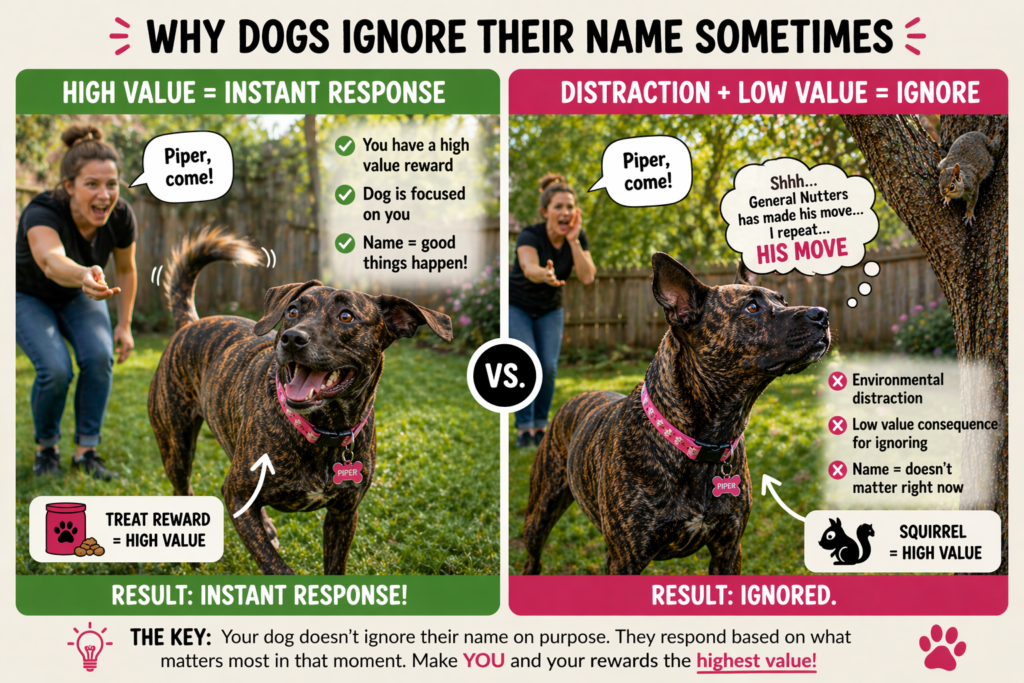
That’s why Piper lights up like a rocket when I say her name while holding a treat or heading for the leash, but the exact same word can fall completely flat when she’s locked onto something more interesting. The other day I called “Piper” while holding her leash and she came flying across the yard like her life depended on it… but ten minutes later, same name, same tone, and she didn’t even blink because General Nutters had made an appearance in the tree line. It’s not stubbornness or selective hearing in the human sense. It’s her brain doing exactly what it evolved to do: asking, moment by moment, “Does this matter to me right now?”
And if the answer is no… you don’t exist.
Here’s where a lot of us accidentally make the problem worse. If you repeat your dog’s name over and over—“Piper… Piper… Piper… come on, Piper”—without anything valuable following, the sound starts to lose its power. It becomes background noise—no different than the hum of the fridge or a TV playing in the next room. The environment plays a huge role too—those environmental triggers can completely override the name in a heartbeat. That’s why understanding what’s happening around your dog is so important: Environmental Triggers in Dogs.
The same pattern shows up in so many other areas of life with your dog—like those frustrating moments when they seem to hear you perfectly but still choose to ignore you.
A lot of owners fall into the trap of thinking their dog is just being stubborn or doesn’t really “know” their name when they ignore it. That misconception comes from expecting dogs to respond like humans do, out of some sense of identity or politeness. But dogs operate on value and context. They’ve simply learned when the name is worth their attention… and when it isn’t.
So how do you make your dog respond better without turning it into a battle? You don’t need to reteach the name from scratch—you need to rebuild its value. Use the name intentionally, pair it with something genuinely good (a treat, play, praise, or a quick game), and then let the moment end naturally. Avoid the repetition trap. When the name consistently predicts something positive, your dog’s brain starts treating it like the important cue it’s meant to be.
If you’re sitting there thinking “yep… that’s exactly my dog,” then you’re already part of the pack—so head over to Piper’s Corner and send us your dog’s picture so they can officially join Team Piper. We’re building something fun over there, and your dog belongs in it. We’re featuring dogs from all over, and Piper’s always looking for new members of her pack. Piper’s Pack
A reward your dog enjoys can help build attention during short training sessions. A raw diet has not been established here to improve name recognition or responsiveness. Related links: We Feed Raw · (Affiliate Disclosure).
Try We Feed Raw for Your DogFAQ
Do dogs actually know their names? Research shows recognition of familiar name sounds in tested dogs; it does not tell us whether dogs understand identity as humans do.
Why does my dog ignore their name sometimes? They respond based on value and context. If something more interesting is happening in their environment or their emotional state is locked onto a distraction, the name simply doesn’t win their attention.
How do I teach my dog their name better? Pair the name with genuinely positive outcomes like treats, play, or affection, use it sparingly and intentionally, and avoid repeating it when they don’t respond so it keeps its power.
Should I repeat my dog’s name if they don’t respond? No—repeating it actually teaches them the name is optional background noise. Reset, create a stronger positive association, and try again later.
At what age do dogs learn their name? Puppies can practise attention to their name in short, rewarding sessions. Learning speed varies; there is no fixed age or timetable for reliable responses.
Disclaimer This content is for educational purposes only and is not a substitute for professional dog training advice. Every dog is unique—consult a qualified trainer or behaviorist if you’re dealing with persistent issues.
Research and related reading
The cocktail party effect in the domestic dog (2019) studied name recognition in background speech. It did not test whether dogs understand personal identity. Compare how dogs learn and browse related guides.