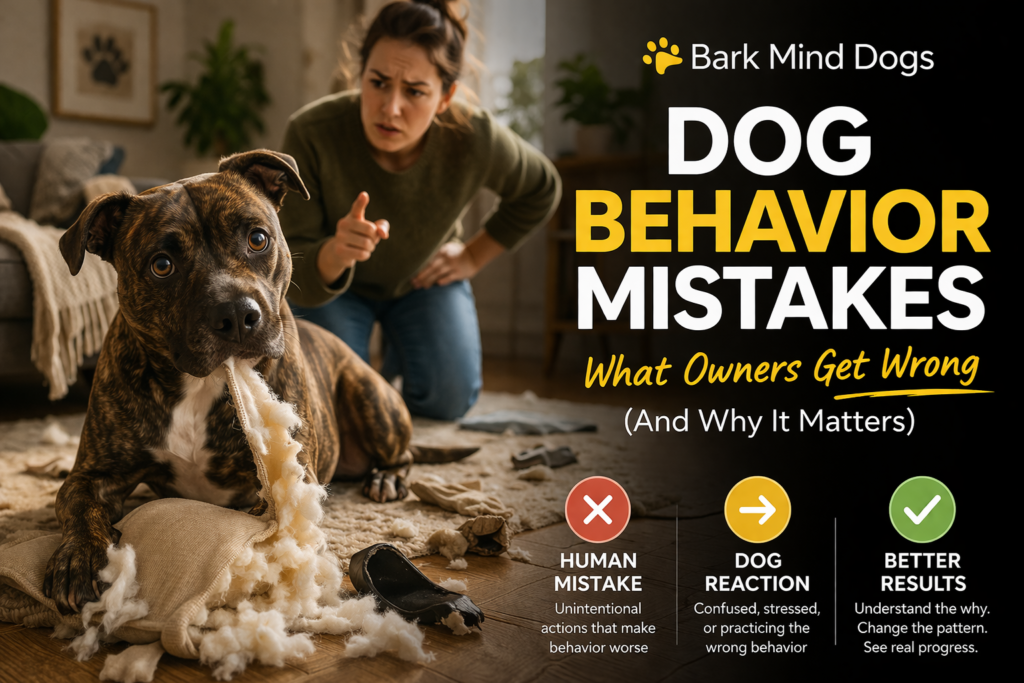
Dog Behavior Mistakes: Why Most Problems Are Created by Humans, Not Dogs
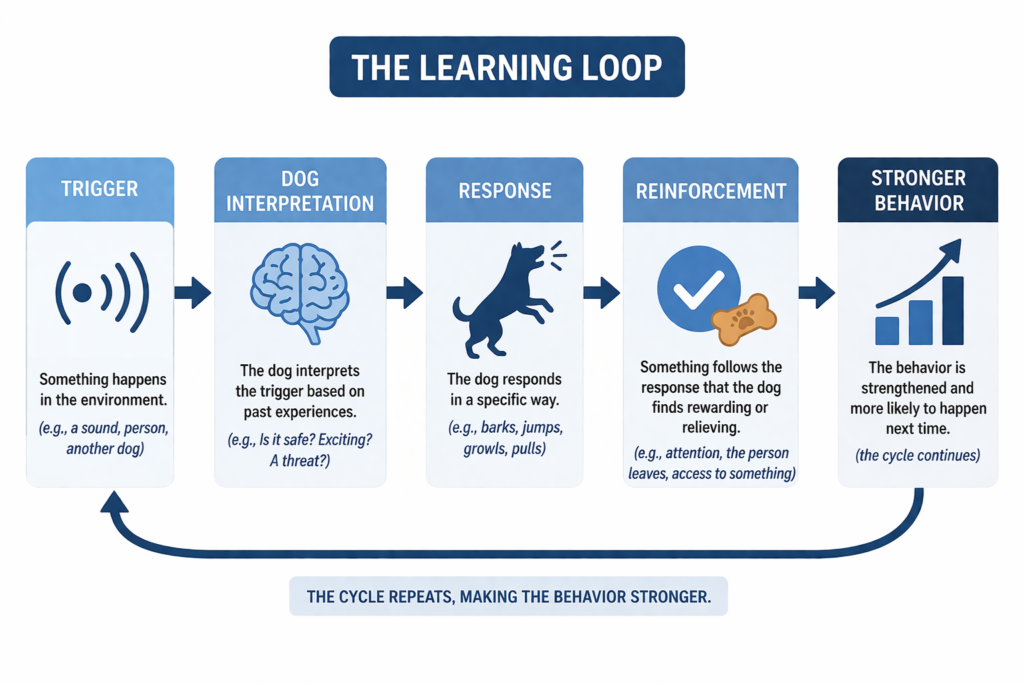
What are dog behavior mistakes? Dog behavior mistakes are common human misunderstandings of how dogs learn — including accidentally reinforcing unwanted behavior, poor timing, ignoring environmental triggers, punishing warning signals, and focusing on stopping symptoms instead of changing the underlying system of trigger → interpretation → response → reinforcement.
Most “problems” are not the dog being stubborn or dominant. They are predictable outcomes of how the environment and our responses shape behavior every day.
Key Takeaways
- Behavior problems are usually human-driven through reinforcement and environment, not dog-driven.
- Reinforcement determines what behavior repeats — whatever “works” gets stronger.
- Timing mistakes create confusion and slow learning.
- Stress blocks learning and prevents skills from transferring to real life.
- Punishment increases fear and risk without solving the root cause.
- Behavior improves reliably when you change the system, not just the symptom.
Reinforcement Is the Hidden Driver of Every Behavior Problem
Behavior does not repeat because dogs are stubborn or spiteful. Behavior repeats because it works — it produces attention, space, access, relief, or any outcome the dog values.
Research consistently shows that behavior maintained by reinforcement is more stable than behavior suppressed through punishment (Hiby et al., 2004; Ziv, 2017). Owners unintentionally strengthen unwanted actions every day without realizing it.
Common examples:
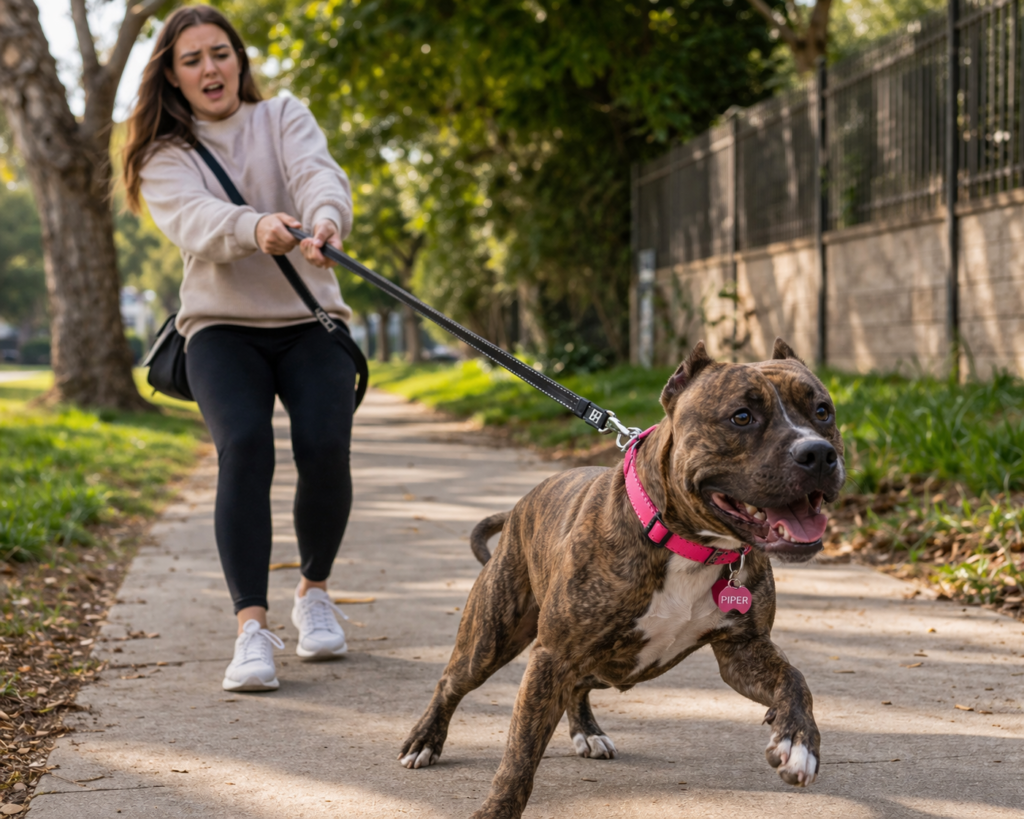
- Dog pulls on leash → reaches the next smell or person → pulling is reinforced.
- Dog barks at the window → owner yells or approaches → barking is reinforced.
- Dog jumps on guests → receives eye contact, talking, or petting → jumping continues.
Another common pattern Dog pulls on leash → owner allows forward movement → dog learns pulling works.
From the dog’s perspective: “Pulling gets me where I want to go.” The behavior strengthens over time — even though the owner is trying to stop it.
Why Timing Matters More Than Most Owners Realize
Dogs learn from what happens immediately after a behavior. Even a delay of one or two seconds can teach the wrong lesson.
Poor timing is one of the most frequent mistakes. Reward or interrupt too late, and the dog connects the outcome to whatever it was doing right before — not the action you intended.
Why Stress Blocks Learning (And Why Training Often Fails in the Real World)
Dogs cannot learn effectively when stressed or over-aroused. High arousal impairs cognitive processing, making it difficult to respond to cues or form new associations.
This is why commands that work perfectly at home often fail on walks, at the vet, or around other dogs.
What causes dog behavior problems? Dog behavior problems are caused by triggers, interpretation, and reinforcement — not stubbornness.
Why do dogs repeat unwanted behavior? Dogs repeat behavior because it has been reinforced, even unintentionally.
Why Punishment Makes Behavior Worse — Not Better
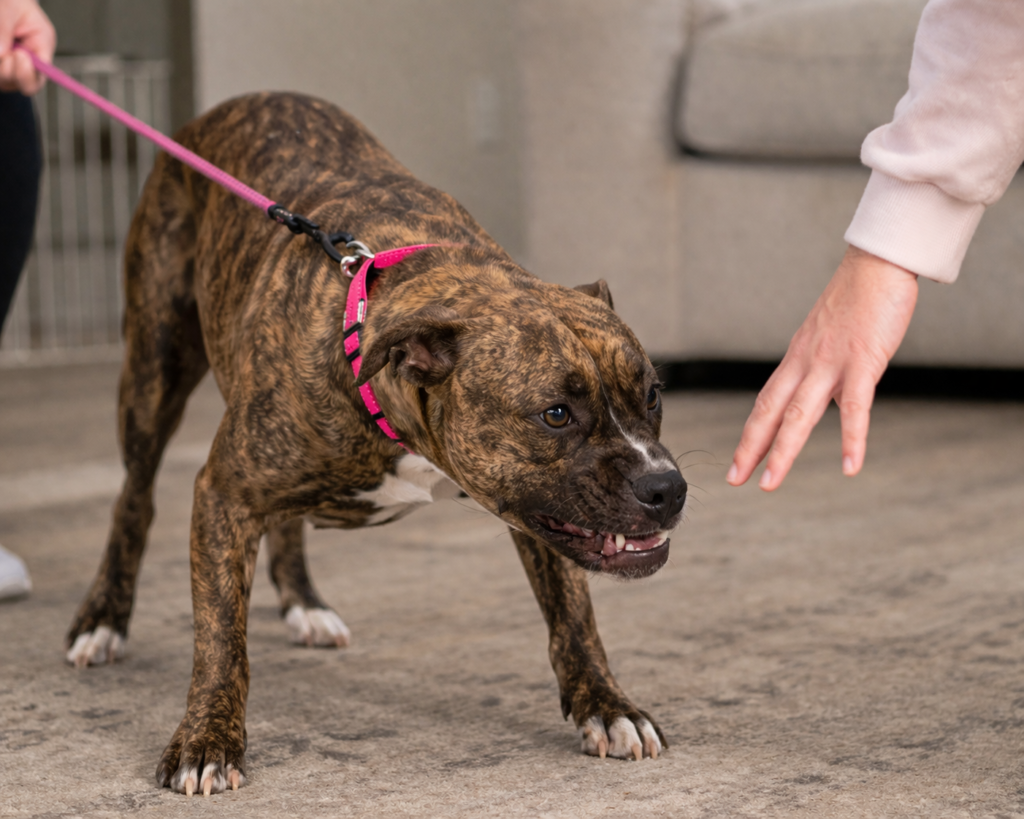
Punishment can suppress a behavior temporarily, but it frequently increases fear, anxiety, confusion, and risk of escalation — including suppressed warning signals or outright aggression.
Studies show aversive methods are associated with increased stress, fear, and behavior problems in dogs (Ziv, 2017; Casey et al., 2021; Vieira de Castro et al., 2020). Punishment does not teach an alternative behavior and often damages the human-dog relationship.
Why Behavior Problems Keep Coming Back
Behavior returns when the underlying trigger and reinforcement have not changed. Managing or interrupting the symptom leaves the cause untouched, so the pattern re-emerges as soon as the interruption ends.
Behavior Problem vs. Root Cause (The System Most Owners Miss)
Barking, lunging, jumping, ignoring cues, or destructive chewing are symptoms. The real cause is the system: trigger → interpretation → response → reinforcement.
Behavior does not exist in isolation. It is the result of repeated interactions between the dog and its environment.
Treating only the visible behavior is like turning off the check-engine light without fixing the engine. Change the triggers and reinforcement, and symptoms fade naturally.
The Real Problem Most Owners Miss Most behavior problems are not caused by the dog. They are caused by how the environment and our responses shape behavior over time.
Dogs are always learning. The only question is what they are learning from us and their surroundings.
Why Does My Dog Keep Repeating Bad Behavior? Dogs repeat behavior because it continues to be reinforced, even unintentionally. If the action produces any desired outcome, the dog learns “this works.”
Why Is My Dog Getting Worse? Behavior worsens when reinforcement continues or triggers increase without being managed.
Why Doesn’t My Dog Listen? Dogs respond to the strongest stimulus and reinforcement in the environment, not simply commands.
Most Common Dog Behavior Mistakes
- Ignoring environmental triggers and competing reinforcement
- Reinforcing behavior unintentionally with attention or access
- Poor timing of rewards or interruptions
- Punishing warning signals instead of addressing the cause
- Training or expecting compliance while the dog is stressed
- Inconsistency between household members
- Giving too much freedom too soon in distracting environments
Most common dog behavior mistakes:
- ignoring triggers
- reinforcing behavior unintentionally
- poor timing
- punishing warning signals
- training under stress
- inconsistency
Why this matters Most owners are not doing anything wrong on purpose. They are following patterns that seem logical — but accidentally reinforce the behavior they want to stop. Once you see this, everything changes.
Why Behavior Problems Feel Personal Behavior problems often feel frustrating or intentional. But dogs are not trying to be difficult — they are responding to patterns that have been reinforced over time.
Real-Life Example Dog barks at the window → owner yells or comes over → dog barks louder next time. From the dog’s perspective: “Barking works. It gets a reaction.” The behavior strengthens — even though the owner is trying to stop it.
Why does training fail? Training fails when triggers, stress, and reinforcement patterns are not addressed.
These patterns begin with environmental triggers, which determine how behavior starts. This is the same pattern seen in barking behavior.
Behavior is not a personality problem — it is a learning pattern.
Strategic Takeaways
- Reinforcement is constant and powerful — make sure it favors the behaviors you want.
- Timing is critical; small delays change what the dog actually learns.
- Stress blocks learning — manage arousal before expecting reliable responses.
- Punishment adds risk without solving the root cause.
- Treat the system (triggers + reinforcement), not just the symptom.
When you understand these human-side patterns, behavior stops feeling mysterious or personal and becomes something you can influence with clarity.
FAQ
What is the biggest mistake dog owners make? Treating the visible symptom instead of changing the underlying trigger and reinforcement patterns in the system.
Why do dog training mistakes happen? Because owners misunderstand how learning, reinforcement, and environment shape behavior.
What causes behavior problems in dogs? Behavior problems are caused by triggers, interpretation, and reinforcement — not stubbornness or dominance.
Why does my dog seem stubborn? Dogs are not stubborn — they are responding to the strongest reinforcement and triggers in the moment.
Why does my dog behave differently in different places? Different environments create different triggers, stress levels, and competing reinforcement.
Can behavior mistakes be reversed? Yes. Stop reinforcing the unwanted behavior, manage triggers, and consistently reinforce the desired alternative. The system responds reliably to consistent change.
Why does my dog ignore me sometimes? The dog is responding to stronger environmental triggers or competing reinforcement, not defiance.
Why does punishment make behavior worse? It increases fear and stress without teaching an alternative, often leading to suppressed signals or escalation (Ziv, 2017).
Why do behavior problems return after I think I fixed them? Because the underlying trigger and reinforcement were never fully addressed.
Why is my dog getting worse? Behavior worsens when reinforcement continues or triggers increase without being managed.
Why doesn’t my dog listen? Dogs respond to the strongest stimulus and reinforcement in the environment, not simply commands.
How does reinforcement affect dog behavior? Any behavior followed closely by a desired outcome becomes stronger over time. Reinforcement shapes behavior every single day.
Why does my dog keep making the same mistakes? Because the behavior is still being reinforced by some outcome the dog values.
What is the fastest way to fix dog behavior problems? The fastest way is to change triggers, reinforcement, and environment rather than trying to stop behavior directly.
Why does my dog act worse some days than others? Behavior changes based on stress, triggers, and environment, which can vary from day to day.
References
- Hiby, E. F., Rooney, N. J., & Bradshaw, J. W. S. (2004). Dog training methods: Their use, effectiveness and interaction with behaviour and welfare. Animal Welfare, 13, 63–70.
- Ziv, G. (2017). The effects of using aversive training methods in dogs—A review. Journal of Veterinary Behavior, 19, 50–60.
- Casey, R. A., et al. (2021). Dogs are more pessimistic if their owners use two or more aversive training methods. Scientific Reports.
- Vieira de Castro, A. C., et al. (2020). Does training method matter? Evidence for the negative impact of aversive-based methods on companion dog welfare. PLOS ONE.
Explore the Full BarkMindDogs Behavioral System