There’s a certain look dogs give us that can really make you wonder.
Not the hungry look. Not the let-me-out look. Not even the I-heard-the-cheese-wrapper-from-three-rooms-away look.
I mean that deep, thoughtful, slightly judgmental stare. The one where your dog watches you fold laundry, talk to yourself, dance in the kitchen, sneeze six times in a row, or get emotionally invested in a vacuum-sealed package delivery like it’s the Super Bowl, and you can almost feel them thinking, What exactly are you supposed to be?
It’s a funny question, but it’s also a fascinating one. Do dogs think we’re just weird hairless dogs?
The short answer is no. Dogs do not appear to confuse us with other dogs. But they do treat us as part of their social world in a way that is unusually deep, unusually flexible, and in many cases more emotionally important than their relationships with other dogs. Studies and reviews on the dog-human bond describe dogs as forming attachment relationships with owners, using us as a kind of secure base, and showing an unusual ability to respond to human social cues like pointing, voice, and emotional tone.
That matters, because once you understand that your dog does not see you as another dog — but as something more like a bonded social partner, guide, provider, translator, emotional reference point, and occasional walking buffet — a whole lot of dog behavior starts to make more sense. And that is exactly what we do here at BarkMindDogs: explain behavior in a way that feels real, useful, and actually connected to everyday life. If you’re new here, the best place to begin is Why Your Dog Does That, because it lays out the full system behind the behaviors owners see every day.
Dogs Know We’re Not Dogs
Your dog is many things. Silly. Loyal. Dramatic. Opportunistic. Beautifully committed to turning a normal trip to the mailbox into a full tactical escort mission. But one thing your dog probably is not is confused about species.
Dogs rely heavily on scent, body language, movement, routine, and the outcomes of repeated social interactions. We do not smell like dogs. We do not move like dogs. We do not vocalize like dogs. We do not greet like dogs. We do not communicate through posture and scent in the same way. In other words, to a dog, we are clearly not canine copies with terrible fur distribution. Research on dog-human cognition shows dogs are especially tuned to human-specific cues, including pointing gestures and emotional vocal information, which strongly suggests they perceive us as a distinct kind of social partner rather than as fellow dogs.
And honestly, from their point of view, we probably are bizarre.
We cover our bodies in fabric. We sit in chairs when the floor is right there. We leave the house for hours and return like heroes. We stare at glowing rectangles. We say the same word in five different tones and expect that to mean five different things. We invite dogs onto the couch and then seem surprised when they decide the couch belongs to them now. If Piper were writing this article, I’m pretty sure she’d describe humans as emotionally expressive, snack-carrying primates with weak noses and no appreciation for rolling in dead leaves.
What Dogs Likely Think We Are Instead
If dogs do not think we are dogs, what do they think we are?
Not in some philosophical, Shakespeare-for-spaniels sense. More behaviorally.
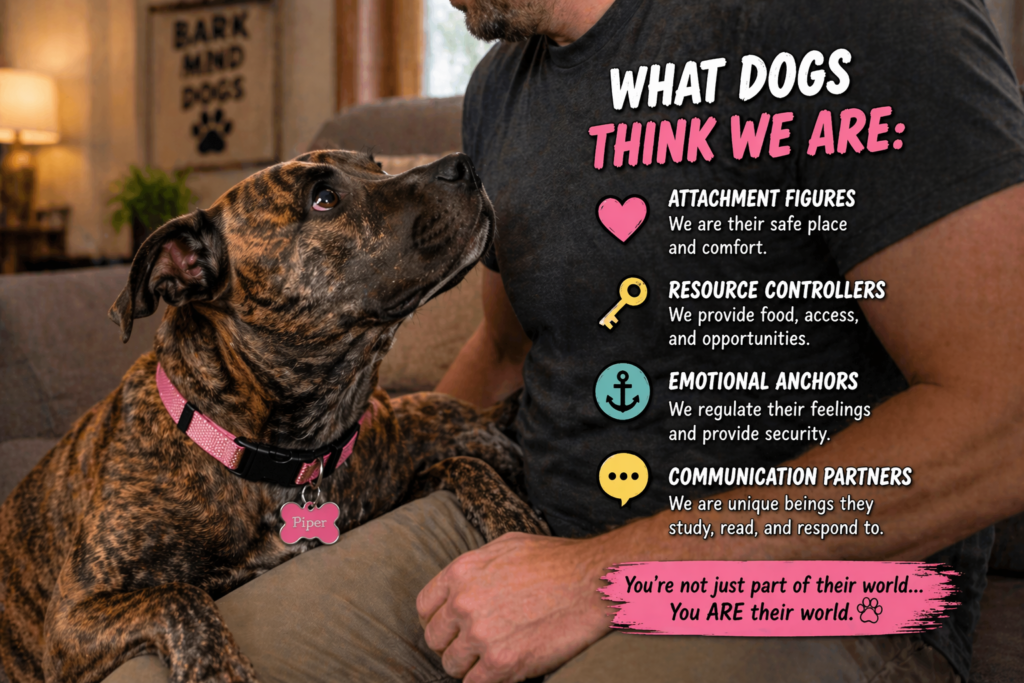
The best answer is that dogs seem to treat humans as a special social category: attachment figures, resource controllers, emotional anchors, and communication partners. Research on the dog-human bond consistently describes attachment-like patterns in dogs, including proximity-seeking, distress during separation in some dogs, and owner-specific secure base effects. That means many dogs use their humans the way a securely attached individual uses a trusted base for confidence, exploration, and emotional regulation.
That is why so many everyday behaviors point back to us.
Why does your dog follow you from room to room? Why do they stare at your face when you talk? Why do they react differently to your voice than to a stranger’s? Why do they rest more deeply when you’re nearby? Why do some dogs panic when their person leaves, but seem totally fine when another dog leaves? A lot of that makes more sense when you understand that the human is not just background scenery. The human is the center of the dog’s map.
That also ties directly into your BarkMindDogs pillar pages. If you want the bigger system behind this, read How Dogs Learn and Environmental Triggers in Dogs. BarkMindDogs already explains that behavior is not random — it is shaped by triggers, interpretation, response, and reinforcement — and that framework fits this topic perfectly.
The BarkMindDogs Framework: Trigger → Interpretation → Response → Reinforcement
This is where the post moves from funny to useful.
Your dog’s opinion of you is not just a cute thought experiment. It affects behavior in real life every single day.
A dog sees you pick up your keys. That is the trigger. The dog has learned that keys often predict departure. The dog then makes an interpretation: my person may be leaving, or my person may be taking me somewhere, or something important is about to happen. That interpretation leads to a response: pacing, barking, circling, whining, sprinting to the door, grabbing a toy, or suddenly becoming your most committed employee. Then comes reinforcement: whatever happens next teaches the dog whether that response was worth repeating. This is the same system BarkMindDogs uses across its behavior guides, including Separation Anxiety in Dogs, Why Dogs Bark, and Dog Aggression Explained.
That means the “what does my dog think I am?” question is not fluff. It is connected to barking, following, clinging, checking in, greeting behavior, distress, recall, and attention patterns.
And once you see that, you can stop treating your dog like they are being random and start seeing them as a creature constantly reading, predicting, and reacting to the strange hairless being at the center of their life.
Piper’s View of the Situation
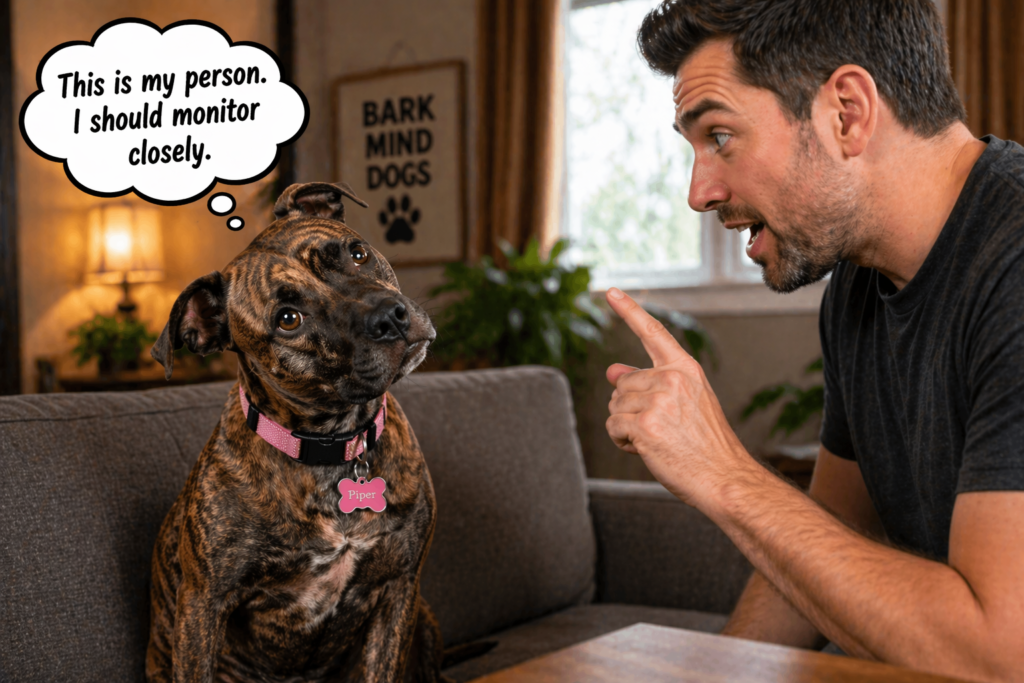
Piper has that classic look sometimes. Head tilt. Eyes locked in. Body still. Like she’s listening to a lecture she didn’t ask to attend.
And if I had to guess what’s going on in her head, it’s not, Ah yes, another dog. Completely normal. Nothing unusual here.
It’s more like, This is my person. They are important. They are a little unpredictable. They keep making noises with their face. Sometimes those noises produce food, movement, cuddles, rules, or nonsense. I should monitor closely.
That last part matters. Dogs monitor us. They check in with us. They use our faces, voices, and movements as information. Dogs are well documented as unusually responsive to human pointing and social cues compared with many other animals, and they can distinguish emotional qualities in human vocalizations.
So when Piper watches a human like we are a fascinating but mildly unstable life form, that is not confusion. That is attention. That is pattern reading. That is a social animal trying to stay connected to the most important moving part in her environment.
What This Means for Training and Daily Life
This is where a lot of dog owners accidentally make things harder than they need to be.
If your dog sees you as central to safety, reward, access, and emotional information, then your timing matters. Your consistency matters. Your reactions matter. Your routines matter. The way you enter a room matters. The way you leave the house matters. The way you talk during exciting or stressful moments matters.
That is one reason the BarkMindDogs site emphasizes the human side of the equation too. Dog Behavior Mistakes shows how owners unintentionally reinforce behavior patterns, and that idea is supported all across the live BarkMindDogs framework pages.
A practical way to use that in this post is to encourage more intentional connection. Not dramatic. Not overcomplicated. Just deliberate.
For example, if you want to reward your dog for calm check-ins instead of frantic demand behavior, a simple treat pouch. A pouch like the PET N PET Dog Training Treat Pouch (Affiliate Disclosure) or a more premium quick-access option like the Ruffwear Treat Trader (Affiliate Disclosure) makes it easier to mark and reward calm eye contact, following politely, or relaxed orientation toward you during walks and daily life. That fits this article because the point is not just that your dog watches you — it is that you can shape what happens next.
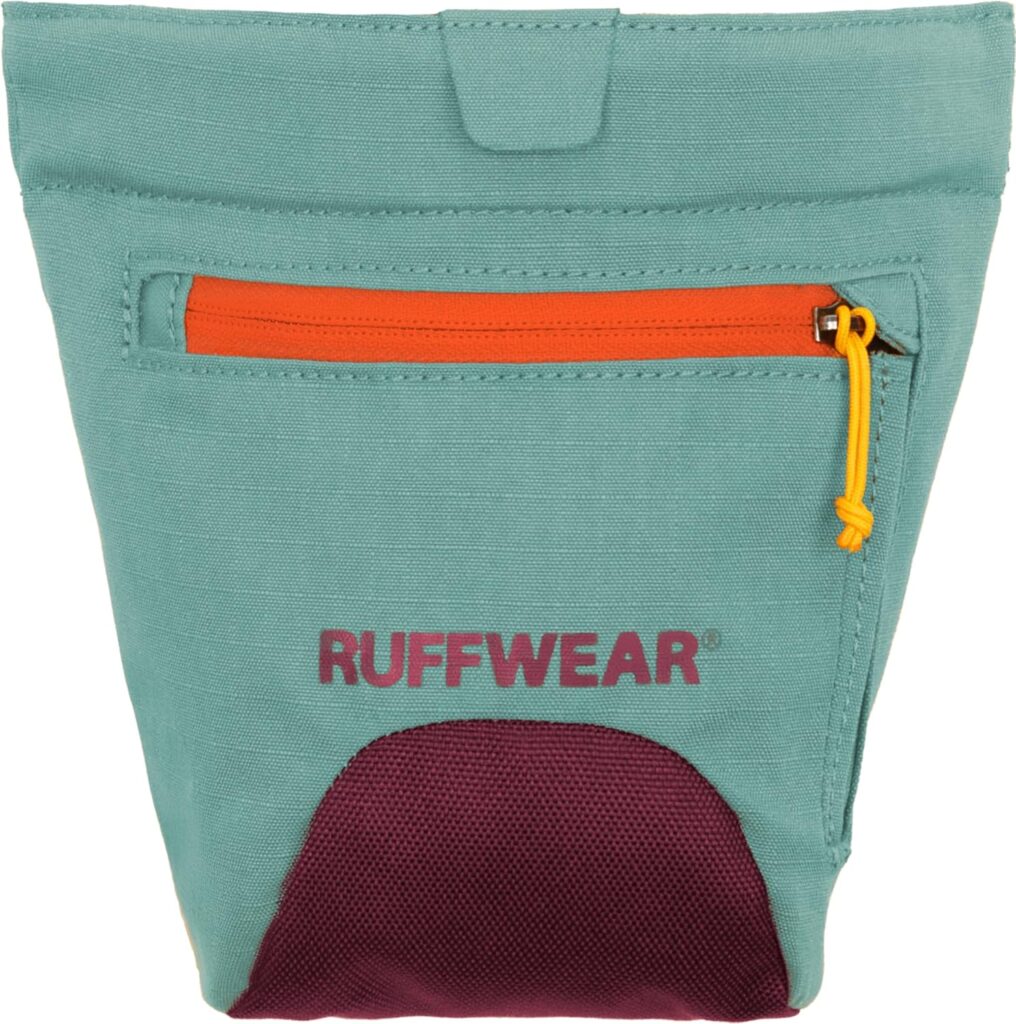
Ruffwear, Treat Trader Dog Treat Pouch, (Affiliate Disclosure) Hands-Free Waist-Worn, One-Handed Magnetic Closure, Belt (30-48 in) or Clip, Waterproof Food-Grade Lining
Your Dog’s Brain Loves Meaningful Interaction
One of the big mistakes people make is assuming bonding is only about affection. Dogs absolutely love affection, but connection is broader than that. It is shared attention, predictable outcomes, communication, and emotional safety.
That is why enrichment products actually fit this blog naturally when used the right way. Not as random gadgets. As tools that strengthen interaction and reduce chaotic energy.
A snuffle mat (Affiliate Disclosure) like the TRIXIE Snuffle Mat Level 1 (Affiliate Disclosure) or an activity-based enrichment option like the Golden Pup Snuffle Mat (Affiliate Disclosure) can work well here because they let owners create calmer, more meaningful engagement moments. Instead of the dog spiraling into restless attention-seeking, you can redirect that energy into sniffing, foraging, and structured interaction. That complements the BarkMindDogs worldview beautifully: behavior is not just stopped, it is redirected through understanding.
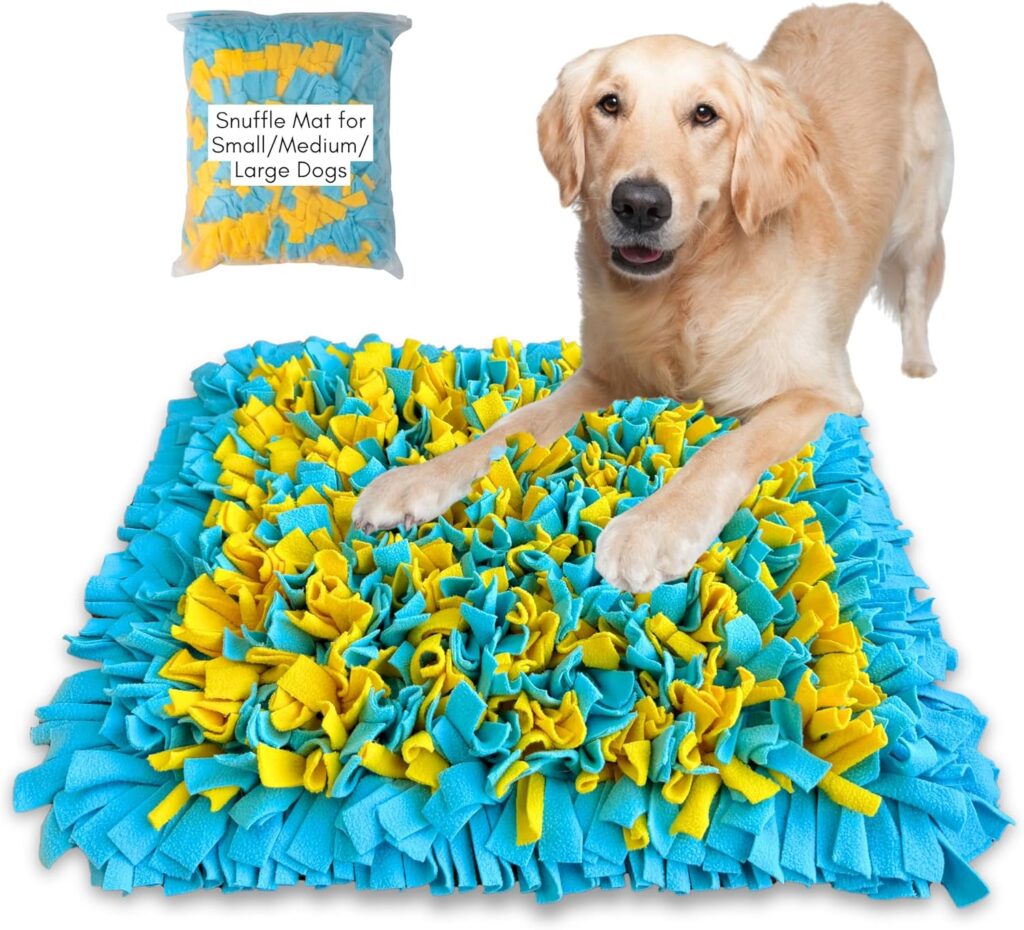
Golden Pup Snuffle Mat (Affiliate Disclosure) for Large Dogs, Slow Feeder Foraging Dog Toy for Stress Relief & Smell Training, Interactive Enrichment to Keep Dogs Busy
Why Some Dogs Seem Extra Attached to People
Not every dog expresses attachment the same way. Some are velcro dogs. Some are more independent. Some are socially confident but still deeply bonded. Some are outwardly chill but track every move you make like an underpaid security guard.
That variation is normal. But when attachment tips into distress, this topic overlaps directly with Separation Anxiety in Dogs. BarkMindDogs already explains that separation-related behavior is not spite or disobedience; it is a predictable pattern tied to emotional state, triggers, and reinforcement.
That gives you another natural affiliate spot that actually makes sense: a pet camera with a treat dispenser. (Affiliate Disclosure) Something like the Petcube Bites 2 Lite (Affiliate Disclosure) fits this article because owners who resonate with the “my dog sees me as the center of their universe” theme often also struggle with alone-time behavior. A camera can help them observe patterns, talk to the dog, and build more informed routines rather than guessing what happens after they leave. It is not a cure-all, but it is directly relevant.
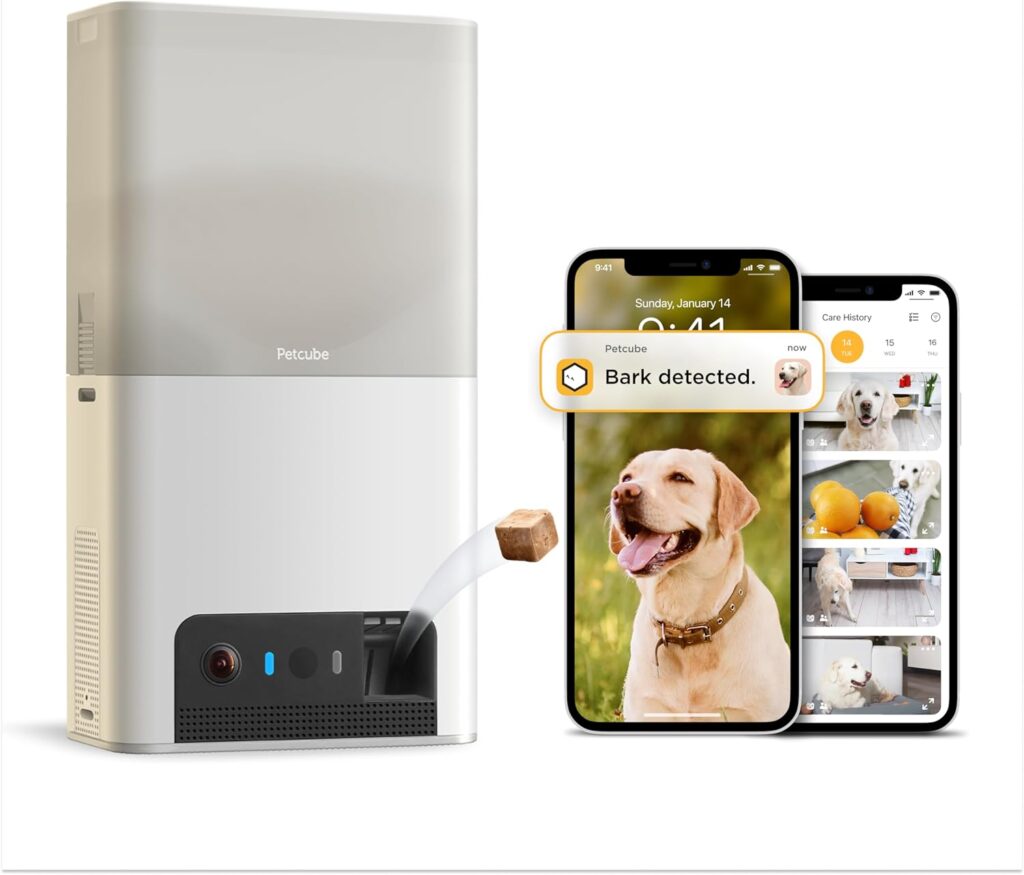
Petcube Bites 2 Lite (Affiliate Disclosure) + Extra Care Service with Smart Alerts [Paid in-App Subscription] | Interactive WiFi Pet Monitoring Camera with Phone App and Treat Dispenser.
If Your Dog Thinks You’re Important, Build That Relationship on Purpose
A lot of owners want a better bond with their dog, but they think that means more petting, more baby talk, or more constant access. Sometimes it does. Often it means something simpler: becoming clearer, calmer, and more rewarding to be around.
That can mean rewarding check-ins on walks. Practicing gentle recall. Building confidence outdoors. Creating small moments where your dog learns that orienting back to you is worth it.
That is why a long training leash (Affiliate Disclosure) fits here naturally too. A basic long line, like a 30-foot training lead, (Affiliate Disclosure) is a smart affiliate addition because it helps owners practice relationship-based recall and connection without turning freedom into chaos. It supports the whole message of this post: your dog does not think you are another dog — your dog thinks you matter, so use that thoughtfully.
So… Do Dogs Think We’re Just Weird Hairless Dogs?
No.
They almost certainly know we are not dogs.
But they also do something arguably more interesting than mistaking us for canine roommates. They build their lives around us. They study us. They anticipate us. They respond to our bodies, our moods, our patterns, our habits, and our timing. They do not just coexist with us. They orient to us.
And that may be the real answer underneath the funny question.
Your dog does not look at you and think, Ah yes, one of my own, but bald and alarmingly overdressed.
Your dog looks at you and thinks something closer to, This is my person. This is the one who changes the environment. This is the one worth reading. This is the one worth following. This is the one whose return matters.
Which is honestly a pretty beautiful thing.

And if you want to understand that relationship even more deeply, keep going through the BarkMindDogs system: start with Why Your Dog Does That, then read How Dogs Learn, Environmental Triggers in Dogs, Why Dogs Bark, Separation Anxiety in Dogs, Dog Aggression Explained, and Puppy Behavior Development. You can also keep your monetization clean by linking your Affiliate Disclosure in the post footer or near the first affiliate mention.