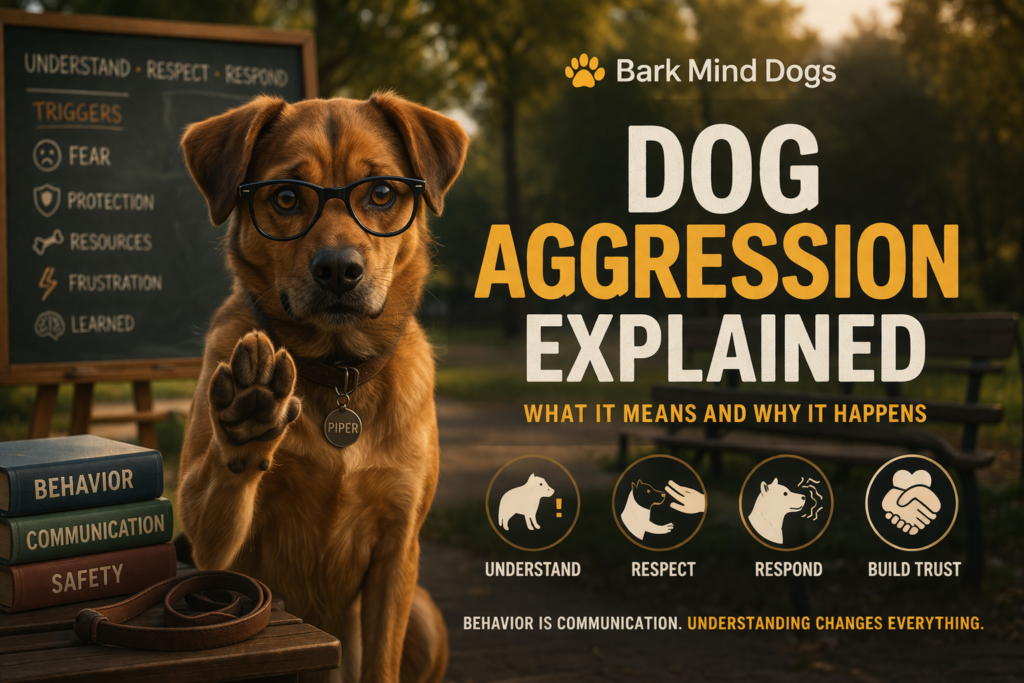
Dog Aggression Explained: Why Your Dog Growls, Lunges, or Bites
What is dog aggression? Dog aggression is a behavioral response involving warning or threat signals such as growling, barking, lunging, snapping, or biting. It is not random bad behavior. It follows a pattern of trigger → interpretation → response and is shaped by emotional state, environment, and reinforcement.
Key Takeaways
- Aggression is communication, not disobedience.
- Dogs react to perceived threat, pressure, or frustration.
- Warning signals matter — they are information.
- Aggression becomes stronger when it works.
- Understanding the cause matters more than stopping the display.
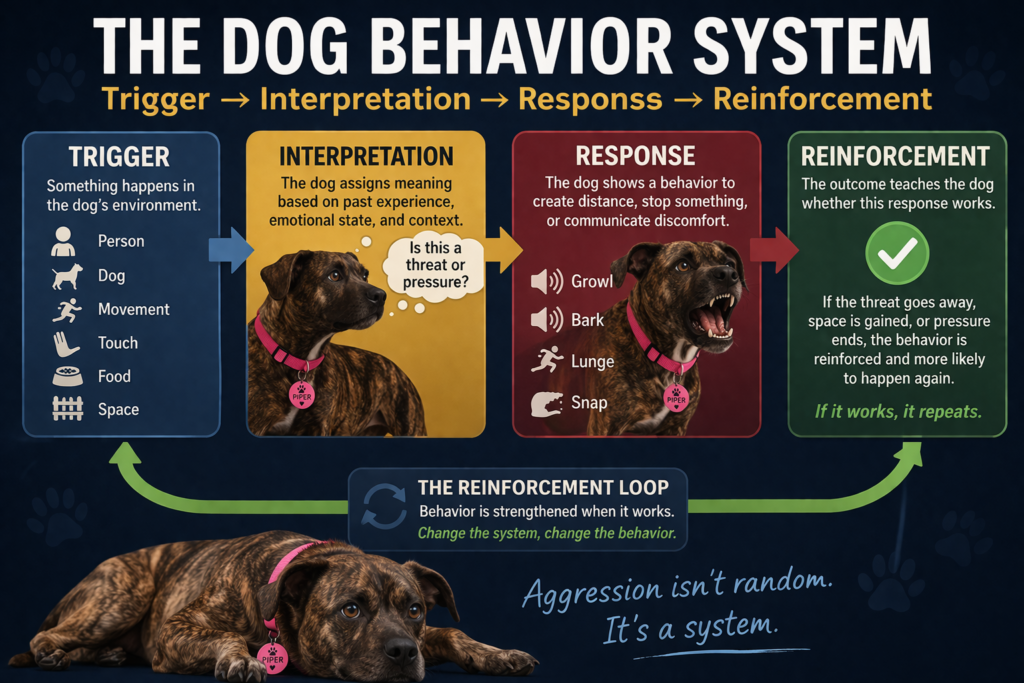
The Aggression Behavior System Aggression follows the same BarkMindDogs Behavioral Framework as all other behaviors: Trigger → Interpretation → Response → Reinforcement.
- Trigger: person, dog, movement, touch, food, space
- Interpretation: threat, discomfort, frustration, pressure
- Response: growling, barking, stiffening, lunging, snapping
- Reinforcement: the threat backs off, space is gained, pressure ends
What is dog aggression? Dog aggression is a predictable behavioral response driven by perceived threat, emotional state, and reinforcement.
What Aggression Actually Is Dog aggression is a distance-increasing behavior. The dog is trying to create space, stop something, or communicate discomfort. It is communication with teeth, not a personality flaw or attempt to dominate.
Why is my dog aggressive all of a sudden? Aggression often appears sudden to people, but it usually follows buildup, repeated triggers, threshold lowering, and missed warning signs.
Aggression: Cause vs Symptom Growling, barking, lunging, snapping, and biting are symptoms.
The cause is the dog’s emotional response to a trigger, shaped by learning history, environment, and reinforcement.
The Aggression Loop Trigger → Perceived threat or pressure → Emotional escalation → Warning or defensive response → Relief (threat backs off) → Reinforcement. When aggression works, it repeats.
Types of Dog Aggression Dogs do not show aggression the same way in every situation. The main types are:
- Fear-based aggression
- Territorial aggression
- Resource guarding
- Frustration-based aggression
- Protective aggression
- Redirected aggression
- Pain-related aggression
Main types of dog aggression:
- fear-based
- territorial
- resource guarding
- frustration-based
- protective
- redirected
- pain-related
Dog Aggression vs Reactivity Reactivity is a fast, emotional response and is not always true aggression.
Aggression is a distance-increasing response meant to stop, warn, or control a perceived threat.
Aggression Escalation Ladder Stiff body → Stare → Growl → Bark → Lunge → Snap → Bite
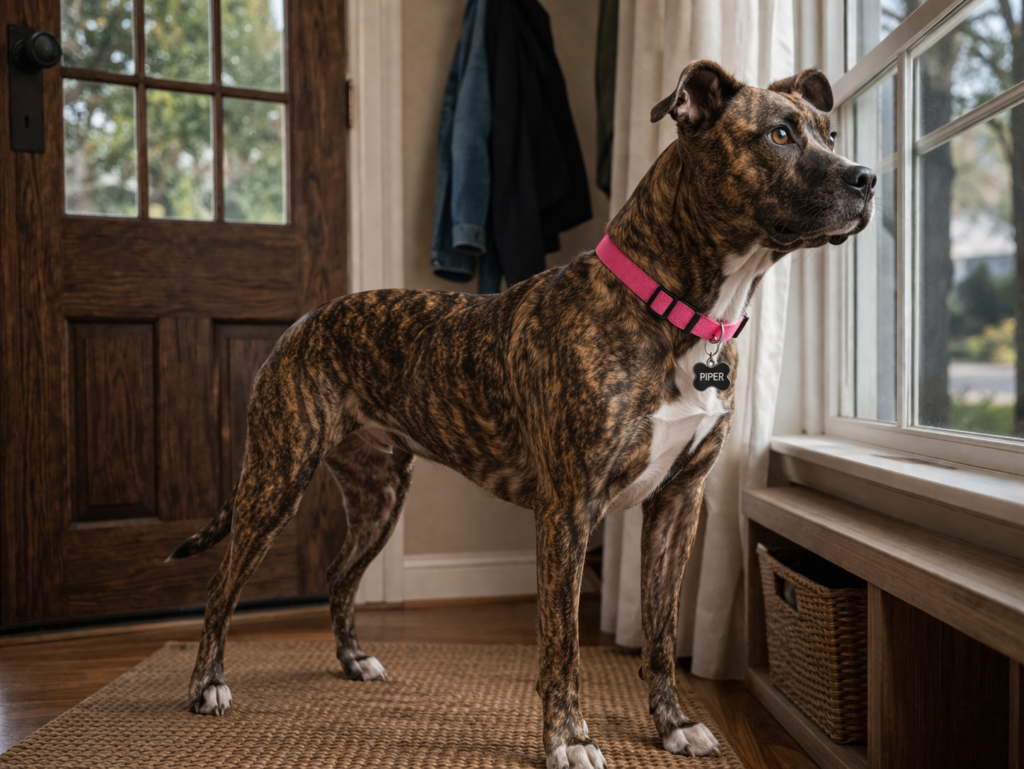
Every step is communication. The earlier signals matter most.
Why Do Dogs Growl? Dogs growl as a warning signal to create distance and communicate discomfort.
Why Do Dogs Lunge? Dogs lunge when fear, frustration, or over-arousal builds and the dog cannot regulate or create enough space.
Why Do Dogs Bite? Biting is usually the final stage of escalation when earlier warning signs are missed, ignored, or suppressed.
How Do You Treat Aggression in Dogs? Dog aggression is addressed by changing triggers, pressure, environment, and reinforcement patterns rather than punishing warning signals.
Can Dog Aggression Be Fixed? Aggressive behavior can improve when the underlying trigger-response system is changed.
Common Human Errors That Worsen Aggression Many well-meaning responses (punishment, forcing interactions, ignoring warnings) accidentally reinforce or escalate aggression. These mistakes are explored in Dog Behavior Mistakes.
Real-Life Aggression Examples
- A dog growling when someone approaches its food bowl
- A dog lunging at other dogs on leash
- A dog barking aggressively at strangers entering the home
- A dog snapping when cornered or handled
- A dog redirecting onto a leash or person during high arousal
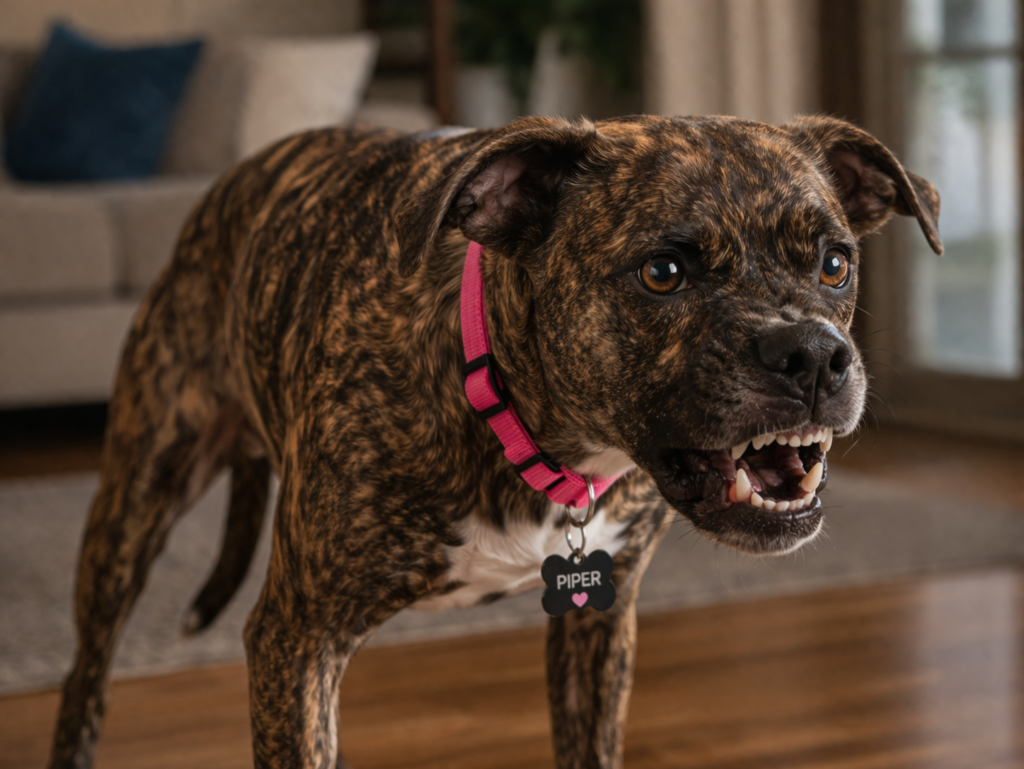
Dogs bark because something changed — not because nothing happened. Aggression is communication under pressure. Dogs rarely become aggressive out of nowhere. Warning signals are not the problem. They are the information. If aggression works, aggression repeats.
What People Are Really Trying to Solve Most people searching about dog aggression are dealing with barking, growling, lunging, snapping, or fear around people or other dogs. Understanding the full system is the first step to changing it.
This connects directly to the full behavior system explained in Why Your Dog Does That. This is part of the broader framework covered in How Dogs Learn. To understand how triggers influence aggression, see Environmental Triggers in Dogs.
To understand how these behaviors occur, we need to look at how the system builds over time.
If your dog is showing aggression, the solution is not to suppress the display but to understand what is causing it.
Once you identify the trigger and the reinforcement behind it, the behavior becomes predictable — and changeable.
Related Aggression Topics
- Why Dogs Bark – Understanding vocalization and communication
- Separation Anxiety in Dogs – Distress when alone
- Environmental Triggers in Dogs – Hidden forces shaping behavior
- Dog Behavior Mistakes – How humans unintentionally shape behavior
Simple Summary Dog aggression is a predictable behavioral response driven by perceived threat, emotional state, and reinforcement.
When the system changes, the behavior changes.
Main aggression triggers:
- strangers
- other dogs
- food or toys
- confined space
- sudden movement
- physical pressure
Comprehensive FAQ
What is dog aggression? Dog aggression is a behavioral response involving warning or threat signals such as growling, barking, lunging, snapping, or biting.
Why is my dog aggressive all of a sudden? Aggression often appears sudden to people, but it usually follows buildup, repeated triggers, threshold lowering, and missed warning signs.
Why do dogs growl? Dogs growl as a warning signal to create distance and communicate discomfort.
Why do dogs lunge? Dogs lunge when fear, frustration, or over-arousal builds and the dog cannot regulate or create enough space.
Why do dogs bite? Biting is usually the final stage of escalation when earlier warning signs are missed, ignored, or suppressed.
What triggers aggression in dogs? Common triggers include strangers, other dogs, food or toys, confined space, sudden movement, and physical pressure.
Is aggression the same as reactivity? Reactivity is a fast, emotional response and is not always true aggression. Aggression is a distance-increasing response meant to stop or control a perceived threat.
Can aggression be fixed? Aggressive behavior can often be significantly improved by changing triggers, environment, and reinforcement patterns.
Does punishment stop aggression? Punishment often makes aggression worse by increasing fear or frustration and suppressing warning signals.
Why does my dog guard food? Resource guarding is a protective response to perceived threat over valuable items like food or toys.
Why does my dog bark aggressively at strangers? This is typically territorial or alarm barking driven by protective instinct.
Why does my dog snap without warning? Snapping rarely happens without warning. Earlier signals (stiff body, stare, growl) are often missed.
What are the signs before a dog bites? Warning signs include stiff body, staring, lip licking, whale eye, turning away, growling, and lunging.
Learn More About Dog Behavior
- Why Your Dog Does That – The complete behavioral framework
- Why Dogs Bark – Understanding vocalization
- How Dogs Learn – The science of canine learning
- Environmental Triggers in Dogs – Hidden forces shaping behavior
- Separation Anxiety in Dogs – Distress when alone
- Puppy Behavior Development – Early pattern formation
- Dog Behavior Mistakes – How humans unintentionally shape behavior
Research & Citations
- Overall, K. L. (2013). Clinical Behavioral Medicine for Small Animals.
- Sherman, B. L., & Mills, D. S. (2008). Canine anxieties, phobias, and aggression. Journal of Veterinary Behavior.