
How Dogs Learn: The Science Behind Canine Behavior and Why Your Dog Is Always Learning
What is how dogs learn? Dogs learn through repeated experiences, not instructions alone. Every behavior forms through a consistent system: a trigger occurs, the dog interprets it, responds, and that response is reinforced over time. Learning is not random — it is the accumulation of repeated outcomes that shape future behavior.
Dog learning is the process of forming automatic behavior patterns through repeated reinforcement.
Key Takeaways
- Dogs learn from outcomes, not commands.
- Every behavior is shaped by reinforcement.
- Repetition builds automatic behavior patterns.
- Stronger reinforcement = stronger behavior.
- Learning happens constantly, not just during training.
What Does It Mean for a Dog to Learn?
Learning is the process of forming behavior patterns through repeated trigger-response-reinforcement loops. Once a behavior consistently produces a result, the brain begins to automate that response.
A learned behavior is any response that has been repeated and reinforced enough to become automatic. Once a behavior reaches this point, the dog is no longer “thinking” — it is reacting based on past outcomes.
What Is the Learning Loop? The learning loop is the continuous cycle of trigger → interpretation → response → reinforcement. Once this loop repeats enough times, behavior becomes automatic and predictable.
This loop is always running — whether you are training your dog or not.
The dog is not choosing behavior randomly — it is following the strongest learned pattern.
The strongest pattern always wins.
Behavior follows reinforcement, not intention.
This is the same system explained in Why Your Dog Does That.
The Core Learning System: Trigger → Interpretation → Response → Reinforcement
Every behavior your dog shows — good or bad — follows this repeatable loop:
- Trigger — Something in the environment happens (sound, movement, person, isolation, scent). Every behavior starts with a trigger. See Environmental Triggers in Dogs.
- Interpretation — The dog assigns meaning based on past experience and current state.
- Response — The dog acts (bark, sit, jump, ignore, hide). Many of these responses later evolve into adult patterns. See Why Dogs Bark for how early responses develop into barking and Dog Aggression Explained for how they can escalate.
- Reinforcement — The outcome either strengthens or weakens the behavior. This is the same mechanism behind most behavior problems. See Dog Behavior Mistakes for how humans unintentionally reinforce unwanted behaviors.
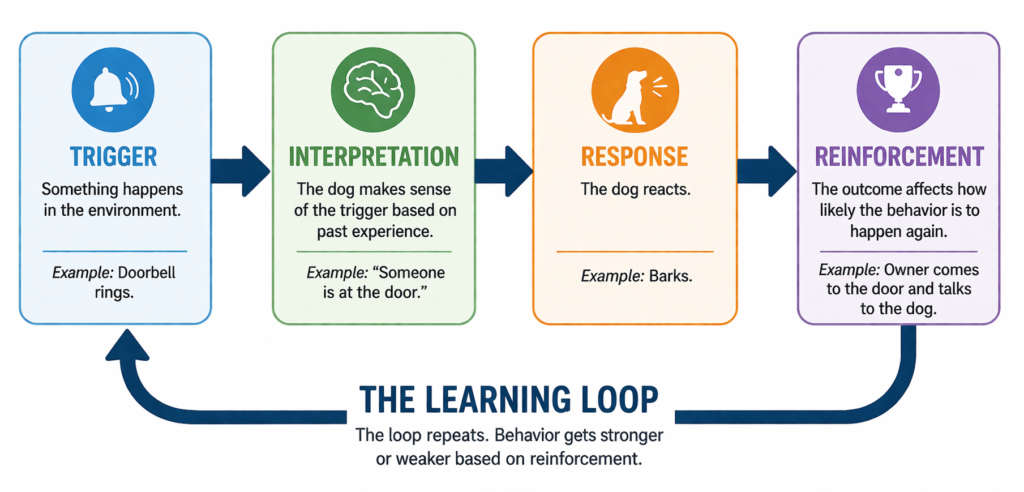
Behavior is not random — it is learned through repetition. Every behavior you see is the result of a pattern that has been repeated. The system does not turn off — it is always running in the background. Every repetition strengthens the pattern. Every outcome teaches the dog what to do next.
Patterns don’t fade — they are replaced.
Classical Conditioning: Learning by Association
Classical conditioning occurs when a dog learns to associate two things that happen together. This type of learning shapes strong emotional responses and is heavily involved in Separation Anxiety in Dogs.
Operant Conditioning: Learning by Consequences
Operant conditioning is learning through the results of behavior. Positive reinforcement is the most effective and humane method for building reliable behaviors.
Why Dogs Form Habits So Quickly
Dogs form habits quickly because their brains are designed to repeat behaviors that produce results. When a behavior consistently leads to a rewarding outcome, the brain begins to automate that response. This is why early patterns become difficult to change over time. This learning process begins early in puppyhood. See Puppy Behavior Development.
This is how early behavior patterns become long-term behavior problems.
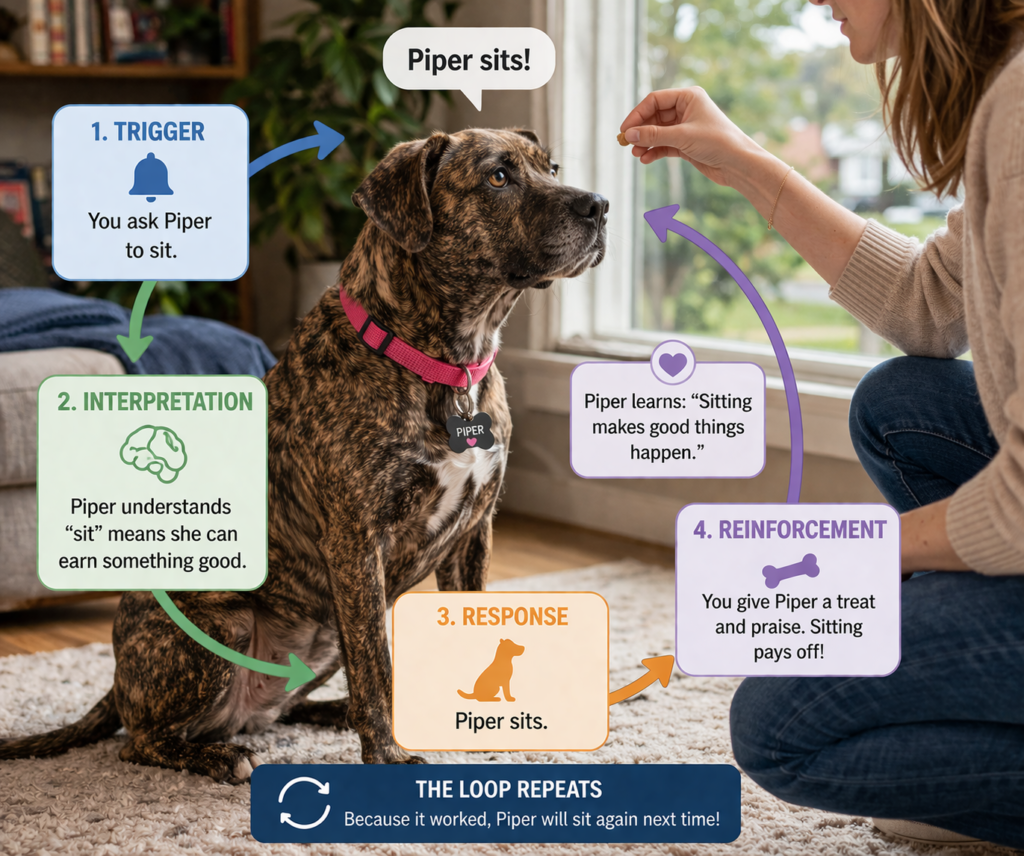
Why Dogs Don’t Generalize Learning Well
Dogs do not automatically apply learning from one environment to another. A behavior learned at home may not transfer to a park, street, or vet office because the triggers and reinforcement change. To a dog, a different environment is a different learning situation. This is why consistency across environments is critical for reliable behavior.
This is why many behavior problems appear inconsistent across environments. See Dog Behavior Mistakes.
Why Training Sometimes Fails
Training often fails because it focuses on commands instead of reinforcement patterns and environmental triggers. Dogs don’t fail training — training fails to match real-world reinforcement.
What feels like defiance is usually a behavior that has simply been practiced more. Your dog isn’t being difficult — it’s being consistent.
Real-Life Examples
Every real-world behavior — from barking to ignoring commands — follows this same learning pattern.
Example 1 – Barking at the Door Trigger: doorbell sound → Interpretation: alert or visitor → Response: bark → Reinforcement: owner reacts or opens door → Barking strengthens. This is exactly how barking develops. See Why Dogs Bark.
Example 2 – Jumping on Guests Trigger: person enters → Interpretation: excitement → Response: jump → Reinforcement: attention or petting → Jumping becomes the default greeting. This pattern is explored in Dog Behavior Mistakes.
Example 3 – Ignoring a Recall Trigger: distraction (another dog, scent) → Interpretation: more rewarding option available → Response: ignore command → Reinforcement: gets to investigate → Recall weakens. This can escalate into patterns covered in Dog Aggression Explained.
These patterns are happening constantly — not just during obvious problem behaviors.
The Pattern Never Changes
The system does not turn off — it is always running in the background. Whether it is a puppy learning to bite or an adult dog developing reactivity, the same learning system is always operating.
Strategic Takeaways
- Your dog is always learning — control the environment and reinforcement to control what is learned.
- Classical conditioning shapes emotions; operant conditioning shapes actions.
- Timing and low-stress practice beat force every time.
- Change the system (triggers + reinforcement) and behavior changes naturally.
Learning Never Stops Dogs are always learning, whether you are actively training or not. Every interaction, every reaction, and every outcome is shaping behavior. The only question is whether the system is reinforcing the behaviors you want — or the ones you don’t.
You are always training your dog — even when you don’t realize it.
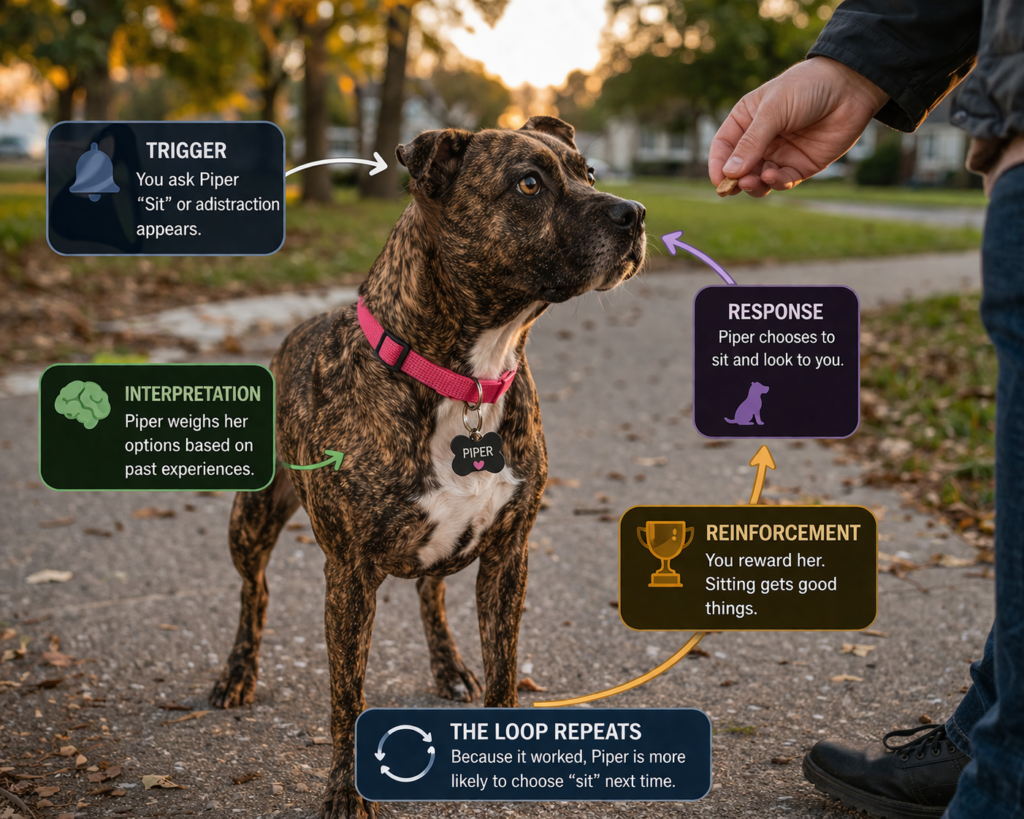
When you understand how dogs learn, behavior stops being confusing and becomes predictable. The system is always running — and once you see it, you can shape it.
FAQ
Why doesn’t my dog listen to me? Dogs respond to the strongest stimulus and reinforcement in the moment, not simply commands. Competing triggers often override previous learning.
How long does it take for a dog to learn a new behavior? It depends on timing, consistency, and low-stress practice. Many behaviors can be shaped in days to weeks with proper reinforcement.
Why does my dog only listen at home? At home there are fewer competing triggers and lower arousal. Real-world environments change the learning context dramatically.
Can older dogs still learn new behaviors? Yes. Dogs can learn at any age, though puppies learn faster due to sensitive developmental periods.
Why does my dog seem to forget training? Stress, new triggers, or inconsistent reinforcement can temporarily override previous learning.
What is the best way to train a dog? Use positive reinforcement with clear timing and low-stress practice. Focus on changing triggers and reinforcement rather than suppressing behavior.
Why is my dog worse after training? If training uses punishment or occurs under high stress, it can increase fear and confusion, making behavior worse.
How does environment affect dog learning? The environment provides constant triggers and competing reinforcement. Training must generalize across different contexts to be reliable.
Is punishment effective for dog training? Punishment can suppress behavior short-term but often increases stress and side effects. Positive reinforcement is more reliable long-term.
Why do dogs learn some things so quickly? Behaviors that are naturally rewarding or tied to strong instincts (food, play, safety) are learned very rapidly through reinforcement.
Why does my dog keep doing the same thing over and over? Because the behavior has been reinforced enough to become automatic.
Can you accidentally train bad behavior? Yes. Any behavior that produces a result is being reinforced, whether intentional or not.
References
- Hiby, E. F., Rooney, N. J., & Bradshaw, J. W. S. (2004). Dog training methods: Their use, effectiveness and interaction with behaviour and welfare. Animal Welfare.
- Ziv, G. (2017). The effects of using aversive training methods in dogs—A review. Journal of Veterinary Behavior.
- Overall, K. L. (2013). Manual of Clinical Behavioral Medicine for Dogs and Cats. Elsevier.
Explore the Full BarkMindDogs Behavioral System