

By BarkMind Dogs · Prepared November 8, 2026
Your dog may bark at your keys because the sound predicts something important: a walk, a car ride, your departure or the end of your attention. The bark alone does not tell you whether your dog is excited or worried. Watch the whole sequence, including what happens after you leave.
Piper considers keys a household announcement system. My Human picks them up, and suddenly there are questions: Are we going somewhere? Am I coming? Has anyone consulted the dog?
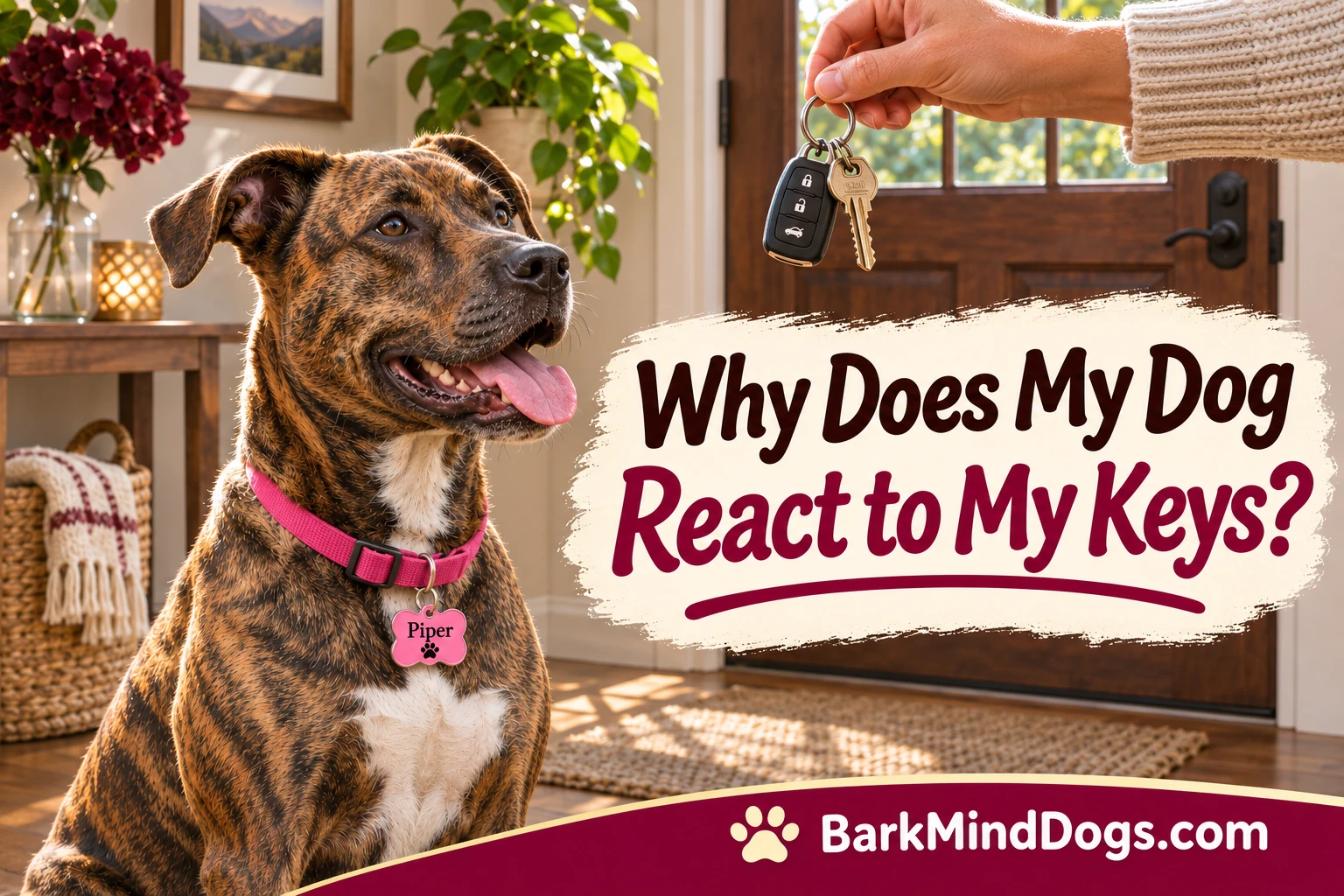
The keys may be a cue for what comes next
When two events repeatedly occur together, the first can become meaningful. Keys, shoes and a work bag may form a familiar departure sequence. Veterinary guidance on separation anxiety discusses these predeparture cues. A response to them is useful information, but it does not establish a diagnosis by itself.
| What you observe | One possibility to investigate | Next useful observation |
|---|---|---|
| Loose movement; runs toward the leash; can settle again | Anticipation of an outing | Does the response also happen before walks without the car? |
| Pacing, tense posture, panting when not hot, repeated whining | Worry about the coming departure | When does tension first appear, and does it continue after you leave? |
| Barking reliably gets conversation or a game | Attention may help maintain the response | Can you provide an easy alternative before the keys move? |
| A sharp startle at the jingle even when nobody leaves | The sound itself may matter | Does the same movement with quieter keys produce a different response? |
These are observation prompts, not tests that assign your dog an emotion. Cornell’s barking guide explains why motivation and context matter. A tail that moves does not cancel other signs of discomfort.
Record the first change, not just the loudest bark
For a few ordinary departures, note the first cue your dog notices, their posture, when barking begins and how quickly they recover. If you already use a home camera, review a normal departure rather than staging a longer absence to test the dog.
A useful record might say, “Picked up work bag; dog paced before keys moved; barking continued at the door.” That gives your veterinarian more to work with than “she hates my keys.” It also prevents you from focusing on the final cue while overlooking the beginning of the sequence.
Our home-camera guide expands on observation, and our separation-anxiety pillar covers the broader pattern.
Keep practice easier than the real departure
For a dog who remains comfortable, work with a small part of the sequence while staying home. For example, touch the keys briefly, put them down and continue a quiet activity. Begin with a movement that does not trigger barking or tension. You are changing what the cue predicts, not seeing how much the dog can withstand.
- Start with a settled dog. Meet ordinary toilet, activity and comfort needs first.
- Choose one small cue. Touching a key ring may be enough. Do not combine shoes, coat, door movement and a departure immediately.
- Keep the response comfortable. Notice whether your dog can disengage, move normally and return to an ordinary activity.
- Stop when it becomes difficult. Pacing, freezing, panting or escalating barking means the exercise needs to be easier or professionally guided.
A few easy experiences are more useful than repeatedly provoking a worried response. There is no fixed number of days that makes every dog comfortable with departures. If the dog is already distressed by the smallest movement, do not keep rehearsing it.
Should I ignore the barking or scold my dog?
First understand the context. Treating panic as a demand for attention can miss the problem. Scolding may add another unpleasant event to the departure sequence. The American Veterinary Society of Animal Behavior recommends reward-based methods; teach useful alternatives and adjust difficulty.
Do not shut a panicking dog in a crate to make them “get used to it.” Help with comfortable separation may require changes to the environment, a training plan and veterinary treatment.
When the problem needs individual help
Contact your veterinarian if you see repeated distress, escape attempts, injury, heavy drooling, house-soiling associated with absences or an abrupt change in behavior. Discuss safe arrangements for unavoidable absences while you work on the problem. You do not have to wait for damage to become severe.
Piper’s practical message: follow the clues before the jingle. The goal is a dog who can cope comfortably with what the keys mean, not simply a quieter moment at the front door.